

Website Redesign Decision Framework
Not every struggling website needs a redesign. Use this framework to decide whether a redesign, a refresh, or targeted fixes are the right move for your situati

Don't have time to read this? Schedule a 30-minute call and we will walk you through exactly how this applies to your business. Book a call
Key Takeaways
- A redesign is the right move in some situations and the wrong move in others. This framework tells you which applies to yours.
- The most expensive redesign mistake is commissioning one when targeted fixes would have produced the same result at a fraction of the cost.
- The second most expensive mistake is delaying a redesign because the investment seems large, while the existing site continues to underperform.
- This framework uses real criteria, not gut feelings, to arrive at a defensible decision.
Three Paths Forward
When a website is underperforming, there are three potential responses:
- Targeted fixes: Address specific, isolated problems without changing the overall site structure, design system, or platform.
- Refresh: Update visual design, update photography and copy, and improve specific page layouts without structural or platform changes.
- Full redesign: Rebuild the site from discovery through launch, including new information architecture, new design system, new content strategy, and often a new platform.
The right choice depends on what is actually causing the underperformance.
The Decision Framework: Five Questions
Work through these questions in order. The answers determine which path is appropriate.
Question 1: Is the Underperformance Caused by Specific, Identifiable Issues?
Pull your analytics and look for patterns:
- Is the conversion problem isolated to one or two pages, or is it consistent across the site?
- Is the bounce rate high on every page type, or only on paid landing pages?
- Is mobile performance poor because of technical issues or because the mobile experience was never designed correctly?
If the problems are specific and isolated:
Targeted fixes are worth trying first. A single page with a broken form, a single landing page with a weak CTA, or a mobile experience with a specific usability failure can often be addressed without rebuilding anything else.
If the problems are consistent across the site:
A full redesign is likely required. Consistent underperformance across page types usually reflects structural problems: information architecture that does not match how visitors think, messaging that does not address the primary audience's decision criteria, or a mobile experience that was never right.
Question 2: How Old Is the Current Site and When Was It Last Updated?
| Age / Condition | Implication |
|---|---|
| Under 2 years, regularly updated | Targeted fixes likely sufficient |
| 2-4 years, some outdated content | Refresh or targeted redesign of key pages |
| 4+ years, minimal updates | Full redesign likely warranted |
| Any age, platform limitation blocking needs | Full redesign required |
| Any age, significant structural problems | Full redesign required regardless of age |
A site that was well-built two years ago and has been maintained regularly is a different situation from a site that was built five years ago and has not been touched since.
Age alone is not the determining factor. A three-year-old site with strong performance and a manageable CMS may not need a redesign for another two years. A two-year-old site built on a platform that cannot support needed integrations may need one now.
Question 3: Is the Current Platform Limiting What the Business Needs to Do?
This question is often the deciding factor.
Platform limitations that indicate a redesign is necessary:
- The marketing team cannot update content without developer involvement for routine changes
- Needed integrations are not supported by the current platform
- The site cannot support new content types, pricing structures, or product configurations without custom development
- Performance optimization is blocked by platform constraints
- The platform is being sunset or no longer receiving security updates
If the answer to any of these is yes, a targeted fix or refresh will not solve the problem. The platform decision requires a redesign, not a patch.
Question 4: Is the Brand Direction Diverging From the Current Site?
A site that no longer reflects where the company has arrived is a credibility problem.
Signs that brand divergence requires more than a refresh:
- The company has repositioned to serve a different market or buyer than the current site addresses
- The current site reflects an old brand identity that has since been updated
- New products, services, or offerings are not represented anywhere on the site
- The messaging framework has changed but the copy has not been updated
- The site was built for a company at an earlier stage and no longer reflects the current level of credibility
A refresh can update photography and copy. A full redesign is required when the information architecture, navigation structure, and conversion paths need to change to reflect a new positioning.
Question 5: Have Targeted Fixes Already Been Tried Without Results?
If specific improvements have already been made to conversion rate, content, or UX without meaningful impact, that is a signal.
When targeted improvements to high-traffic pages produce no improvement in conversion or engagement, the problem is usually structural: the visitor experience is failing before they reach the page being optimized. Information architecture, navigation, or homepage messaging is filtering out or disengaging visitors who should be converting.
Structural problems require structural solutions. Targeted fixes treat symptoms. A redesign addresses root causes.
How to Score Your Situation
Use the responses above to build a picture:
Lean toward targeted fixes if:
- Problems are isolated to specific pages
- Site is under 3 years old and performing reasonably
- Platform supports current needs
- Brand direction has not significantly changed
- No previous targeted fixes have been attempted
Lean toward a refresh if:
- Visual design is dated but structure is sound
- Copy is outdated but architecture is correct
- Brand has evolved but the core positioning is the same
- Targeted fixes have addressed the most critical issues
Lean toward a full redesign if:
- Conversion problems are consistent across the site
- Platform is limiting what the business needs
- Brand positioning has significantly changed
- Site is 4+ years old with structural problems
- Targeted fixes have been tried without meaningful improvement
- Mobile experience was never designed correctly
Connecting the Decision to Business Outcomes
The decision to redesign is ultimately a ROI question: what is the cost of the status quo versus the cost of the investment?
A site generating 10 qualified leads per month at a conversion rate of 0.8% has a measurable cost to inaction. If a redesign raises conversion rate to 2.5%, that is 31 qualified leads per month from the same traffic. If each lead is worth $500 in closed revenue on average, the delta is $10,500 per month in additional revenue from the same traffic.
Setting measurable redesign goals before starting any project is what makes this calculation possible, and what makes the investment decision defensible.
The factors that determine redesign success go beyond this framework into the operational prerequisites that determine whether a redesign, once committed to, actually delivers.
For a clear picture of what a structured website redesign engagement involves from discovery through post-launch measurement, the service page covers scope, timeline, and what the process delivers at each phase.


The right decision is only useful if you have someone objective to help you think it through
Deciding between a full redesign, a refresh, and targeted fixes is harder when the agency you are talking to has a financial interest in recommending the most expensive option. Most businesses get biased advice at this stage and end up either overbuildling for what they need or underinvesting in what would actually move the needle.
LOW/CODE Agency is built to give you the honest answer. Our web development practice has walked away from full redesign engagements when a more targeted intervention was the right call, because our reputation depends on outcomes, not project size.
For organizations that want a structured, objective assessment of their digital infrastructure before committing to a direction, our technology consulting service provides the analysis and recommendation without a conflict of interest.
After 450+ projects for clients including Medtronic, American Express, and Coca-Cola, we know the difference between a problem that needs a redesign and one that needs something else. Get an honest assessment.
Last updated on
September 25, 2026
.

Daniel is a Web Developer at LowCode Agency who has been building websites in Webflow since 2022. With a background in graphic design, he turns the design team's concepts into fast, responsive sites built to scale.


FAQs
**The Four Questions the Framework Answers**
**What Evidence You Need Before Starting**
**Who Should Be Involved in the Assessment**
**Performance Score (0 to 25)**
**UX Score (0 to 25)**
**Brand and Strategic Score (0 to 25)**
Related Articles
Custom App Development
Webflow
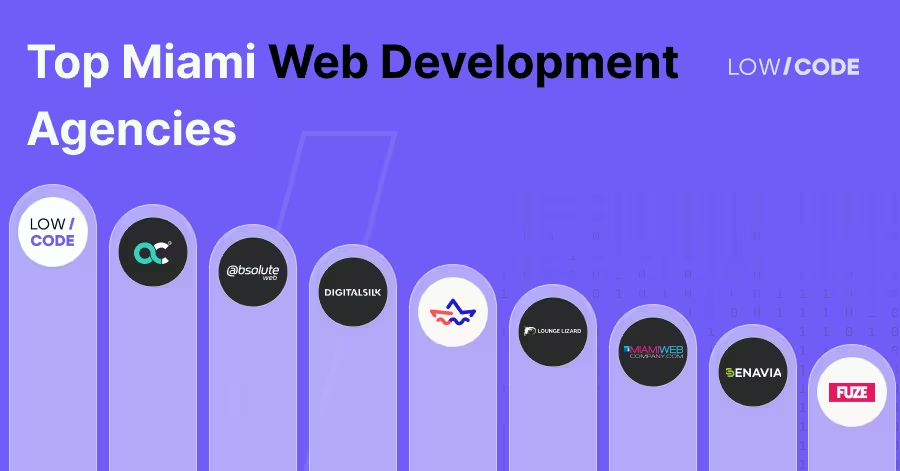
Best 9 Web Development Agencies in Miami (2026)
Find the best web development agency in Miami for your startup. Our 2026 list features fast, trusted teams that help you launch and grow fast
Webflow
Webflow CMS Structure: How to Plan Your Content Model
How to design a Webflow CMS structure that scales with your content team — collections, fields, references, and slug patterns.

Webflow
Webflow for E-Commerce: What You Can and Can't Build
Honest guide to Webflow e-commerce — what it handles natively, where it falls short, and when to use a different platform.

Webflow
Benefits Of Website Redesign For Manufacturers
Manufacturing websites are often the weakest link in B2B sales. Here is what a redesign actually delivers in terms of lead quality, sales support, and competiti

Why customers trust us for no-code development


