

Webflow for AI Search Visibility and LLM Citations
How to optimise your Webflow site for AI search engines and LLM citations — structured data, content clarity, and schema.

Webflow AI search visibility is not automatic, but Webflow's clean semantic HTML, fast hosting, and structured content capabilities give it a meaningful advantage over messier platforms when it comes to being cited by AI systems. The question is not whether your Webflow site can appear in AI-generated answers. The question is whether you are using the platform's structural advantages deliberately enough.
Whether Webflow suits your strategy for AI-era SEO depends on how well you use its technical foundations, not just whether you have the platform. Before expanding into AI search optimization, evaluate whether Webflow suits your strategy relative to your content goals and team capabilities.
For expert Webflow development services, LOW/CODE Agency delivers fast, conversion-focused builds for businesses ready to move off template platforms.
Key Takeaways
- Clean HTML helps AI parsing: Webflow's semantic markup makes it easier for LLMs and AI search crawlers to extract and interpret your content accurately.
- Content structure matters more than keywords: AI systems favor well-organized, clearly attributed, factually specific content over keyword-dense copy.
- Schema markup is underused in Webflow: Adding Organization, Article, and FAQ schema via Webflow's custom code fields significantly improves AI citation potential.
- Page speed affects AI crawler access: Slow-loading pages are crawled less frequently by AI systems; Webflow's CDN infrastructure is an asset here.
- Brand mentions and backlinks signal authority: AI systems weight external references; a Webflow site with strong domain authority and third-party mentions is cited more often.


Why does Webflow have a technical advantage for AI search?
Webflow's technical output gives it a structural advantage over many competing platforms when AI crawlers are extracting and evaluating web content.
- Semantic HTML output is clean and consistent: Webflow generates proper heading hierarchy, nav elements, and landmark regions that AI parsers rely on for content structure understanding.
- Fast server response via global CDN: Webflow's infrastructure serves content quickly; Googlebot and AI crawlers prioritize fast-loading pages and crawl them more frequently.
- Mobile-first rendering matches AI crawler behavior: Many AI search tools use mobile user-agent crawlers for content retrieval; Webflow's responsive output is optimized for this environment.
- Clean URL structures improve content identification: Readable slug conventions without URL parameters or dynamic query strings make content easier for AI systems to categorize and reference.
- Server-rendered content is immediately parseable: Unlike client-side rendered JavaScript frameworks, Webflow content is available in the HTML response without requiring JavaScript execution, giving AI parsers instant access.
These technical advantages are structural, not features Webflow markets. They exist because Webflow's output quality is higher than most visual builders, and AI crawlers behave similarly to search engine crawlers in favoring clean, fast, accessible content.
How should you structure your Webflow content for AI search?
Content structure is the primary factor determining whether AI systems can extract, understand, and cite your Webflow content accurately.
Following marketing site content architecture principles gives Webflow site owners the structural foundation that serves both search engines and AI citation systems simultaneously.
- Heading hierarchy makes content extractable: H1, H2, and H3 structure that reflects logical content sections allows AI systems to pull discrete answers from specific sections rather than treating a page as undifferentiated text.
- Clear definitions near section openings improve citation: Factual statements that directly answer the implied question of each heading give AI systems the clean extracts they surface in response to user queries.
- Author attribution increases LLM weighting: LLMs weight content from identifiable, credentialled expert authors more heavily than anonymous content; author bio pages, bylines, and profile pages improve citation probability.
- Internal linking improves crawler completeness: A well-linked site is crawled more completely by AI indexers; orphaned pages with few internal links are less likely to be discovered and cited.
- Content depth and evidence improve citation probability: AI systems favor comprehensive, well-evidenced content over thin pages; depth of explanation and factual specificity are citation signals.
The structural decisions that improve AI citation potential are the same ones that have always improved search engine performance. The shift is in the degree to which structure, attribution, and depth are now weighted.
What schema markup should your Webflow site use?
Schema markup is one of the most underimplemented AI citation improvements available to Webflow site owners. The implementation is straightforward; the impact on structured answer eligibility is significant.
`html
| Schema Type | What It Does | Where to Implement in Webflow |
|---|---|---|
| Organization | Identifies your brand, URL, logo, and social profiles to AI and search systems | Custom code head field on homepage |
| Article | Attributes blog posts and case studies with author, date, and content type | Custom code embed on each CMS template page |
| BreadcrumbList | Communicates site structure and content hierarchy to crawlers | Custom code on inner pages with clear navigation paths |
| HowTo | Marks step-based instructional content for featured answer eligibility | Custom code embed on how-to and guide pages |
| FAQPage | Structures question-and-answer content for AI and featured snippet extraction | Custom code embed on FAQ and Q&A sections |
`
- Organization schema is the baseline: Name, URL, logo, and social profile links added to your homepage via Webflow's custom code head field give AI systems the foundational brand identification data they need.
- Article schema improves content attribution: Adding Article schema to blog post and case study CMS templates ensures AI systems correctly attribute authorship, publication date, and content type when citing your work.
- BreadcrumbList schema clarifies site structure: Structured breadcrumb data helps both Google and AI systems understand where each page sits within your site hierarchy, improving topical authority signals.
- HowTo and FAQPage schema target AI answer formats: These schema types match the question-and-answer format that AI systems specifically favor when generating featured responses to user queries.
- Implementation is via custom code embed in Webflow: JSON-LD schema can be added per-page through Webflow's embed elements or injected into CMS templates for consistent application across collection pages.
Start with Organization schema on your homepage and Article schema on your blog template. These two implementations cover the majority of AI citation improvement opportunity for most Webflow sites.
Which types of Webflow sites get cited most by AI?
AI systems show consistent preferences for certain content types and site positioning when generating answers to user queries.
For non-profit and institutional organizations, the strong citation performance of mission-driven content is documented in AI search behavior data; non-profit and authority content signals discusses how these organizations build the trust signals that AI systems weight heavily.
- Authoritative how-to and educational content performs best: AI tools consistently cite clear, step-based explanations with logical structure; instructional content that directly answers a question is the highest-citation content type.
- Original data and research is heavily referenced: Pages containing original statistics, proprietary research, or primary survey data are cited disproportionately often because AI systems value factual specificity from credible primary sources.
- Product and service pages with factual specificity convert to citations: Vague product descriptions are ignored; specific, accurate capability descriptions with evidence are the content AI systems extract for capability comparison queries.
- Comparison pages serve AI tool queries directly: Structured, fair assessments of competing options or approaches are used heavily by AI tools responding to "X versus Y" queries; Webflow comparison content performs well in this format.
- Institutional and mission-driven sites receive authority signals: Non-profit, academic, and established institutional sites benefit from the organizational credibility signals that AI training data and crawling behavior associate with higher citation probability.
The common thread across high-citation content types is factual depth, clear structure, and credible attribution. These are editorial standards, not platform features.
Does gated content affect your Webflow AI search visibility?
Gated content presents a direct trade-off for Webflow sites using membership features: member-only content earns revenue but is invisible to AI search systems.
The architecture decisions around gated content and AI crawling in Webflow require deliberate planning to preserve both member value and public discoverability.
- AI crawlers cannot access content behind Webflow Memberships login: Any content that requires authentication to access will not be indexed or cited by AI search systems; it is invisible from a citation perspective.
- Partial gating preserves discoverability: A structure where introductory content, abstracts, or overview pages are publicly accessible while deeper resources are gated maintains AI visibility for the content that attracts attention.
- The revenue versus discoverability trade-off is real: Fully gated content generates subscription revenue; fully public content generates AI citations and brand visibility; the right balance depends on your business model.
- robots.txt and noindex on member-only pages is essential: Without proper exclusions, AI crawlers encounter login redirect responses that can confuse indexing behavior and create coverage problems in Search Console.
- Public AI-facing content should be architecturally separate: Plan your site structure so that the content intended for AI and search visibility is clearly separated from the member-restricted layer.
Gating decisions should be made with AI visibility consequences in mind, not just user access logic. The two concerns are not the same.
How do you build external authority signals for AI citation?
Off-site authority is a significant factor in whether AI systems cite your Webflow content. The structural technical advantages of Webflow only compound when combined with strong external domain authority.
- Third-party brand mentions are foundational: Press coverage, podcast appearances, and partner sites that reference your domain build the external mention profile that AI training data and real-time crawling use to assess authority.
- Backlink quality signals trustworthiness: High-authority links from industry publications, academic sources, and established media tell both Google and LLM systems that your content is trusted by credible parties.
- Social proof and community presence extend reach: Consistent presence on LinkedIn, discussions in industry forums, and community participation in your sector creates the citation trail that AI systems detect.
- Digital PR and expert contribution accelerate citation probability: By-lines on third-party publications, expert commentary in media, and quoted contributions in industry reports directly increase the probability of LLM citation.
- Consistent NAP data and Google Business Profile support branded queries: For organizations with local or branded AI query appearances, consistent name, address, and phone data across the web improves AI answer accuracy.
External authority is built over time through consistent, visible expertise. There is no shortcut that substitutes for a sustained track record of credible content and third-party recognition.
What does AI search mean for the future of Webflow SEO?
The shift to AI-mediated search is not a distant possibility. It is happening now, and the content ranking signals that determine AI citation eligibility are already active.
Understanding Webflow's development trajectory gives context for how the platform itself is evolving to meet AI search requirements alongside the content strategy adaptations this article covers.
- Zero-click search is increasing but citation still matters: AI answers reduce direct click-through, but being cited as a source generates brand visibility and authority signals even without a page visit.
- Brand awareness is becoming the primary SEO KPI: In an AI-first search landscape, the question is not just "are we ranking" but "are we being mentioned as an authority" in the answers users receive.
- Content depth and specificity become increasingly valuable: As AI systems filter out generic pages from their answers, the competitive advantage shifts toward teams that produce comprehensive, expert-attributed, factually specific content.
- Webflow's structured output positions it well for AI search: Compared to bloated WordPress sites and JavaScript-heavy frameworks, Webflow's clean HTML and fast hosting maintain an advantage as AI crawlers become more sophisticated.
- Adapt content strategy toward expert authorship and structured data: The practical changes are adding schema, establishing author credentials, building factual depth, and structuring content for extractable answers rather than keyword volume.
Conclusion
Webflow's technical foundation is well-suited for AI search visibility: clean HTML, fast hosting, and structured content capabilities give the platform a meaningful structural advantage. But the work of being cited happens at the content and authority layer, not the platform layer.
Audit your Webflow site's schema markup, heading structure, and external authority signals this month. These three areas represent the highest-impact changes available for improving AI citation rates without rebuilding anything technical.
Webflow sites that get cited by AI search engines are structured for clarity, not just crawlability
AI search visibility requires content that answers specific questions directly, structured data that makes entity relationships explicit, and page architecture that lets language models extract accurate information without ambiguity. Most Webflow sites were built for human readers and Google bots, not for LLM citation logic.
LOW/CODE Agency is the leading web development partner for SMBs and mid-market businesses. Our Webflow development team implements schema markup, FAQ structured data, and content architecture patterns that improve your site's visibility in AI-powered search results alongside traditional organic rankings.
For teams that want a comprehensive AI and traditional SEO strategy, our SEO services team combines technical implementation with content structure consulting so your Webflow site is positioned well for both search paradigms as they evolve.
After 450+ projects for clients including Medtronic, American Express, and Coca-Cola, we stay ahead of how search is changing. Book a call to improve your site's AI search visibility.
Last updated on
September 25, 2026
.

Jesus is a visionary entrepreneur and tech expert. After nearly a decade working in web development, he founded LOW/CODE Agency to help businesses optimize their operations through custom software solutions.


FAQs
How does Webflow improve AI search visibility?
What are LLM citations and why are they important?
Can Webflow help generate better LLM citations?
Is Webflow suitable for optimizing content for AI-driven search engines?
What are common challenges when using Webflow for AI search optimization?
How do LLM citations affect content ranking in AI search results?
Related Articles
Webflow
Webflow Accessibility: WCAG Compliance for Your Site
How to build WCAG-compliant Webflow sites — what Webflow handles automatically and what your team must configure manually.

Webflow
How To Choose A Website Redesign Agency
Choosing the wrong agency for a website redesign is expensive and slow to fix. Here is what to evaluate before you sign a contract.

Webflow
How To Write A Website Redesign Proposal
A strong website redesign proposal wins the right projects. Here is what to include, how to structure it, and what separates proposals that close from ones that
Comparison
Webflow
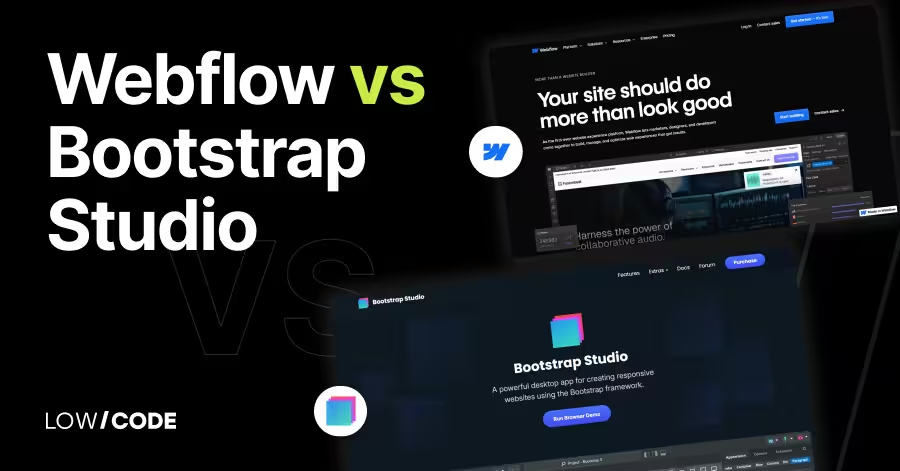
Webflow vs Bootstrap Studio | 11 Factors to Decide the Best One
Compare Webflow vs Bootstrap Studio across 11 key factors to find the best tool for your design style, coding skills, and website goals
Why customers trust us for no-code development


