

How to Design a Mobile App Users Will Love
13 min
read
Good mobile app design is more than looks. Learn the key principles, process, and decisions that make users keep coming back.


Building a mobile app that looks good is not enough. The apps that win are designed around how people actually think, move, and make decisions on a 6-inch screen. Good mobile app design is the difference between an app that gets opened once and one that becomes a daily habit.
This guide covers every stage of mobile app design, from research and wireframes to visual systems and handoff. You will learn what separates functional mobile app design from forgettable interfaces and how to make better decisions at each step.
Key Takeaways
- Start with research. Mobile app design must be grounded in user behavior data, not assumptions about what looks good.
- Prioritize navigation. Users abandon apps within seconds when mobile app design makes core actions hard to find.
- Design for thumbs. Touch targets, gesture zones, and one-handed use define effective mobile app design more than visual polish.
- Build a system. Reusable components and a design system make mobile app design scalable and consistent across every screen.
- Test on real devices. Emulators miss performance issues, gesture conflicts, and rendering bugs that only physical device testing reveals.
- Plan for iteration. The best mobile app design evolves through user feedback loops, not a single handoff to developers.
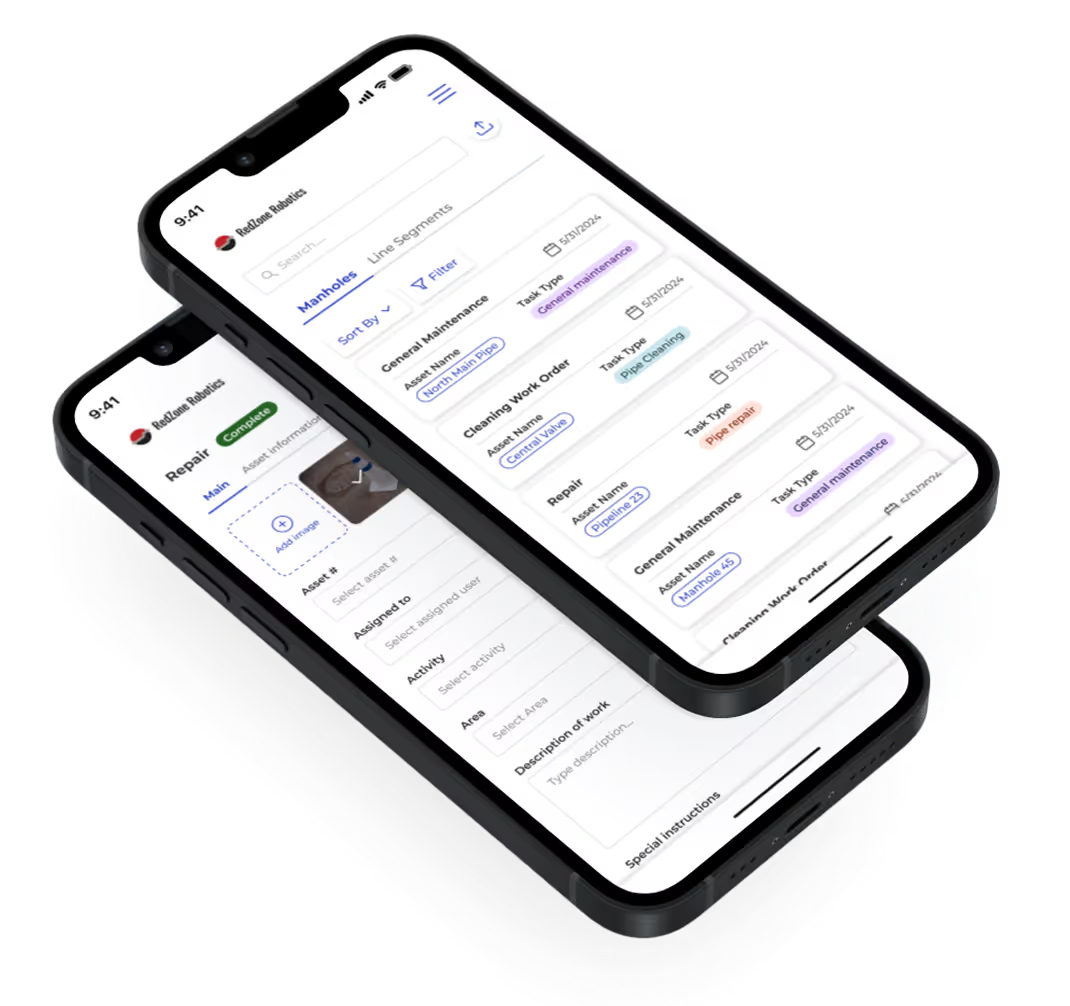

What Makes Mobile App Design Different From Web Design?
Mobile app design requires designing for touch, limited screen space, and interrupted attention spans, while web design optimizes for mouse input, larger viewports, and longer sessions.
Mobile app design operates under constraints that web designers rarely face. Screen real estate is roughly 85% smaller than a desktop monitor, and users interact with thumbs instead of precision cursors. These physical differences change every design decision from layout to typography.
- Touch targets in mobile app design need a minimum of 44x44 points to prevent mis-taps and frustration on small screens
- Information density must drop significantly because mobile app design cannot rely on sidebars, hover states, or multi-column layouts
- Session length averages 3 to 5 minutes per app visit, so mobile app design must surface core value immediately
- Context awareness matters more because mobile app design accounts for users in bright sunlight, on moving vehicles, or multitasking
- Performance expectations are higher since mobile app design must deliver smooth 60fps animations on hardware with limited processing power
Understanding these constraints early prevents costly redesigns later. Teams that apply web design patterns directly to mobile app design consistently produce apps that feel awkward and unintuitive on phones.
How Do You Start the Mobile App Design Process?
The mobile app design process starts with user research, competitive analysis, and defining core user flows before any visual work begins.
Jumping straight into screens is the most common mobile app design mistake. Research reveals what users actually need, how competitors solve similar problems, and which workflows matter most. Skipping this phase means designing based on assumptions that often prove wrong after launch.
- User interviews with 8 to 12 target users expose pain points and expectations that shape every mobile app design decision going forward
- Competitive audits of 5 to 8 similar apps reveal common mobile app design patterns users already understand and expect
- User personas distill research into 2 to 3 archetypes that keep mobile app design decisions grounded in real needs
- Journey mapping identifies the critical moments where mobile app design either earns trust or loses a user permanently
- Feature prioritization using frameworks like MoSCoW separates essential mobile app design elements from nice-to-have additions
At LOW/CODE Agency, we start every project with a discovery phase that maps user needs to technical constraints. This research directly shapes the mobile app design direction and prevents building features nobody uses. Our mobile app development process builds design into every stage, not just the beginning.
What Are the Essential Principles of Mobile App Design?
Effective mobile app design follows principles of clarity, consistency, feedback, and minimal cognitive load to create interfaces people can use without thinking.
Principles are not abstract theory. They are practical rules that prevent mobile app design from becoming confusing, inconsistent, or frustrating. Every screen, interaction, and animation should trace back to a core principle that serves the user.
- Clarity means every element in mobile app design communicates its purpose instantly through visual hierarchy, labels, and familiar patterns
- Consistency ensures that identical actions look and behave the same way across every screen in your mobile app design
- Feedback provides immediate visual or haptic response so users always know their mobile app design registered their input
- Progressive disclosure reveals complexity gradually rather than overwhelming users with every option on a single mobile app design screen
- Error prevention designs forms, inputs, and workflows so mobile app design makes mistakes hard to make in the first place
These principles apply whether you are designing for iOS, Android, or cross-platform. The best way to build a mobile app depends partly on how well your design system supports these principles across platforms.
How Do Wireframes and Prototypes Fit Into Mobile App Design?
Wireframes establish layout and user flow structure in mobile app design, while prototypes add interactivity to test usability before writing any code.
Wireframes are the blueprints of mobile app design. They strip away color, imagery, and branding to focus purely on information architecture and navigation. This low-fidelity stage is where you solve structural problems cheaply.
- Low-fidelity wireframes use simple boxes and text to map screen layouts, letting teams iterate mobile app design structure in hours instead of days
- Mid-fidelity wireframes add realistic content and spacing so stakeholders can evaluate mobile app design flow without getting distracted by visual style
- Interactive prototypes connect wireframed screens with tap targets and transitions to test whether mobile app design navigation feels intuitive
- User testing at prototype stage catches 80% of usability issues when mobile app design changes cost minutes rather than engineering sprints
- Stakeholder alignment improves when prototypes let non-technical reviewers experience mobile app design flow firsthand before development starts
The tools you choose for this phase matter. Selecting the right mobile app design software determines how fast your team can iterate and how smoothly designs translate to development.
What Makes a Great Mobile App Onboarding Experience?
Great mobile app onboarding teaches users the core value proposition in under 60 seconds through progressive, action-oriented screens rather than passive tutorials.
Onboarding is the first real test of your mobile app design. If users cannot figure out what your app does and how to start using it within the first minute, they leave. Research shows 25% of apps are abandoned after a single use, and poor onboarding is the leading cause.
- Action-oriented onboarding in mobile app design gets users doing something meaningful within 3 taps rather than reading explanation screens
- Progressive profiling collects only essential information upfront so mobile app design does not create friction before users experience value
- Contextual tooltips teach features exactly when users encounter them, making mobile app design education feel natural rather than forced
- Skip options respect experienced users who want to explore mobile app design on their own terms without mandatory walkthroughs
- Success moments celebrate first completions so mobile app design reinforces the behaviors that drive long-term engagement and retention
A detailed breakdown of mobile onboarding best practices covers specific patterns, metrics, and examples for getting this critical stage right.
How Do You Design for Both iOS and Android?
Designing for both iOS and Android means following each platform's Human Interface Guidelines and Material Design standards while maintaining a consistent brand identity across mobile app design.
iOS and Android users have different muscle memories and expectations. Mobile app design that ignores platform conventions forces users to relearn basic interactions they already know. The goal is not identical screens but consistent brand experience adapted to each platform.
- Navigation patterns differ fundamentally because iOS mobile app design uses bottom tab bars while Android uses navigation drawers and top tabs
- Typography defaults vary between San Francisco on iOS and Roboto on Android, and mobile app design should respect these system fonts for readability
- Gesture conventions like swipe-to-go-back on iOS and the system back button on Android require mobile app design to support both interaction models
- Component libraries from each platform provide native-feeling elements that make mobile app design feel familiar rather than foreign to users
- Adaptive layouts ensure mobile app design works across the full range of screen sizes from compact phones to large tablets on both platforms
Cross-platform frameworks like Flutter and React Native can share mobile app design logic while rendering native components. Understanding the mobile app development cost implications of single versus dual-platform design helps you budget realistically.
How Does Mobile App Design Connect to Business Strategy?
Mobile app design directly impacts retention, revenue, and user acquisition costs because design quality determines whether users stay, pay, and recommend the app.
Design is not a visual layer applied after engineering. Mobile app design decisions drive business metrics. Every friction point in the interface reduces conversion rates. Every delightful interaction increases session length and referral likelihood.
- Retention correlation shows that apps with intuitive mobile app design retain 3x more users at 30 days than apps with confusing navigation
- Conversion optimization through mobile app design places CTAs, forms, and purchase flows where thumb reach and attention naturally focus
- Acquisition cost reduction happens when strong mobile app design generates organic word-of-mouth and higher app store ratings
- Brand perception is shaped by mobile app design quality since 94% of first impressions are design-related according to Stanford research
- Lifetime value increases when mobile app design creates habits through features like streaks, progress indicators, and personalized dashboards
Your mobile app business strategy should treat design as a core investment, not a cost center. The ROI of mobile app design compounds over every user session and every month of retention.
What Mistakes Should You Avoid in Mobile App Design?
The most damaging mobile app design mistakes are overloading screens, ignoring platform conventions, skipping user testing, and designing for aesthetics over usability.
Mistakes in mobile app design are expensive because they compound. A confusing home screen leads to lower engagement, which leads to poor reviews, which leads to fewer downloads. Avoiding common pitfalls early saves months of redesign work later.
- Feature overload crams too many options onto a single screen, making mobile app design feel overwhelming instead of powerful and focused
- Inconsistent patterns use different interaction models for similar actions, forcing users to relearn your mobile app design on every screen
- Ignoring accessibility excludes users with visual, motor, or cognitive differences from your mobile app design experience entirely
- Designing for perfect conditions assumes users have strong WiFi and full attention, when real mobile app design must handle edge cases gracefully
- Late testing discovers usability issues in mobile app design after code is written, when fixes cost 10x more than catching them at wireframe stage
Avoiding these mistakes requires discipline and process. Working with experienced teams who have shipped hundreds of mobile apps prevents you from learning these lessons the expensive way.
How Do You Build a Mobile App Design System?
A mobile app design system is a collection of reusable components, style tokens, and usage guidelines that ensure consistency and speed across every screen and future feature.
Design systems transform mobile app design from a screen-by-screen exercise into a scalable framework. Without a design system, every new screen requires custom decisions about colors, spacing, typography, and component behavior. With one, new screens assemble from proven parts.
- Design tokens define colors, spacing, typography, and elevation values as named variables so mobile app design updates propagate across every screen automatically
- Component libraries package buttons, inputs, cards, and navigation elements as reusable parts so mobile app design stays consistent without manual enforcement
- Usage documentation explains when and how to use each component so mobile app design decisions stay aligned even as new team members join the project
- Version control tracks changes to the design system over time so mobile app design evolution is documented and reversible when experiments fail
- Platform parity ensures the design system maps to both iOS and Android implementations so mobile app design consistency extends through development to the final product
A strong design system pays for itself within the first quarter of development. Teams with design systems build new mobile app design screens 40 to 60% faster than teams working from scratch on every screen.
How Do You Hand Off Mobile App Design to Developers?
Effective mobile app design handoff provides developers with exact specifications, interactive references, and annotated prototypes that eliminate guessing and reduce implementation errors by 70% or more.
The handoff stage is where mobile app design either translates faithfully into code or falls apart. Poor handoff leads to developers improvising spacing, colors, and interaction behavior. Strong handoff makes every implementation decision explicit.
- Annotated specs document spacing, sizing, and behavior for every component so mobile app design intent is clear without verbal explanation
- Interactive prototypes show developers exactly how transitions, animations, and state changes should feel in the final mobile app design implementation
- Asset exports provide icons, images, and illustrations in the exact formats and resolutions that mobile app design requires for each target platform
- Responsive rules specify how mobile app design adapts to different screen sizes, orientations, and accessibility settings so developers handle edge cases correctly
- Design-dev sync meetings at the start of each sprint ensure developers understand mobile app design intent for the features they are about to build
Investing time in handoff quality prevents the rework cycles that inflate project timelines. When mobile app design and development communicate through clear specifications rather than assumptions, projects stay on schedule.
How LOW/CODE Agency Approaches Mobile App Design
LOW/CODE Agency treats mobile app design as a strategic product discipline, not just pixel work.
- Discovery-driven design starts every engagement with user research and competitive analysis before a single screen is sketched
- Platform-optimized approach selects the right technology for each project, whether that means native, cross-platform, or low-code tools
- Integrated product teams pair designers with developers and product managers so mobile app design decisions account for technical feasibility
- Iterative process builds, tests, and refines mobile app design through multiple feedback cycles rather than a single waterfall handoff
- Scalable design systems create reusable component libraries so your mobile app design stays consistent as the product grows
Related Articles
Last updated on
September 3, 2026
.

Jesus is a visionary entrepreneur and tech expert. After nearly a decade working in web development, he founded LOW/CODE Agency to help businesses optimize their operations through custom software solutions.


FAQs
What makes a mobile app design great from a user perspective?
How important is UX research in mobile app design?
What are the most common mobile app design mistakes to avoid?
How do I test whether my mobile app design is working?
What role does onboarding play in mobile app design?
Should my mobile app follow iOS and Android design guidelines?
Related Articles

Mobile App Development
No-code/Low-code
No-code Mobile App Development (Build, Launch, and Scale)
Learn how to build no-code mobile apps step by step, choose the right tools, avoid mistakes, and scale your app without coding in 2026.

Mobile App Development
iOS Mobile App Development: Complete Guide
Building an iOS mobile app? Get a complete guide covering costs, timelines, tech choices, and what to expect from the process.

Mobile App Development
Future-Proof Mobile App Tech Stack in 2026
Choosing a mobile app tech stack that won't age badly? Learn what technologies to pick in 2026 to keep your app scalable and modern.

Mobile App Development
Mobile App Risk Management: What to Know
Every mobile app project carries risk. Learn how to identify, plan for, and manage the most common risks before they derail you.


Why customers trust us for no-code development


