

How to Build a Marketplace App MVP Quickly
10 min
read
Learn key steps to develop a marketplace app MVP efficiently and avoid common pitfalls for a successful launch.


Most attempts to build a marketplace app MVP fail because the scope is wrong from the start. Founders list every feature they eventually want, call it an MVP, spend $80,000 to $150,000 building it, and launch to discover the market is not what they assumed.
The right MVP tests one question: will buyers transact with sellers through your platform, in this category, in this context? This guide covers how to scope, build, and launch an MVP that answers that question without wasting capital that should fund the real build.
Key Takeaways
- MVP scope is defined by the transaction loop: If a feature is not required for a buyer to find a seller and complete a transaction, it is Phase 2 scope, not MVP scope.
- Product discovery is a prerequisite: An MVP built without validated user research tests the wrong hypothesis, the data from that MVP is not actionable.
- No-code tools are valid for marketplace MVPs: Sharetribe, Bubble, and Webflow with Stripe can validate most marketplace hypotheses at $15,000 to $40,000 versus $80,000 to $200,000 for a custom build.
- The MVP answers one question: Will users transact? Not: does this impress investors, serve edge cases, or showcase every feature.
- Launch to fewer than 100 users first: A controlled soft launch with handpicked vendors and buyers produces better data than a public launch and surfaces UX problems before they affect your reputation.
- Measure completion rate, not signup rate: The only metric that matters in the MVP phase is whether users who enter the transaction flow complete it.
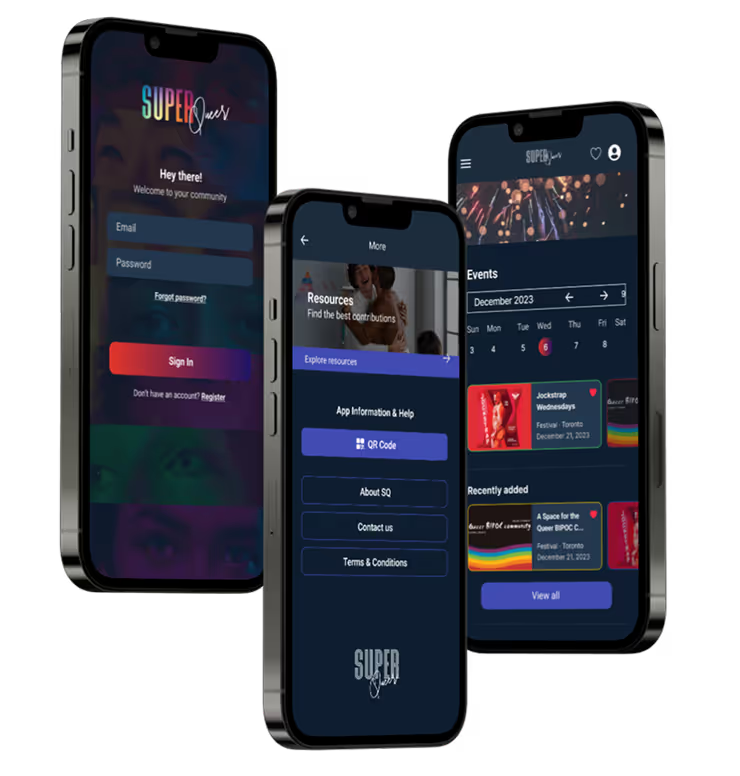

What Is a Marketplace MVP, and What Is It Not?
A marketplace MVP is the smallest functional version of the platform that allows a real buyer to find a real seller and complete a real transaction, end-to-end, with payment, in a production environment.
"Minimum" means minimum features required for the core loop to function. Not minimum quality, not minimum design, and not minimum trust infrastructure. Trust infrastructure is non-negotiable from day one.
- What an MVP is not: A prototype, a landing page with a waitlist, or a demo environment without payment processing, these test something, but none of them test whether users will actually transact.
- Two-sided functionality is required: A buyer-only MVP with no live sellers is not a marketplace MVP, it is a landing page. Both sides must be able to complete their respective journeys.
- The MVP failure pattern: Building a feature set so large it takes 8 months to launch, by which time market assumptions have shifted and validation data is already outdated.
- Quality is not optional: Minimum viable does not mean broken or visually incomplete, trust fails immediately when the platform feels unreliable or unfinished.
- Payment must be real: A marketplace MVP without real payment processing does not generate valid transaction data, "contact seller for payment" is not a test of the transaction loop.
The single most expensive MVP mistake is defining "minimum" as a reduced version of the full platform vision. It is not. Minimum means the smallest system that answers the core hypothesis.
What Must Be True Before You Build Your MVP?
Five conditions must be in place before writing a line of MVP code. Building without them does not accelerate validation, it produces data that cannot be acted on.
These are not steps in a methodology. They are preconditions. Missing any of them significantly increases the probability that the MVP tests the wrong hypothesis.
- Validated problem on both sides: You need evidence from actual conversations with intended users, not assumptions, that buyers want what sellers offer and sellers want access to your buyer pool.
- Defined narrow scope: One vertical, one geography, one transaction type, multi-vertical MVPs never achieve liquidity in any vertical.
- Seeded supply side: Before opening to buyers, have 10 to 30 committed vendors ready to list, launching with no supply destroys buyer trust before you have built it.
- Monetisation decision made: Your take rate, fee structure, or subscription model must be decided before development begins, the payment infrastructure you build depends on the revenue model.
- Clear "done" definition: What specific behaviour, measured over what time period, will tell you whether the hypothesis is correct or incorrect?
If you have not yet completed the marketplace product discovery process, that is the phase to finish before scoping a single feature.
What Features Should Your Marketplace MVP Include?
The non-negotiable core marketplace app features, the ones that must be present for a transaction to complete, form the outer boundary of your MVP scope. Every other feature is Phase 2.
The list is shorter than most founders expect. The discipline is in what you exclude, not what you include.
- Dual registration: Separate onboarding flows for buyers and sellers with the appropriate fields and verification steps for each user type.
- Listing creation and management: Sellers can create, edit, and publish listings with photos, descriptions, pricing, and availability, this is the supply side foundation.
- Search and basic filtering: Buyers can find listings by category, location (if relevant), and price, basic faceted search, not AI-powered recommendation.
- Transaction and payment processing: Buyers can purchase or book directly on-platform with real payment processing, no "contact seller" workarounds that bypass the transaction loop.
- In-platform messaging: Buyer and seller can communicate within the platform without exchanging personal contact details, this protects the platform relationship.
- Reviews and ratings: Post-transaction review system for both sides, this is trust infrastructure, not a nice-to-have, and must be present at launch.
- Admin moderation panel: Ability to approve listings, manage disputes, and process refunds, without this the platform cannot be operated safely.
Explicitly exclude from the MVP: native mobile apps, advanced analytics dashboards, AI-powered search, subscription management for sellers, and multi-currency support. Each of these is a Phase 2 feature contingent on a validated Phase 1.
How Do You Design an MVP That Users Will Actually Use?
The fastest way to validate your MVP design before writing code is by wireframing your marketplace flows with real users first. Flow errors found in wireframes cost a fraction of flow errors found in built code.
Three user flows must be fully designed before any visual design begins: the buyer journey end-to-end, the seller onboarding and listing flow, and the admin dashboard for moderation and dispute management.
- Flow errors are the expensive mistakes: Missing steps, unclear call-to-action placement, and confusing navigation cost $200 to fix in a wireframe and $2,000 to fix in code.
- Trust signals at decision points are mandatory: Show reviews, secure payment badges, and seller verification status at the exact points where users decide whether to proceed.
- Consistency between buyer and seller interfaces: A marketplace that feels like two separate products destroys user confidence, the design system must be coherent across both user journeys.
- Usability test before development: Share the clickable prototype with 5 to 10 people from each user side; watch where they get stuck without helping them; fix every point of confusion before handoff.
- Clarity beats aesthetics in the transaction flow: Users abandon beautiful checkout flows that are confusing, every design decision in the transaction flow should optimise for clarity, not style.
The usability test is not optional. It is where you find the flow errors that would otherwise surface as conversion problems after launch, at much higher cost.
What Tech Stack Should You Use for an MVP Build?
Choosing the right marketplace MVP tech stack at this stage determines how much refactoring you will need when you scale. The decision comes down to three honest trade-offs: speed, cost, and future scalability.
The payment infrastructure decision cannot be deferred regardless of which stack you choose. Even at MVP stage, the platform must process real payments through a properly integrated gateway, Stripe Connect is the default recommendation.
- No-code option (Sharetribe, Bubble, Webflow with Stripe): $15,000 to $40,000 in build cost; 4 to 10 weeks to launch; appropriate when the MVP hypothesis is unproven and capital preservation is the priority.
- Custom-built MVP (Node.js or React with Stripe Connect and PostgreSQL): $60,000 to $150,000; 3 to 5 months to launch; appropriate when the model is validated and scalable foundation is the priority from day one.
- Hybrid approach (no-code frontend, custom API layer for payment and data): $30,000 to $70,000; 8 to 14 weeks; the most common successful pattern, speed of no-code frontend with flexibility of a custom backend.
- Database schema is the long-term constraint: Even in a no-code build, define the data model for listings, users, and transactions before building, retrofitting a data model after launch is the most expensive technical operation a marketplace team performs.
- The platform ceiling will be hit eventually: No-code tools have capability limits, but for most unproven marketplace hypotheses, this ceiling is not relevant at MVP stage; it becomes relevant in Phase 2.
LOW/CODE Agency builds marketplace MVPs on Bubble, FlutterFlow, and hybrid stack combinations. The stack choice follows the hypothesis and the timeline, not the other way around.
How Long Does a Marketplace MVP Take to Build?
Honest timeline estimates require including the phases that are consistently underestimated. Design, QA, and payment integration together account for 30 to 40% of total build time and receive less than 10% of planning attention.
The timeline also depends entirely on which build approach is right for the hypothesis being tested.
- No-code or low-code MVP: 4 to 10 weeks from scope-complete to launch, primary time variables are content population, payment configuration, and user acceptance testing.
- Custom MVP: 12 to 20 weeks from architecture-complete to launch, primary time variables are backend API complexity, third-party integration count, and QA thoroughness.
- Design takes 2 to 4 weeks: This phase is consistently compressed in planning and consistently runs over, build in the full range before committing to a launch date.
- Payment gateway integration takes 1 to 3 weeks: Split payment logic and escrow add to this estimate, do not plan for a single week of payment work on any marketplace build.
- Admin moderation tooling adds 1 to 2 weeks: This is the most consistently underscoped component in marketplace builds, scope it explicitly before development starts.
Build in 2 weeks between "feature complete" and "public launch" for controlled testing with real users. This buffer is where the most expensive production bugs are caught at the lowest possible cost. For a full breakdown of timelines by build approach and team type, the marketplace MVP development guide covers the variables in detail.
How Do You Measure Whether Your MVP Worked?
The MVP's job is to answer one question: will users transact? That question has a specific metric, a specific benchmark, and a specific diagnostic path when the answer is no.
Define what you are measuring before you launch, not after. The post-launch discovery that you forgot to instrument the transaction flow is a common and entirely avoidable problem.
- Primary metric is transaction completion rate: Of users who start the checkout or booking flow, what percentage complete a transaction? The healthy benchmark is 15 to 35%; below 10% indicates a UX or trust problem.
- Supply health metric matters equally: Are vendors listing actively, accepting transactions, and responding to buyer messages within acceptable windows? Supply quality determines whether buyer retention is even possible.
- Retention signal within 30 days: In a healthy marketplace, 25 to 40% of first-transaction buyers return within 30 days, below this indicates supply quality issues or product-market fit uncertainty.
- Diagnose before concluding the market is wrong: If transaction completion is below 10% after 4 to 6 weeks, identify the specific drop-off point in the flow before pivoting, the problem is almost always a specific friction point, not a failed market thesis.
- Read the right signal from the right symptom: Buyers who register but never initiate a transaction indicate a supply quality problem; buyers who initiate but abandon at checkout indicate a UX or trust problem, these require different responses.
The data from a well-scoped MVP is worth more than the features of an over-built one. Instrument the transaction flow before launch and you will know exactly where to focus the next iteration.
Conclusion
Building a marketplace MVP is not about building a small version of your full platform vision. It is about building the smallest system that answers one specific question: will buyers transact with sellers through this platform, in this category, in this context?
Write your MVP hypothesis as one sentence before scoping a single feature: "If we provide [supply type] to [buyer type] on [platform], [percentage] of users who search will complete a transaction within [timeframe]." If you cannot write that sentence, your discovery phase is not complete.
Building a Marketplace MVP? Get the Scope Right Before the Build Begins.
Most marketplace MVPs cost more than they should and deliver less data than they need to because the scope was wrong before development started. Features were added without testing the core transaction loop, the tech stack was chosen by familiarity rather than fit, and the success metrics were defined after launch instead of before.
LOW/CODE Agency is the AI product development partner built for SMBs. We build and ship web apps, mobile apps, chatbots, RAG systems, and AI agents — end to end, without the enterprise overhead. We scope marketplace MVPs by working backward from the hypothesis, defining the exact feature set, the right build approach, and the measurement framework before a single line of code is written.
- MVP scoping: We define the minimum feature set required to test your core transaction hypothesis, with clear reasoning for what is included and what is deferred to Phase 2.
- Product discovery support: We run the validation interviews and hypothesis documentation needed to confirm that the MVP is testing the right question before the build begins.
- Tech stack selection: We recommend Bubble, Sharetribe, FlutterFlow, or custom stack based on your hypothesis maturity, timeline, and scalability requirements, not defaults.
- Payment architecture: We configure Stripe Connect or equivalent for your marketplace's specific transaction model, including split payment, escrow, and payout flows.
- Design and wireframing: We design all three core user flows, buyer journey, seller onboarding, and admin moderation, with usability testing before development handoff.
- Post-launch measurement: We instrument the transaction flow, define the primary metrics, and set the benchmarks so MVP success or failure is measurable from day one.
- Full product team: Strategy, UX, development, and QA from a single team, so your MVP is scoped, built, and launched as a coherent product, not assembled from separate workstreams.
We have built 350+ products for clients including Coca-Cola, American Express, and Sotheby's. We know exactly where marketplace MVPs go wrong, and we scope around those failure points from the first conversation.
Related Articles
Last updated on
September 3, 2026
.

Jesus is a visionary entrepreneur and tech expert. After nearly a decade working in web development, he founded LOW/CODE Agency to help businesses optimize their operations through custom software solutions.


FAQs
What are the essential features for a marketplace app MVP?
How long does it typically take to build a marketplace MVP?
Should I build a marketplace MVP with no-code tools or custom development?
How can I test my marketplace MVP with real users?
What are common mistakes to avoid when building a marketplace MVP?
How do I ensure my marketplace MVP is scalable?
Related Articles

Marketplace
How to Build a Manufacturing Marketplace
Learn key steps to create a manufacturing marketplace, including platform features, supplier onboarding, and marketing strategies.
Marketplace
How to Build an Event Venue Marketplace
Learn step-by-step how to create a successful event venue marketplace with key features and tips for growth and user engagement.
Marketplace
How to Build a Musician Booking Marketplace
Learn key steps to create a successful musician booking platform with essential features and marketing tips.

Marketplace
How to Build an Event Marketplace App
Learn how to create an event marketplace app with key features, development steps, and tips for success in this concise guide.

Why customers trust us for no-code development


