

Marketplace App Wireframing & Prototyping Guide
9 min
read
Learn key steps and best practices for wireframing and prototyping marketplace apps effectively.


Most teams treat marketplace app wireframing as a formality between discovery and design. A quick set of boxes and arrows before the "real work" begins.
That assumption is expensive. In marketplace apps, where three distinct user types navigate overlapping but different flows, wireframing is where the most costly product failures get caught early. A confused flow found in a wireframe takes 20 minutes to fix. The same confusion found in a built product takes weeks and costs real money.
Key Takeaways
- Three user types to map: Buyer, seller, and admin journeys must all be wireframed before any visual design begins, without exception.
- Wireframes define flow, not visuals: Their job is to show what appears on each screen and in what order, not how it looks aesthetically.
- Prototypes are where validation happens: A static wireframe shows screens. A clickable prototype reveals whether users can actually navigate between them.
- Admin is the most neglected flow: Founders spend 90% of wireframing effort on buyer and seller UX. The admin panel is consistently wireframed last and built inadequately.
- Five usability test rounds catch most errors: Testing with real users before development is the highest-ROI activity in the pre-development phase.
- Tool choice matters less than completeness: Whether you use Figma or pen and paper is less important than whether every flow is mapped for every user type.

Why Does Wireframing Come After Discovery, Not Before?
Wireframes translate validated user flows into screen sequences. Without validated flows from discovery, wireframes are guesses about user behaviour, not maps of confirmed behaviour. This distinction determines whether your development budget builds the right product.
Teams that skip discovery and go straight to wireframes essentially do visual design twice. Once in wireframe form, and once again properly after research reveals the flows were wrong.
- Discovery feeds wireframes directly: Buyer journey maps, seller onboarding requirements, trust infrastructure needs, and admin moderation requirements all come from discovery interviews.
- Unvalidated wireframes create compounding errors: Screens that look plausible to the founding team may map to journeys real users never take.
- Trust requirements become UI elements: Each trust signal identified in buyer research (review display, verification badge, payment indicator) maps to a specific wireframe element.
- Admin requirements come from operational planning: Each moderation and dispute function identified in planning becomes an admin panel view in the wireframe.
- The cost of skipping discovery: Design and development work built on unconfirmed assumptions gets rebuilt after usability testing reveals the flows were wrong.
Wireframes built without completed product discovery are flow maps for unvalidated assumptions and they produce expensive rework downstream.
What Screens Does a Marketplace App Wireframe Need to Cover?
The wireframe scope should be driven by the must-have marketplace features, every feature in the MVP needs a corresponding user flow mapped before design begins. Gaps in the wireframe become gaps in the design and eventually gaps in the built product.
A complete marketplace wireframe covers three user types across buyer-facing, seller-facing, admin, and shared utility screens.
- Buyer-side screens: Homepage, search results, listing detail, seller profile, checkout flow, order confirmation, messaging, order tracking, and review submission.
- Seller-side screens: Registration, listing creation, listing management, order notifications, earnings dashboard, messaging, and review management.
- Admin screens: Listing approval queue, user management, dispute resolution, commission management, reporting overview, and moderation tools.
- Shared utility screens: Authentication flows, notification preferences, profile editing, and terms acceptance must be wireframed for all user types.
- Prioritisation sequence: Wireframe buyer and seller flows first, admin flows second, utility screens third. Review cycles should focus on highest-impact flows first.
Completeness means every screen reachable from the core transaction flow must be wireframed. This includes edge cases, empty states, and error flows, not just the happy path.
What Does the Buyer Flow Wireframe Need to Cover?
The buyer flow has multiple entry points. Direct search, category browse, homepage featured listings, and external traffic landing on a listing page each need their own wireframed onramp into the transaction flow. Designing only for direct search misses significant real-world traffic patterns.
Edge cases are where buyer-side wireframes most commonly fail. What happens if a listing goes unavailable mid-checkout? What does the buyer see if a dispute is raised against their review?
- Search and filter flow: Wireframe search input, results display (list and grid views), filter panel, empty state for zero results, and sorting options explicitly.
- Listing detail page components: Photos, description, pricing, seller rating, availability, call-to-action placement, and trust signals all need defined positions on this screen.
- Checkout flow screens: Cart summary, buyer details confirmation, payment entry, and order confirmation each get their own wireframe showing exactly what information appears and where the primary action sits.
- Post-transaction screens: Order confirmation with contact information, the buyer-seller messaging interface, and review submission triggered at the correct post-transaction point.
- Edge case flows: Unavailable listing mid-checkout, failed payment retry, and the dispute submission flow must be wireframed before design begins.
Mapping the buyer journey completely means accounting for all buyer panel feature requirements, from first search through to post-transaction review.
What Does the Seller/Vendor Flow Wireframe Need to Cover?
The seller onboarding flow determines your seller activation rate and is consistently under-wireframed. Every step from registration through first listing publication needs its own screen with validation states for incomplete fields.
The payout and earnings flow is equally critical. Sellers who cannot see clearly when they will be paid and what fees were deducted become anxious about the platform. That anxiety drives churn.
- Seller onboarding screens: Registration with verification steps, profile setup, bank account connection, and first listing creation walkthrough all require dedicated wireframe screens.
- Listing creation validation states: Every required field in the listing form needs a wireframed validation state showing what the form looks like when that field is incomplete.
- Seller dashboard layout: Active listings, incoming orders with action prompts, message notifications, earnings summary, and performance metrics must all be above the fold on first load.
- Order management flow: New order notification, acceptance action, fulfilment status update, dispute management, and buyer feedback review each need wireframed screens.
- Dispute flow from seller's perspective: What can a seller do when they believe a buyer's dispute is unwarranted? Absent this flow, sellers churn post-launch when the first dispute appears.
The seller-side wireframes should account for all vendor dashboard feature requirements, not just the listing creation flow, but the full management and reporting experience.
How Do You Turn Wireframes Into a Clickable Prototype?
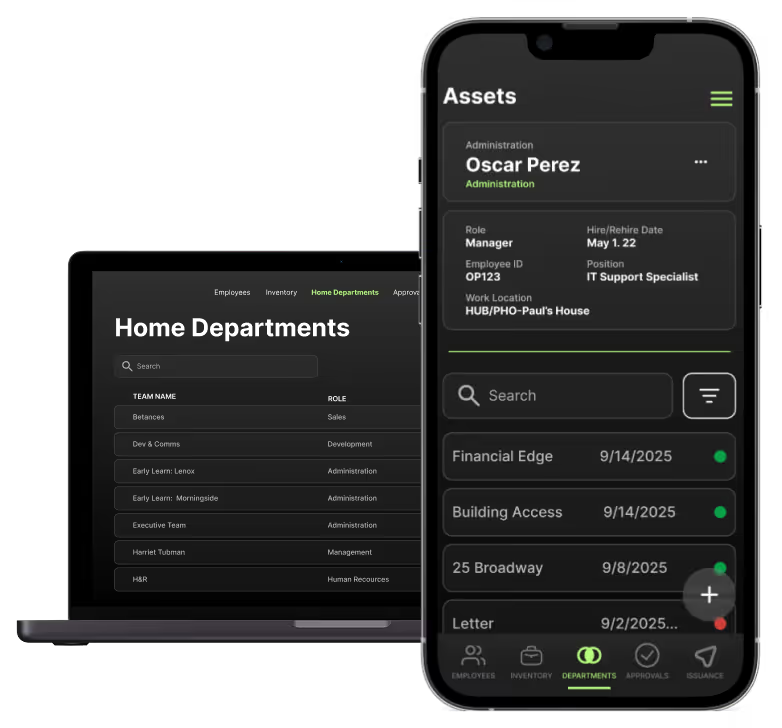
A clickable prototype is a linked set of wireframe screens that simulates the navigation of the final product. Users tap through flows as if using a real app, without any working code. This is where flow validation actually happens.
Figma is the most widely used tool for marketplace prototypes due to component reusability and team collaboration. InVision and Adobe XD are viable alternatives depending on your team's existing toolchain.
- What to link: Connect all primary navigation paths: buyer search to listing to checkout, seller dashboard to listing to order management, and admin approval flow. Do not attempt to link every edge case first.
- Focus on five to eight flows: Link the flows users are most likely to take in the real product. Comprehensiveness comes after the primary paths are validated.
- Annotation layer: Add brief notes to prototype screens explaining the intent of each element and any interaction logic that is not visually apparent to reviewers.
- Handoff package contents: A complete prototype handoff includes the screen inventory, linked prototype, annotation layer, and a written summary of what each of the five to eight flows is testing.
- Prototype fidelity: Keep the prototype at wireframe fidelity, not visual design fidelity. Adding colour and imagery before flows are validated generates visual feedback instead of flow feedback.
The prototype is the last low-cost opportunity to change the structure of your user flows before design work begins. Every flow problem caught here costs minutes to fix.
How Do You Test a Marketplace Prototype With Real Users?
Test with five users per side minimum: five buyers and five sellers. Recruit from your intended user population, not from your professional network. Testing with familiar users introduces confirmation bias that makes every flow look better than it is.
The moderated test structure gives each participant a specific scenario. Give them a task like: "You are looking for a freelance graphic designer. Use the platform to find one and go as far as you can through the booking process." Then observe without helping.
- Task completion rate: Did the participant complete the scenario? Completion rate is the primary signal that a flow works or does not work.
- Time on task: How long did each step take? Hesitation time at any point in the flow identifies where users are confused even if they ultimately complete the task.
- Points of hesitation: Where did the user stop, reread, or ask questions? These moments reveal the specific screen elements that are not communicating clearly.
- Verbal feedback: "I would have expected the search bar to be here" is more useful than "I liked it." Encourage specific observations about expectation gaps.
- Five failure signals: User cannot find search entry, user abandons checkout before payment, user cannot locate messaging, user does not understand listing creation requirements, user cannot find the dispute mechanism.
One revision cycle after usability testing typically resolves 70-80% of identified flow problems. Retest the specific failed flows before proceeding to design, not the full prototype, just the sections that failed.
What Comes After Prototyping? Moving to UI/UX Design
The validated prototype hands off directly to the design phase. At that point, the marketplace UI/UX design principles that govern visual design take over. The wireframe phase ends when flows are validated for all three user types.
What the design phase receives: a confirmed screen inventory, validated user flows, interaction annotations, and a usability test report documenting what was tested and what was revised.
- What design does not receive: Specific visual decisions about colour, typography, or iconography. These are design-phase decisions, not wireframe deliverables.
- Design brief requirements: Brand guidelines or a brand brief, design system preferences, and accessibility requirements should accompany the prototype handoff.
- Visual design risk: Adding colour and imagery to wireframe screens before flows are validated creates attachment to the visual layer before the structural layer is confirmed.
- Wrong phase feedback: Feedback sessions on visually designed screens consistently produce visual feedback. The wireframe phase is for collecting structural feedback.
- Transition cost: From the design phase forward, changes to user flow structure become significantly more expensive. The prototype phase is the last low-cost structural change opportunity.
The handoff from wireframe to design is a discrete transition, not a gradual one. Once the design team begins visual work, reopening flow questions costs design hours that could have been avoided.
Conclusion
Wireframing and prototyping are not administrative steps between discovery and design. They are where marketplace failures get caught at the lowest possible cost before they become development problems.
A flow problem found in a wireframe takes 20 minutes to fix. The same problem found in code takes a week. Before starting any wireframe work, produce a screen inventory for all three user types. If you cannot produce that list with confidence, discovery is not finished.
Want Wireframes That Your Development Team Can Actually Build From?
Most wireframe deliverables look complete but leave critical gaps: edge cases not wireframed, seller flows only half-mapped, admin panels as vague placeholders. Development teams fill those gaps with guesses, and the guesses cost rework.
We are LOW/CODE Agency — an AI product development company for SMBs. We build across the full stack: web apps, mobile apps, AI chatbots, RAG pipelines, and autonomous agents. Custom software, built by experts. We produce annotated, validated wireframes and clickable prototypes for all three marketplace user types, designed to feed directly into design and development without re-work.
- Three-user-type coverage: We wireframe buyer, seller, and admin flows completely before any design work begins, including edge cases and validation states.
- Discovery-fed wireframes: Our wireframes are built from validated user research outputs, not founding team assumptions about how users behave.
- Clickable prototype production: We build linked prototypes in Figma that simulate real navigation and can be tested with users before development starts.
- Usability testing: We run moderated usability tests with five buyers and five sellers minimum and revise the prototype before design handoff.
- Annotation layer: Every wireframe screen includes interaction notes and intent documentation so designers and developers have a clear brief, not just screens.
- Screen inventory: We produce a complete inventory of every screen required for each user type so nothing is missed before design begins.
- Full product team: Strategy, UX, development, and QA from one team, so wireframe decisions are made with build feasibility in mind from day one.
We have built 450+ products for clients including Coca-Cola, American Express, and Sotheby's.
Related Articles
Last updated on
September 3, 2026
.

Jesus is a visionary entrepreneur and tech expert. After nearly a decade working in web development, he founded LOW/CODE Agency to help businesses optimize their operations through custom software solutions.


FAQs
What is the purpose of wireframing in marketplace app development?
How does prototyping improve marketplace app design?
What tools are best for wireframing marketplace apps?
How detailed should a marketplace app wireframe be?
What common mistakes should be avoided during prototyping?
Can wireframing and prototyping reduce development costs?
Related Articles
Marketplace
How to Build a Tenant-Landlord Marketplace
Learn key steps to create a successful tenant-landlord marketplace with practical tips on features, technology, and user experience.
Marketplace
How to Build a Personal Trainer Marketplace
Learn the key steps to create a successful personal trainer marketplace platform with essential features and marketing tips.

Marketplace
Marketplace App Development Process Explained
Learn the key steps and best practices in marketplace app development for a successful launch and user engagement.
Marketplace
How to Build a Skill Sharing Marketplace
Learn key steps to create a skill sharing marketplace, including platform features, user engagement, and monetization strategies.


Why customers trust us for no-code development


