

Admin Panel Design Tips for Marketplace Platforms
15 min
read
Learn key features and best practices for designing effective admin panels in marketplace platforms to improve management and user experience.


Admin panel design for marketplace platforms is not a cosmetic task. Most marketplace admin panels are built as an afterthought, assembled after the buyer and vendor UX is finished. The result is an operator who can see everything but act on almost nothing.
The platforms that scale without operational chaos are the ones that architect the admin panel from day one. This guide gives you the full specification, module by module.
Key Takeaways
- Admin panels are operational infrastructure: The admin panel is where disputes are resolved, fraud is caught, and commission rules enforced, not just where charts are viewed.
- Three user types drive scope: Platform operator, finance/compliance manager, and vendor support agent each need a different permission tier and default view.
- Vendor management is the most critical module: Onboarding, suspension, and performance visibility determine marketplace supply quality.
- Financial controls must be built before launch: Commission overrides, payout holds, and dispute flows cannot be retrofitted once real money is moving.
- Role-based access is non-negotiable: A single superuser admin account is a security and compliance failure at any meaningful scale.
- Admin UX density kills adoption: If a common task takes more than three clicks, operators will work around the panel entirely.

What Does an Admin Panel Actually Need to Control?
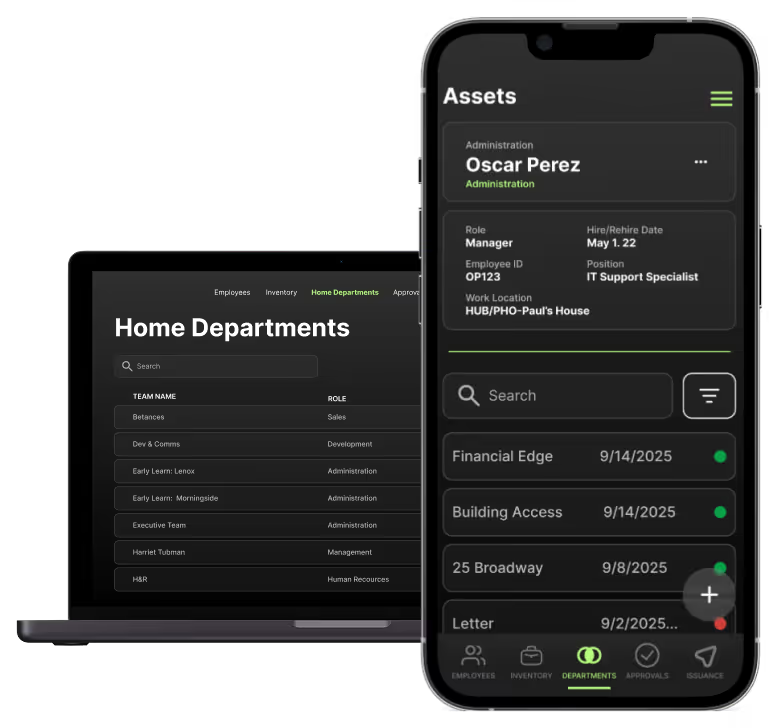
A marketplace admin panel must cover five domains: user management, order and transaction oversight, content and listing moderation, financial controls, and platform configuration. Missing any one of these creates an operational gap that shows up as a customer support cost.
The scope of each domain depends on your marketplace type. Product marketplaces need inventory moderation. Service marketplaces need booking and dispute management. Rental marketplaces need calendar and damage claim controls.
- Read vs write access: Most poorly designed panels give broad visibility but restrict action, forcing operators into workarounds for tasks the panel should handle natively.
- Product marketplaces: Require listing image review, SKU-level inventory flags, and return condition management in the admin layer.
- Service marketplaces: Require booking status overrides, cancellation fee application, and provider availability management.
- Rental marketplaces: Require calendar conflict resolution, damage claim processing, and security deposit release controls.
- Three operator roles: Platform superadmin, finance/compliance manager, and vendor support agent must be defined before scoping begins, or the panel ends up serving no one well.
Before scoping admin controls, align on must-have marketplace app features, since what the platform does determines what the admin must manage.
How Should the User Management Module Be Structured?
The user management module is the highest-frequency part of any marketplace admin panel. It must support both buyer and vendor records with full action capability, not just visibility.
Each user type has distinct fields and actions. Grouping them in a single undifferentiated list is a common design failure.
Buyer Account Management
Buyer account management handles suspension, fraud investigation, and refund initiation. These are the most frequent operations in any marketplace with consumer-side volume.
The fields and actions required are specific.
- Required fields: Account status, registration date, order history, dispute history, fraud flags, and contact details must all be surfaced on the primary record view.
- Required actions: Suspend, ban, merge duplicate accounts, initiate refund, reset password, and view session logs must all be one-click from the buyer record.
- Filtering and search: Filter by status, registration date, order volume, and dispute rate, with bulk action support for processing flagged accounts efficiently.
Bulk action capability is essential. Individual record-by-record processing stops scaling past a few hundred flagged accounts.
Vendor Account Management
Vendor account management governs marketplace supply quality. The onboarding queue is the highest-frequency admin workflow on most platforms.
Getting this module right has a direct impact on supply-side conversion and time-to-live for new vendors.
- Required fields: Business verification status, listing count, average rating, order volume, payout history, and compliance documents on the primary vendor record.
- Required actions: Approve or reject onboarding, suspend listing, trigger manual payout, apply commission override, and send compliance notice.
- Onboarding queue design: Show pending verification requests with document preview and one-click approve/reject, aged by days waiting, not a flat unordered list.
The onboarding queue design alone separates well-built admin panels from the ones that create bottlenecks in vendor operations.
Role and Permission Management
Role-based access control is not optional at any scale where compliance matters. Three roles cover most marketplace operational structures.
Every action taken in the panel must be traceable to a named user.
- Minimum role structure: Superadmin with full access, operations with read plus moderate plus support actions, and finance with read financial data plus trigger payouts plus apply holds.
- Audit log requirement: Every admin action must be timestamped and attributed to a named user, including the entity affected and the before/after state.
- Permission boundaries: Finance should not access user personal data. Vendor support should not access payout controls. Minimum access per role is a security requirement.
The audit log is not a nice-to-have. It is the evidence trail you need when a vendor disputes a commission calculation or a compliance audit occurs.
How Should the Vendor Management Module Be Structured?
The admin's view of vendor data should mirror and extend what vendors see in their own vendor dashboard features, surfacing the same KPIs plus override controls.
Vendor management spans three functional areas: onboarding pipeline, performance monitoring, and communication.
Vendor Onboarding Pipeline
The onboarding pipeline converts vendor applications into active, verified marketplace participants. Every step must be tracked and visible to admins managing the queue.
A flat application list is not a pipeline. Stage-based views with SLA visibility are.
- Staged approval flow: Application submitted, documents uploaded, identity verified, category approved, and listing enabled as discrete, trackable stages.
- Document type variation: Food delivery requires health certificates, financial services require licensing, and freelance platforms require portfolio review. The system must support category-specific document requirements.
- SLA visibility: Admins should see a queue aged by days waiting at each stage, with automated flags when a vendor has been stuck longer than your stated processing window.
The aged queue view prevents vendor applications from going stale and reduces the support tickets asking "when will my account be approved."
Vendor Performance Dashboard
The vendor performance dashboard is where admin teams catch quality and compliance issues before they become buyer-facing problems.
Alert thresholds are what separate a monitoring tool from a reporting dashboard.
- KPIs at a glance: GMV, order count, return and dispute rate, average rating, response time, and policy compliance flags on a single vendor record view.
- Alert thresholds: Automated flags when dispute rate exceeds platform threshold or rating drops below minimum, surfaced to admin without manual monitoring.
- Bulk action tools: Apply policy warning, initiate performance review, and suspend listings pending review, all available as bulk operations from the vendor list.
Admins should not have to search for underperforming vendors. Threshold-based alerts bring the right vendors to the top of the queue.
Vendor Communication Tools
Communication records tied directly to vendor accounts close the gap between what was said and what action followed.
A separate CRM or email thread for vendor communications is an operational liability.
- In-panel messaging: Template library covering policy updates, compliance notices, and onboarding instructions reduces drafting time and ensures consistent language.
- Communication log: Every message visible on the vendor record, with timestamps and the admin user who sent it.
- Template management: Admins should be able to create and update templates without developer involvement, keeping communications current as platform policies evolve.
The communication log also protects the platform in vendor disputes about whether a policy notice was sent.
What Financial Controls Does the Admin Panel Require?
The financial layer of admin design is inseparable from order and commission management. The panel must expose exactly what the commission engine produces, with full override and hold capability.
Financial controls that require a developer to execute are a production bottleneck and a fraud risk.
Commission Configuration
Commission rules must be editable by authorised admin users without code changes. Relying on developers for commission adjustments creates delays and errors.
Every change to commission rules must be logged with full before/after state.
- Rule types: Flat rate per transaction, percentage of transaction value, tiered by vendor category or volume, and promotional overrides for specific vendors or date ranges.
- Rule priority logic: When multiple rules apply, the precedence order must be visible and editable in the admin panel. Ambiguous rule priority produces incorrect charges.
- Audit trail: Every commission rule change logs the acting admin, timestamp, and before/after values. This is the evidence layer when vendors dispute their take rate.
Promotional commission overrides are one of the most-requested features post-launch. Build the override capability before you need it.
Payout Management
Payout management must be fully actionable from the admin panel. Finance teams cannot wait for engineering support to release or hold a vendor payment.
A read-only payout view creates the exact bottleneck that slows fraud response and dispute resolution.
- Schedule controls: Configure payout frequency per vendor or platform-wide, covering weekly, bi-weekly, monthly, and on-demand options.
- Manual triggers: Force immediate payout for specific vendors or apply a hold pending dispute resolution, both from the payout dashboard.
- Status dashboard: Pending, processing, completed, and failed status with one-click retry for failed payouts and linked transaction detail.
The one-click retry for failed payouts alone reduces finance team workload significantly on platforms with any payout volume.
Dispute and Refund Processing
Dispute processing is where financial controls, user management, and operations intersect. The admin panel must make resolution fast and traceable.
An unresolved dispute queue without SLA visibility creates a growing backlog with no accountability.
- Dispute queue with SLA timer: Every open dispute shows how long it has been unresolved against the platform's stated resolution window.
- Resolution actions: Full refund, partial refund, release funds to vendor, and split resolution, each requiring a mandatory admin note before confirming.
- Escalation path: Disputes exceeding SLA auto-escalate to a senior admin role or flag for manual review, preventing disputes from stalling indefinitely.
Mandatory admin notes on every resolution create the audit trail that protects the platform in payment disputes and chargeback challenges.
What Analytics and Reporting Belongs in the Admin Panel?
Choosing which metrics to surface requires a clear view of marketplace KPIs and analytics. The admin panel should display only what drives decisions, not everything available.
Analytics in the admin panel serve two different purposes: operational monitoring for daily use and platform health review for weekly and monthly cycles.
Operational Metrics (Daily Use)
Daily-use metrics should surface anything requiring admin action today. These are not trend reports, they are action queues.
The operational dashboard is the first thing admins should see when they open the panel.
- Order status breakdown: Pending, in progress, completed, cancelled, and disputed counts by day and week, with prior period comparison for quick anomaly detection.
- Payout pipeline: Total pending payouts, scheduled release dates, and holds in place, giving finance teams a single view of what is moving and what is blocked.
- Moderation queue: Pending listing approvals, flagged content, and open disputes surfaced as a single action queue, not buried in separate module menus.
Keeping operational metrics separate from strategic metrics prevents admins from drowning in trend data when they need to process a queue.
Platform Health Metrics (Weekly/Monthly)
Platform health metrics give operators the signals needed to make supply, demand, and pricing decisions on a slower cycle.
These are the metrics that go into a weekly operations review, not the ones checked hourly.
- GMV trend: Total and by category, with month-over-month change to identify category-level growth and decline patterns.
- Vendor health: Active versus inactive vendors, new onboardings versus churned, and average rating by category to identify supply quality changes early.
- Buyer health: New registrations, repeat purchase rate, and dispute rate to surface changes in buyer quality or satisfaction.
Commission revenue actual versus projected is a critical financial health metric that belongs in the monthly review, with breakdown by rule type.
Export and Integration
Finance teams and executives will not live in the admin panel. Export and integration capabilities are what make admin panel data useful beyond the operations team.
The admin panel's built-in charts are a convenience layer, not the source of truth for strategic decisions.
- CSV/XLSX export: Available for all report types, covering order data, payout history, commission calculations, and user activity.
- Webhook or API connection: Connect to external analytics tools such as Tableau or Google Looker Studio so data flows to wherever the business makes strategic decisions.
- Export scheduling: Automated scheduled exports to email or cloud storage reduce the manual pull requests finance teams send to operations weekly.
Scheduled exports eliminate the recurring "can you pull last month's commission report" request that consumes admin team time every billing cycle.
What UX Mistakes Make Admin Panels Fail?
The same marketplace UI/UX design principles that govern buyer and vendor flows apply here. Density and discoverability are the two axes that determine whether an admin panel gets used or worked around.
Each mistake below comes with a concrete fix. The goal is not a beautiful panel, it is a usable one.
Mistake 1: Information Density Without Hierarchy
Showing all available data on a record at once makes the panel exhausting to scan. Operators stop using it as their primary tool and revert to direct database queries or spreadsheets.
Hierarchy is not aesthetic preference. It is what determines whether a task takes 10 seconds or 3 minutes.
- Surface quick actions first: The five highest-frequency actions on every entity record should be visible as buttons without scrolling or expanding menus.
- Secondary fields behind expand: Less-used fields go behind a "details" expand, keeping the primary view clean and focused on action.
- Priority by frequency: Design the default view around what admins do 20 times a day, not what they do once a week.
A quick audit of the ten most common admin tasks on your platform will tell you exactly which five actions need to be front and centre on each record.
Mistake 2: No Bulk Action Capability
Individual record-by-record processing breaks on any platform with meaningful volume. Approving 50 vendors one at a time is not an admin workflow, it is a full day's work.
Bulk actions are not a nice-to-have. They are what makes the panel function at growth-stage volumes.
- Checkbox selection on all list views: Every list view supports selecting multiple records with bulk action options that mirror single-record actions.
- Bulk actions required: Approve, reject, suspend, and export as minimum bulk operations on vendor and buyer lists.
- Confirmation with count: Bulk actions should confirm the number of records affected before executing, preventing accidental mass changes.
Platforms that add bulk actions as a post-launch improvement consistently report that operators were manually processing records in batches for months before the feature arrived.
Mistake 3: Read-Only Finance Views
Finance managers who can see payout data but cannot trigger or hold payouts without contacting a developer create an operational bottleneck that slows every dispute resolution.
The answer to "can you hold this payout while we investigate?" should not require an engineering ticket.
- Finance role action access: The finance role should have full payout action access with audit logging, covering trigger, hold, and retry operations.
- Audit log on every action: Every finance action logs the user, timestamp, and affected transaction, so full write access does not mean unaccountable access.
- Approval flow for large payouts: For payouts above a defined threshold, require a secondary confirmation from a second finance user to prevent single-point fraud.
A finance manager who can act independently on payout operations reduces average dispute resolution time from days to hours.
Mistake 4: No Audit Trail
Platforms that cannot answer "who changed this commission rule and when" have a compliance and accountability failure. It shows up the first time a vendor disputes a payout calculation.
Audit trails are also the internal record that protects admins from blame for errors they did not make.
- Write action logging: Every write action in the admin panel logs actor, timestamp, entity, and before/after state without exception.
- Audit log search: Admins should be able to search the audit log by user, date range, entity type, and action type for fast investigation.
- Log retention policy: Define a minimum log retention period (12 months minimum for financial actions) and enforce it at the infrastructure level.
The first compliance audit or serious vendor dispute will surface this requirement. Building it before launch is significantly cheaper than retrofitting it.
Mistake 5: Mobile-Blind Design
Admin panels designed for desktop-only fail operators who need to respond to disputes or approve urgent vendor requests outside business hours.
Critical actions do not only happen during office hours.
- Mobile-functional critical actions: Approve/reject, suspend, and release payment must be functional on mobile, even if the full panel is desktop-primary.
- Touch-target sizing: Action buttons on mobile must be large enough to tap accurately. A misfire on a payout release or suspension is a serious operational error.
- Progressive disclosure on mobile: Show only the most critical fields and actions on mobile, with a "view full record" option for the complete desktop view.
Not pixel-perfect on mobile, but usable for the five most urgent actions is the correct design target for marketplace admin panels.
How Should Admin Panel Access Be Secured?
A single compromised admin account can trigger mass refunds, extract user data, or manipulate commission rules. The admin panel is the highest-value attack surface on any marketplace platform, and it must be secured as such.
These are requirements, not recommendations. Every control listed here should be present at launch.
- MFA for all admin roles: Multi-factor authentication applies to every role without exception. Making MFA optional for lower-privilege roles creates an attack vector.
- Session timeout with re-auth: Write actions require re-authentication after a defined session window, preventing credential reuse from an unattended session.
- IP allowlisting for superadmin: Restrict superadmin access to known IP ranges, adding a second factor that cannot be bypassed by credential theft alone.
- Permission minimums per role: Finance accesses financial data only. Vendor support accesses vendor records only. No role gets more access than its function requires.
- Environment separation: Staging and production admin panels must be completely isolated. Shared credentials between environments are a common early-stage breach vector.
- Failed access logging: Admin panels should log not only actions taken but access attempts that were denied. Failed access attempts are intelligence, not noise.
Incident response starts with knowing what was attempted. Failed access logging is what makes that possible.
Conclusion
Admin panel design for marketplace platforms is operational infrastructure. The platforms that scale without constant operational crisis are the ones where admins can act, not just observe.
Map your three operator roles and their required actions before writing any specification. If you cannot list the ten most frequent admin tasks your team will perform in the first 90 days, the panel will be built around what is easy to build, not what is needed.
Building a Marketplace Admin Panel That Actually Runs the Business
Most marketplace teams underscope the admin panel until it becomes a daily operational problem. By then, retrofitting financial controls, audit logging, and role-based access costs more than building it correctly the first time.
At LOW/CODE Agency, we started as builders and that has not changed. Today we build AI-powered products — web apps, mobile apps, RAG systems, chatbots, and AI agents — specifically for SMBs that want real software, not a SaaS subscription. We design and build marketplace admin panels from permission architecture through financial controls and vendor management workflows, so your operations team has tools that match the complexity of what they are managing. We treat the admin panel as a product, not a database view.
- Permission architecture first: We define your operator roles and access tiers before any panel screen is designed, ensuring every module serves a real user with defined responsibilities.
- Financial controls scoped for launch: Commission configuration, payout management, and dispute processing are designed as interconnected modules, not separate afterthoughts bolted together.
- Vendor management workflows: We design onboarding pipelines, performance dashboards, and communication tools that reduce vendor support workload from day one.
- Audit logging built in: Every write action in the panels we build creates a timestamped, attributed log entry, making compliance and dispute resolution straightforward.
- Bulk action design: We build list views with bulk action capability from the start, because platforms always grow past individual record management faster than expected.
- Mobile-functional critical actions: The approval, suspension, and payment release actions in our admin panels work on mobile so urgent actions are never blocked by device.
- Security controls at launch: MFA, session timeout, IP allowlisting, and environment separation are standard in every marketplace admin panel we deliver.
We have built 350+ products for clients including Coca-Cola, American Express, and Sotheby's. We know exactly where marketplace admin panels fail in production and how to prevent it.
Related Articles
- B2B Marketplace App Development Guide
- AI in Marketplace Apps: Benefits and Risks Explained
- AI in Marketplace App Development Benefits & Risks
- How to Build a Workflow Automation Tool with FlutterFlow
- How to Build a Wholesale Ordering Platform with FlutterFlow
- How to Build a Wellness Subscription App with FlutterFlow
Partner with our mobile app development experts to launch your product faster.
Last updated on
September 28, 2026
.

Jesus is a visionary entrepreneur and tech expert. After nearly a decade working in web development, he founded LOW/CODE Agency to help businesses optimize their operations through custom software solutions.


FAQs
What are essential features of an admin panel for marketplace platforms?
How can admin panel design improve marketplace platform security?
What UI elements enhance usability in marketplace admin panels?
How does an admin panel support dispute resolution in marketplaces?
What are common challenges in designing admin panels for marketplaces?
Should admin panels for marketplaces be customized for different roles?
Related Articles

Marketplace
How to Build a Photography Stock Marketplace
Learn step-by-step how to create a successful photography stock marketplace with key features and best practices.

Marketplace
How to Build a Nurse Booking Marketplace
Learn key steps to create a nurse booking marketplace with essential features, legal tips, and technology choices for success.

Marketplace
How to Build an Event Staffing Marketplace
Learn key steps to create a successful event staffing marketplace with tips on platform features, recruitment, and management.

Marketplace
How to Build a Software and Development Marketplace
Learn key steps to create a successful software and development marketplace with expert tips on features, tech stack, and monetization.


Why customers trust us for no-code development


