

How to Build a Healthcare Staffing Marketplace
Learn key steps to create a successful healthcare staffing marketplace with expert tips on development, compliance, and user engagement.


Healthcare staffing shortages cost hospitals billions annually. Most facilities still fill shifts through phone calls and agency middlemen who add 30 to 50 percent to labor costs. A well-built healthcare staffing marketplace eliminates that friction, connecting credentialed clinicians directly with facilities in real time.
The build requirements are more demanding than a standard service marketplace, but the demand justification is stronger too. This article gives you the blueprint.
Key Takeaways
- Compliance is non-negotiable: Credential verification, licensing checks, and HIPAA-aligned data handling must be built into the platform from day one, not added later.
- Shift-based matching is the core mechanic: Healthcare staffing marketplaces must handle real-time shift posting, immediate matching, and last-minute fill requests at scale.
- Both sides need strict vetting: Facilities need accreditation checks; staff need license verification, background screening, and continuing education validation.
- B2B monetization outperforms per-transaction fees: Subscription or placement fee models generate more predictable revenue from institutional buyers than per-shift commissions.
- Technology decisions compound quickly: Choose infrastructure that handles scheduling logic, document management, and secure messaging from the outset. Retrofitting is expensive.
- Geographic licensing creates platform complexity: Healthcare professionals are licensed by state or region. Your matching logic must respect these boundaries automatically.

What Kind of Marketplace Is a Healthcare Staffing Platform?
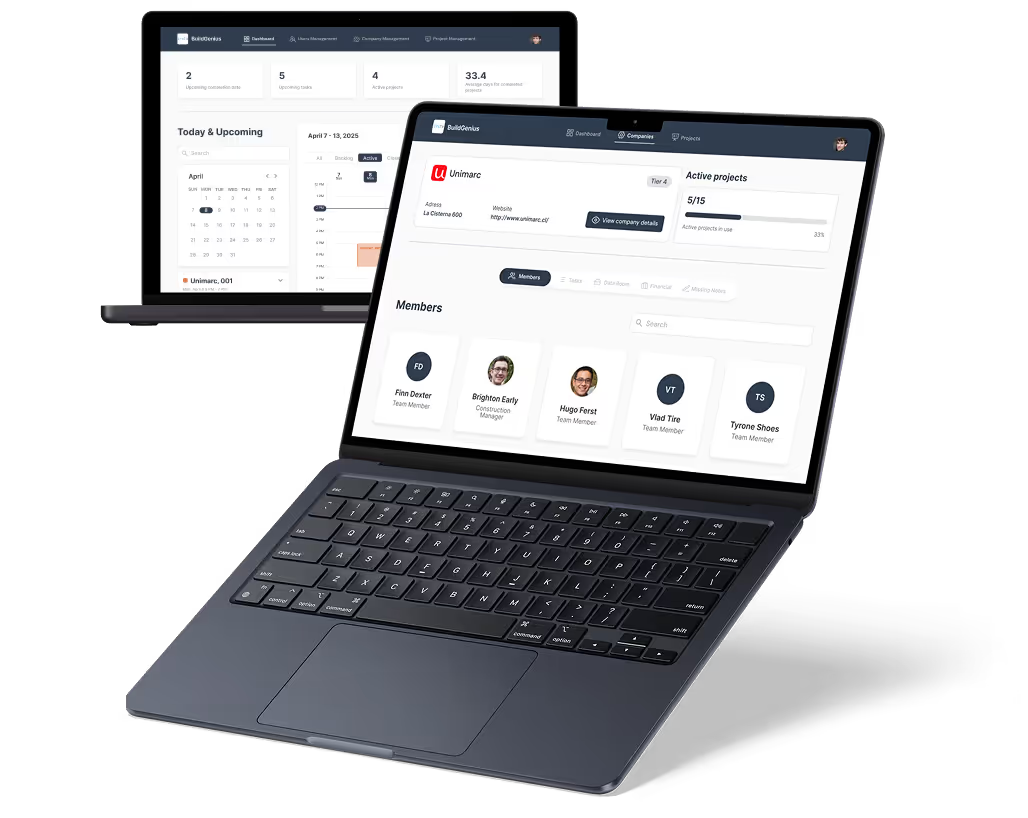
Before scoping features, grounding yourself in B2B marketplace development fundamentals will save significant rework. Healthcare staffing platforms share the same structural dynamics as other institutional marketplaces.
Healthcare staffing is a B2B platform category. This distinction changes almost everything about how you design it.
- Institutional buyers: Hospitals, clinics, and care homes are the demand side. Individual or agency-supplied clinical workers are the supply side. This is not a consumer marketplace.
- Two supply-side models: Direct worker onboarding, where the platform recruits and vets staff directly, versus agency aggregation, where the platform lists pre-vetted agency staff with their own vetting standards.
- B2B dynamics: Longer sales cycles, enterprise contracts, volume-based pricing, and procurement sign-off requirements do not exist in consumer service marketplaces. Design for them from the start.
- Niche specialization options: Travel nursing, per diem shifts, allied health professionals, locum tenens physicians, and non-clinical administrative roles each require different vetting and matching logic.
Healthcare staffing platforms that try to serve all specialties immediately spread their vetting capacity too thin. Launch in one specialty with airtight credentials before expanding.
What Legal and Compliance Requirements Apply?
The marketplace legal requirements for healthcare platforms go well beyond standard terms of service. They are operationally embedded in how the platform functions.
Compliance in healthcare staffing is not a layer added after the platform is built. It is the framework that determines the platform's architecture.
- HIPAA compliance: Any platform handling patient-adjacent data, worker health records, or facility information must meet HIPAA standards for data storage, access controls, audit logging, and third-party vendor agreements.
- State licensing verification: Nurses, physicians, and allied health professionals hold state-specific licenses. The platform must verify license status in real time against state board databases, not just at onboarding.
- Background check requirements: Criminal background checks, OIG exclusion list screening, and sex offender registry checks are legally required in most jurisdictions before a worker can be placed in a healthcare facility.
- Employment classification compliance: Correctly classifying workers as employees versus independent contractors has significant tax and liability implications. Get legal counsel before launching.
- Facility credentialing standards: Joint Commission and CMS standards often dictate what credentials a facility can accept from temporary staff. Your vetting logic must align with these standards.
State licensing rules mean your dispatch logic must automatically restrict placements to geographies where a worker holds an active license. This is a matching engine requirement, not an admin process.
What Features Does a Healthcare Staffing Marketplace Need?
Beyond the core marketplace features every two-sided platform needs, healthcare staffing adds a layer of functionality that is operationally mandatory rather than optional.
The feature set for a healthcare staffing platform is determined by the compliance and operational requirements of the clinical environment, not by standard marketplace conventions.
- Shift posting and real-time matching: Facilities post open shifts with required credentials, experience, and specialty. The platform matches and surfaces qualified, available workers instantly.
- Credential management and document vault: Workers upload licenses, certifications, immunisation records, and background check results. The platform validates and tracks expiry dates automatically.
- In-app scheduling and calendar sync: Workers manage availability; facilities see confirmed bookings; both sides receive automated reminders and shift change notifications.
- Secure messaging: Direct facility-to-worker communication must be encrypted and auditable. Generic chat solutions that do not meet healthcare data standards are not acceptable.
- Timekeeping and verification: Shift start and end confirmation, digital timesheets, and manager sign-off workflows integrated with payroll output.
- Ratings and performance tracking: Post-shift facility feedback on worker performance and worker feedback on facility conditions. Both sides benefit from transparent quality signals.
An automatic expiry notification system for credentials is a compliance requirement, not a convenience feature. Workers placed with an expired license create direct legal liability for the platform.
How Do You Manage and Vet Healthcare Staff Suppliers?
The principles of vendor management in marketplaces apply here, but healthcare staffing adds compliance obligations that require automation rather than manual oversight.
Manual credentialing is the bottleneck that kills healthcare staffing platform growth. Building or integrating automated verification tools is not optional at scale.
- Pre-onboarding vetting workflow: License verification, background check, reference check, skills assessment, document upload, and profile approval. Each step must be tracked and timestamped.
- Continuous monitoring requirements: Licenses expire, OIG exclusions update, and criminal records change. The platform must run automated re-verification at defined intervals, not just at signup.
- Agency versus direct worker management: If aggregating agency staff, the platform needs agency-level contracts, insurance verification, and agency compliance monitoring on top of individual worker checks.
- Credentialing workflow automation: Integrate automated verification tools such as Nursys for nursing licenses and CAQH for physician credentialing. Manual credentialing does not scale.
- Suspension and removal protocols: Define and automate the conditions under which a worker profile is suspended. Expired license, failed background re-check, and facility complaints should all trigger automated suspension.
What Security Standards Must Your Platform Meet?
Getting marketplace security and compliance right is not a post-launch task for healthcare staffing platforms. Regulators and enterprise facility buyers will require evidence of your security posture before signing contracts.
Healthcare staffing platforms handle sensitive worker records and facility data. Security architecture must be designed before any data enters the system.
- Data encryption requirements: All stored data must be encrypted at rest with AES-256 and in transit with TLS 1.2 or higher. These are minimum standards, not aspirational targets.
- Access controls and role-based permissions: Facility administrators, workers, and platform administrators must have strictly separate access levels. A worker should never see another worker's personal or credential data.
- Audit logging: Every access, modification, or export of sensitive data must be logged with a timestamp, user ID, and action. This is required for HIPAA compliance and essential for incident response.
- Business Associate Agreements: Every third-party vendor with access to health-adjacent data must sign a BAA before being integrated into the platform. No exceptions.
- Penetration testing and security review cadence: Healthcare platforms should conduct annual penetration testing at minimum. Platforms above a defined transaction volume should test quarterly.
Enterprise facility buyers will ask for your security documentation before signing a platform contract. Build the security posture before you start enterprise sales conversations.
How Do You Monetize a Healthcare Staffing Marketplace?
Revenue model design for a healthcare staffing platform must account for institutional buyers with procurement processes and the higher-value transactions that clinical placements generate.
The most successful healthcare staffing platforms combine a placement fee model with subscription access for high-volume facility clients, creating both variable and recurring revenue streams.
- Placement fee model: Charge 15 to 30 percent of the worker's shift rate or total placement value. Simpler to implement but produces variable revenue tied to shift volume.
- Subscription model for facilities: Monthly or annual access fee for unlimited shift postings and priority matching. Produces predictable recurring revenue and higher lifetime value per enterprise account.
- Tiered feature access: Basic shift posting at low or no cost; premium features such as priority matching, dedicated account management, and advanced analytics at higher tiers.
- Payroll and compliance services as add-ons: Handling worker payroll, tax administration, and compliance reporting as a premium service layer produces significantly higher margin and retention than platform access alone.
- Volume-based pricing for agencies: Agencies placing high worker volumes can negotiate custom rates, incentivizing agency adoption and locking in supply-side volume.
What Does the Build Process Look Like Step by Step?
A healthcare staffing marketplace is a 4 to 6 month build to minimum viable launch. Any timeline shorter than this means the compliance and credential verification infrastructure has been deprioritized, which creates legal risk at launch.
Each phase below has a dependency on the previous phase. Skipping or underfunding any phase creates compounding problems that are expensive to fix post-launch.
Phase 1: Market and Compliance Scoping (Weeks 1 to 3)
Define target specialties and geographies. Map all applicable licensing, credentialing, and data compliance requirements for those regions. Engage healthcare compliance counsel before writing a line of code. The compliance map determines your feature list, your data architecture, and your launch timeline.
Phase 2: Core Platform Architecture (Weeks 4 to 10)
Build the dual-profile system for facilities and workers. Build shift posting and matching engine, credential document vault, and scheduling infrastructure. Implement HIPAA-aligned data architecture from the start. Retrofitting compliant data architecture into a non-compliant build doubles the work.
Phase 3: Vetting and Verification Workflows (Weeks 8 to 14)
Integrate license verification APIs, background check providers, and document review workflows. Build the automated re-verification and expiry notification system. Skipping this phase means the platform cannot legally place workers in clinical environments.
Phase 4: Payments and Compliance Infrastructure (Weeks 12 to 18)
Implement payment processing with split payment capability, timesheet approval workflows, and payroll output integrations. Add audit logging across all sensitive data operations. This phase is the difference between a platform that can pass a compliance review and one that cannot.
Phase 5: Pilot Launch and Supply-Side Seeding (Weeks 16 to 24)
Launch with a limited geography or specialty. Onboard anchor facility clients before marketing to workers. Supply follows demand in healthcare staffing, not the other way around.
Conclusion
Before scoping the technology build, map every licensing and credentialing requirement for your target specialty and geography. That compliance map determines your feature list, your data architecture, and your launch timeline more than any other input.
The platforms that succeed launch narrow, with one specialty and one geography, and airtight vetting workflows. They expand only after the compliance and operational infrastructure is proven in a live environment.
Building a Healthcare Staffing Marketplace? Get the Compliance Architecture Right First.
Most healthcare staffing platform projects underestimate the credential verification and security infrastructure required before any shift can be filled. Getting this wrong is not just an operational problem. It creates legal liability for the platform and the facilities that rely on it.
We are LOW/CODE Agency — an AI product development company for SMBs. We build across the full stack: web apps, mobile apps, AI chatbots, RAG pipelines, and autonomous agents. Custom software, built by experts. We scope regulated marketplace builds by mapping compliance requirements first, selecting the right infrastructure, and building the credential management and data security layers before any client-facing feature work begins.
- Compliance architecture scoping: We map licensing, credentialing, and data regulation requirements for your target specialty and geography before any build begins.
- Credential management build: We build the verification workflows, document vault, and automated re-verification systems that healthcare staffing platforms require at a regulatory level.
- HIPAA-aligned data infrastructure: We configure and document compliant cloud infrastructure and execute the Business Associate Agreements required before any health data is processed.
- Shift matching engine: We build the real-time shift posting, geo-restricted matching, and worker availability systems that are the operational core of a staffing platform.
- Payment and payroll integration: We implement split payment capability, timesheet approval workflows, and payroll output integrations that handle the complexity of clinical worker compensation.
- Audit logging and security review: We build audit logging across all sensitive data operations and conduct security review before any patient-adjacent data enters the system.
- Full product team: Strategy, design, development, and QA from a single team invested in your outcome, not just the delivery milestone.
We have built 350+ products for clients including Coca-Cola, American Express, and Sotheby's. We understand what regulated marketplace builds require before the first user logs in.
Related Articles
- How to Build a Home Painting Marketplace
- How to Build a Home Diagnostics Marketplace
- How to Build a Home Chef Marketplace
- How to Build a Healthcare Services Marketplace
- How to Build a Handmade Fashion Marketplace That Makers Choose
- How to Build a Hair Stylist Marketplace
Partner with our mobile app development experts to launch your product faster.
Last updated on
September 28, 2026
.

Jesus is a visionary entrepreneur and tech expert. After nearly a decade working in web development, he founded LOW/CODE Agency to help businesses optimize their operations through custom software solutions.


FAQs
What are the essential features of a healthcare staffing marketplace?
How do I ensure compliance with healthcare regulations in the marketplace?
What technology stack is best for building a healthcare staffing platform?
How can I attract healthcare professionals to my staffing marketplace?
What are common challenges when launching a healthcare staffing marketplace?
How do I monetize a healthcare staffing marketplace effectively?
Related Articles

Marketplace
Effective Search & Filtering Design for Marketplace Apps
Learn key strategies for building search and filtering systems in marketplace apps to improve user experience and boost conversions.
Marketplace
How to Build a Web Developer Marketplace
Learn key steps to create a successful web developer marketplace with practical tips and common challenges to avoid.

Marketplace
Marketplace App Development Cost Explained
Discover key factors affecting marketplace app development cost and get answers to common budgeting questions.
Marketplace
How to Build a Streetwear Marketplace That Sells
Learn key steps to create a streetwear marketplace that attracts buyers and sellers effectively.

Why customers trust us for no-code development


