

How to Build a Logistics App with FlutterFlow
13 min
read
Learn how to create a logistics app using FlutterFlow with easy steps, key features, and common challenges explained for beginners.


FlutterFlow logistics app development gives operators a faster, cheaper path to driver management, delivery confirmation, and live shipment tracking than custom development allows. Logistics operations run on real-time visibility, and the companies that get there first gain a measurable operational advantage.
This article covers what FlutterFlow can build for a logistics app, realistic timelines, honest cost numbers, the limitations to plan for, and how to find a team with the right experience.
Key Takeaways
- Core logistics features are achievable: Shipment tracking, driver management, delivery confirmation, and customer notifications are all buildable in FlutterFlow.
- GPS and mapping require third-party integration: Google Maps, Mapbox, or HERE Maps integrate with FlutterFlow via plugin or custom widget for live location tracking.
- Cross-platform by design: FlutterFlow compiles to both iOS and Android, ideal for driver apps where device types vary across a fleet.
- MVPs launch in 8–14 weeks: A shipment tracking and delivery confirmation app can be production-ready in that window.
- Offline capability is limited: Field operations in low-connectivity areas require specific architecture decisions to avoid data loss.

What Can FlutterFlow Build for a Logistics App?
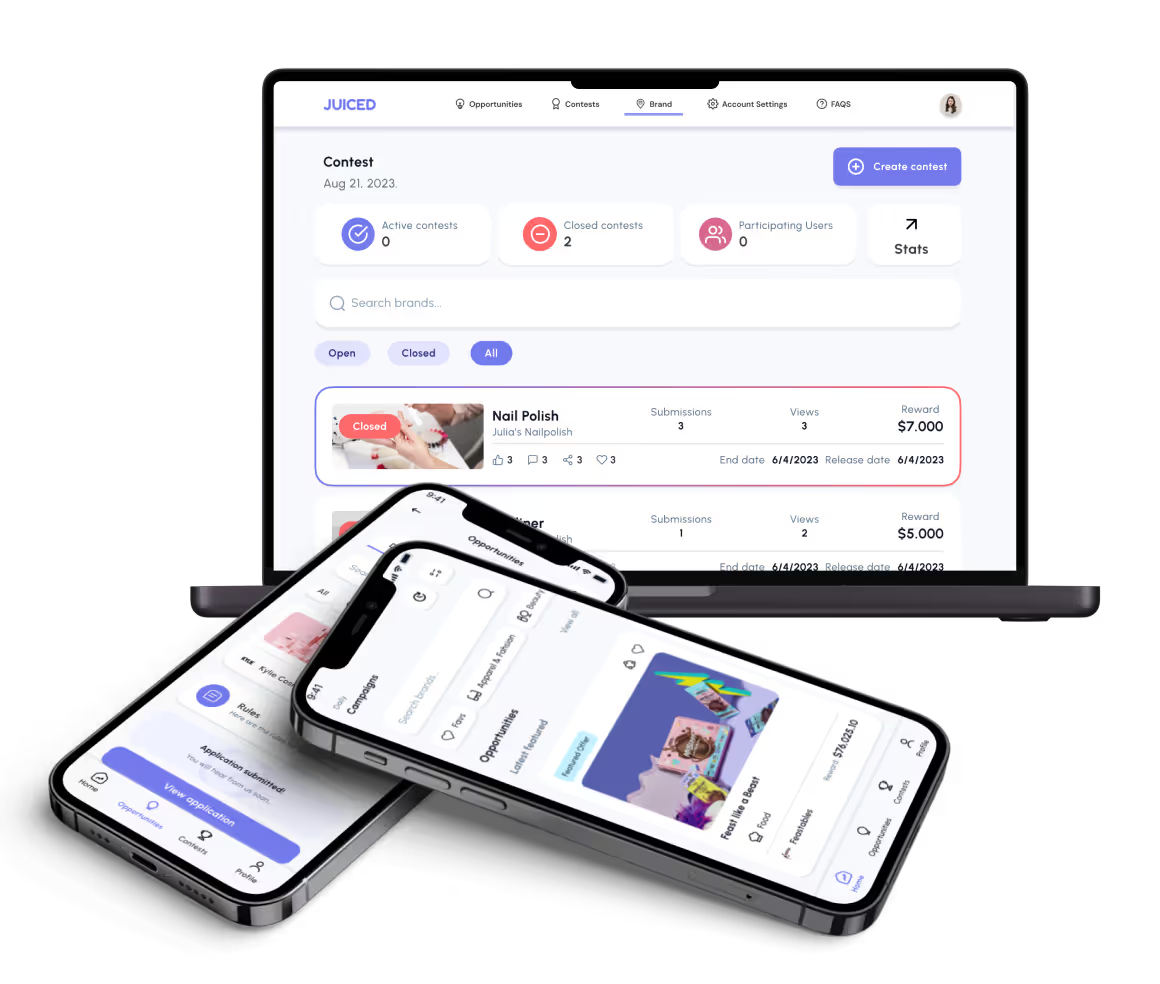
FlutterFlow can build shipment tracking with live map views, driver job management, proof of delivery capture, customer status notifications, route display, a customer self-service tracking portal, and a delivery analytics dashboard.
As your fleet and shipment volume grows, understanding FlutterFlow scalability for logistics will inform how you architect the real-time tracking backend before you hit performance limits.
Shipment Tracking with Live Map View
- Live driver location on map: Google Maps integration renders driver positions updated in Firestore, with the customer tracking screen reflecting current location in near real-time.
- Status-linked map view: The map displays active deliveries with status indicators so dispatchers can see which jobs are in transit, delayed, or completed at a glance.
- Customer-facing tracking link: A unique tracking URL or in-app screen shows customers their delivery's current position without requiring full app registration.
Live map tracking and status-update tracking are two different technical implementations. Live GPS requires continuous location writes; status tracking uses discrete event updates.
Driver Assignment and Job Management
- Dispatcher job assignment: A dispatcher dashboard assigns jobs to drivers with route details, delivery address, and priority level attached to each work order.
- Driver job queue: Drivers receive new job notifications via Firebase Cloud Messaging and view their full job queue in the FlutterFlow mobile app.
- Job status updates: Drivers update job status as they progress through pickups and deliveries, with each update timestamped and visible to dispatchers instantly.
The dispatcher dashboard is the operational control centre. It should be designed as a web-first interface while the driver-facing app runs on mobile.
Proof of Delivery (POD) Capture
- Photo capture at delivery: Drivers photograph the delivered item or drop location using the device camera, with the image written directly to Firestore and linked to the job record.
- Digital signature capture: Customer signatures are captured on the driver's device at handoff, stored as a timestamped record against the delivery.
- GPS and timestamp stamp: Each POD record includes the GPS coordinates and timestamp of the capture, creating an auditable delivery confirmation.
POD capture is a high-value feature for logistics operators. It reduces disputes, supports insurance claims, and creates an auditable record of every delivery.
Delivery Status Updates and Customer Notifications
- Status transition triggers: Each status change (picked up, in transit, out for delivery, delivered) fires a push notification to the customer via Firebase Cloud Messaging.
- Estimated arrival display: A time-based or traffic-informed arrival estimate shows on the customer tracking screen and updates as the driver progresses.
- Notification preference management: Customers opt into SMS, push, or email notifications based on their preference, with FlutterFlow managing the channel routing.
Customer notifications are a key differentiator for last-mile delivery operators. Proactive communication reduces inbound customer service calls significantly.
Route Display and Turn-by-Turn Navigation Launch
- Planned route on map: FlutterFlow displays the planned delivery route as an overlay on the Google Maps view, giving drivers visual confirmation of their sequence.
- Native navigation launch: The driver app launches Google Maps or Waze with pre-filled destination coordinates for turn-by-turn navigation, without building a navigation engine inside FlutterFlow.
- Multi-stop route display: Multi-stop routes with ordered delivery sequences display on the driver's map view, with each stop marked and the current active stop highlighted.
Turn-by-turn navigation is handled by the device's native mapping app. FlutterFlow passes the destination; the navigation app does the routing work.
Customer Self-Service Tracking Portal
- Link-based access: Customers access their tracking screen via a unique link sent at dispatch, with no app download or account creation required.
- Delivery history view: Registered customers view their full delivery history, POD records, and status timelines from a self-service account screen.
- Failed delivery management: Customers rebook failed deliveries or update delivery instructions through the self-service portal, reducing dispatcher intervention.
A self-service customer portal reduces support volume meaningfully. Most delivery-related customer service contacts are resolved by giving the customer accurate, real-time status visibility.
Reports and Delivery Analytics Dashboard
- Delivery performance metrics: A web-facing dashboard displays completion rates, average delivery times, and failed delivery reasons pulled from Firestore.
- Driver performance reports: Individual driver metrics show on-time rates, average delivery duration, and POD capture compliance per driver per period.
- Route efficiency analysis: Delivery data by zone and route identifies patterns for dispatcher scheduling and route optimization decisions.
Analytics dashboards in FlutterFlow are built as web-first views. Firestore aggregation queries feed the charts; complex analytics beyond standard aggregates require a dedicated reporting backend.
How Long Does FlutterFlow Logistics App Development Take?
A simple logistics MVP covering job assignment, delivery confirmation, and basic tracking ships in 8–12 weeks. A full-featured logistics app with live GPS tracking, POD capture, a customer portal, and analytics takes 14–20 weeks.
The phased approach is the most reliable path: launch with driver job management and POD capture first, then add live customer tracking, route optimization, and analytics in phase two.
- Simple MVP timeline: Job assignment, delivery status updates, POD capture, and customer notifications are achievable in 8–12 weeks with an experienced team.
- Full platform timeline: Adding live GPS tracking, customer self-service portal, multi-depot logic, and analytics dashboard extends to 14–20 weeks.
- GPS tracking architecture adds time: Building continuous background location tracking with battery optimization and Firestore write rate management is the most technically complex component.
- TMS integration extends scope: Integration with existing transport management systems adds 2–6 weeks depending on API availability and data mapping complexity.
- Multi-depot and multi-region logic: Routing job assignments to the correct depot based on geography adds conditional business logic that increases build time.
- FlutterFlow speed advantage: Pre-built UI components, Firebase integration, and the visual workflow builder reduce build time by 40–60% compared to custom development.
Planning the cross-platform logistics app build correctly means your driver app runs on iOS and Android without maintaining two separate codebases.
What Does FlutterFlow Logistics App Development Cost?
Beyond the FlutterFlow plan pricing breakdown, Google Maps API costs can become a significant operational expense for logistics apps with high tracking volumes.
Developer costs for a full logistics build run $20,000–$65,000. Agency builds for full-featured logistics platforms run $25,000–$85,000. The platform subscription is the smallest cost item.
- Google Maps API overages are a real risk: High-volume tracking apps with frequent location refreshes accumulate Google Maps API charges quickly. Set billing alerts before launch.
- TMS integration middleware adds cost: Connecting to an existing transport management system requires API mapping and middleware development outside the core FlutterFlow build.
- Background GPS cost consideration: Continuous background location tracking generates ongoing Firestore write costs that scale directly with fleet size and update frequency.
- Custom development comparison: An equivalent logistics app built with Flutter code typically costs $100,000–$250,000, making FlutterFlow a strong cost argument for SME operators.
For SME logistics operators and last-mile delivery startups, FlutterFlow delivers the core features at a fraction of the cost and timeline of custom development.
How Does FlutterFlow Compare to Custom Development for Logistics Apps?
FlutterFlow delivers a logistics app in 8–20 weeks at $20,000–$85,000. Custom Flutter or React Native development takes 9–18 months at $100,000–$300,000+. FlutterFlow wins for most SME and startup logistics builds.
The capability gap with custom development is narrow for most logistics use cases. It only becomes material for enterprise TMS replacements or high-volume freight platforms requiring advanced routing algorithms.
- FlutterFlow wins for: SME logistics operators, last-mile delivery startups, and field service businesses digitising paper-based workflows.
- Custom wins for: Enterprise TMS replacements, high-volume freight platforms with complex routing algorithms, or operators requiring deep ERP system integration.
- Maintenance advantage: FlutterFlow makes status flows, notification logic, and dispatcher interface updates manageable without a full development engagement.
A clear-eyed review of FlutterFlow strengths and trade-offs will help your operations team assess whether the platform's capability ceiling matches your logistics complexity.
What Are the Limitations of FlutterFlow for Logistics Apps?
FlutterFlow's built-in location actions are not designed for continuous background tracking. Background GPS for logistics apps requires custom Dart code with battery optimization, and should be planned for from the start rather than treated as a standard feature.
Understanding the specific limitations for logistics use cases prevents expensive rework after the first version ships.
- Offline mode for drivers is limited: FlutterFlow apps require active connectivity for most real-time operations. Offline-first architecture for rural routes or warehouse environments requires significant custom Dart code.
- Background GPS tracking needs custom code: Continuous location updates when the app is minimized require custom Flutter code and battery optimization that the visual builder cannot configure natively.
- Complex routing logic hits visual builder limits: Multi-stop resequencing, dynamic routing, and load optimization require custom code actions beyond what the visual environment handles.
- High-frequency Firestore writes at scale: Large driver fleets with frequent location updates require Firestore write rate planning and potentially a dedicated real-time backend to avoid performance degradation.
- TMS deep integration limits: Advanced transport management system write-back and bidirectional data sync require custom code actions and often middleware beyond standard FlutterFlow API calls.
- Code export as an escape valve: FlutterFlow's code export lets developers extend the app with custom Dart code when specific logistics requirements exceed the visual builder's capability.
These limitations are manageable with the right architecture from day one. They become expensive problems only when discovered mid-build or after launch.
How Do You Hire the Right Team for FlutterFlow Logistics App Development?
Knowing how to hire FlutterFlow developers fast with logistics-specific experience will determine whether the GPS and mapping integrations are built correctly the first time.
Logistics apps are among the more technically demanding FlutterFlow builds. The GPS tracking, POD capture, and dispatcher interface requirements eliminate developers who have only built standard CRUD apps.
- Logistics domain knowledge required: Look for developers who understand the difference between status-update tracking and live GPS tracking, and who ask about connectivity requirements upfront.
- Google Maps integration experience: Ask to see a FlutterFlow app with a live map and real-time data updates in their portfolio. This is a non-negotiable demonstration of capability.
- Freelancer vs agency: Freelancers at $50–$100/hour suit smaller scopes with defined feature sets; agencies provide project management, system integration experience, and post-launch support.
- Red flag, no location-based portfolio: A developer who cannot show a map-based or GPS-integrated FlutterFlow app should not be building your logistics platform.
- Ask for a live GPS build: The question "Show me a FlutterFlow app you built with real-time GPS tracking or map-based job management" is the fastest filter for relevant experience.
- Scoping call to proposal in one week: A good agency produces a scoping call, written proposal, and phased build plan within one week. Longer timelines suggest capacity or experience issues.
Expect a discovery phase covering connectivity requirements, driver device types, TMS integration needs, and reporting requirements before a build estimate is produced.
Conclusion
FlutterFlow is a strong fit for logistics app development at the SME and startup level. Driver management, delivery confirmation, and customer tracking are deliverable at a fraction of custom development cost.
The primary constraints appear in offline capability and advanced route optimization. Define your connectivity requirements (urban last-mile vs rural long-haul), identify your TMS integration needs, and engage a FlutterFlow team with a verifiable logistics or field service portfolio before committing to a build.
Building a Logistics App with FlutterFlow? Here Is How LOW/CODE Agency Approaches It.
Most logistics app builds underestimate background GPS complexity, Firestore write rate planning, and TMS integration scope. These are not edge cases. They are the features that determine whether the app works in production.
At LOW/CODE Agency, we help SMBs compete with AI-powered software built for them — custom web and mobile apps, RAG systems, chatbots, and intelligent agents delivered by a senior development team. We build FlutterFlow logistics apps for operators who need driver management, live tracking, and delivery confirmation working reliably before the first shipment goes out.
- Discovery and operations mapping: We document your fleet structure, job types, connectivity requirements, and TMS integration needs before scoping a single feature.
- GPS and mapping architecture: We design the live tracking architecture for your fleet size and update frequency, with Firestore write rate and battery optimization planned from the start.
- Proof of delivery build: We build photo capture, signature collection, and GPS timestamping into the driver app with all POD data immediately available to dispatchers.
- Dispatcher dashboard design: We build the web-first dispatcher interface with job assignment, real-time status views, and driver performance data in the same deployment.
- Customer notification system: We configure status-triggered push, SMS, and email notifications so customers receive proactive updates without contacting your support team.
- TMS integration scoping: We assess your existing transport management system's API capability and design the integration layer before any build begins.
- Full product team: Strategy, UX, development, and QA from a single team that understands logistics operations, not just FlutterFlow.
We have built 350+ products for clients including Coca-Cola, American Express, and Sotheby's. We know what makes logistics apps fail in production and we build to prevent those failure modes.
Related Articles
Last updated on
September 24, 2026
.

Jesus is a visionary entrepreneur and tech expert. After nearly a decade working in web development, he founded LOW/CODE Agency to help businesses optimize their operations through custom software solutions.


FAQs
What are the first steps to create a logistics app in FlutterFlow?
Can FlutterFlow handle real-time tracking for logistics apps?
How do I manage user authentication in a FlutterFlow logistics app?
Is FlutterFlow suitable for complex logistics app features like route optimization?
What are common challenges when building logistics apps with FlutterFlow?
How can I test and deploy my FlutterFlow logistics app effectively?
Related Articles

FlutterFlow
How to Build Manufacturing Apps with FlutterFlow
Learn how to create efficient manufacturing apps using FlutterFlow with step-by-step guidance and best practices.
FlutterFlow
How to Build an Invoice Generator App with FlutterFlow
Learn how to create an invoice generator app using FlutterFlow with step-by-step guidance and tips for beginners.

FlutterFlow
How to Build a Housing Management Platform with FlutterFlow
Learn how to create a housing management platform using FlutterFlow with step-by-step guidance and best practices.

FlutterFlow
How to Build a Fleet Management App with FlutterFlow
Learn how to create a fleet management app using FlutterFlow with step-by-step guidance and key features to include.


Why customers trust us for no-code development


