

How to Build a Factory Operations Dashboard with FlutterFlow
13 min
read
Learn how to create a factory operations dashboard using FlutterFlow with step-by-step guidance and best practices.


Factory floors drown in data but starve for visibility. A FlutterFlow factory operations dashboard changes that by aggregating production KPIs, downtime events, and shift data into a real-time display accessible on tablets, browsers, and mobile devices from a single codebase.
Shift supervisors should not be printing reports that are outdated before the ink dries. This guide covers what FlutterFlow can build for factory operations, what it costs, how long it takes, and where the platform reaches its limits for manufacturing environments.
Key Takeaways
- Dashboard scope: A FlutterFlow factory operations dashboard can display production KPIs, downtime events, OEE scores, and shift summaries from a connected database in real time.
- Data source dependency: FlutterFlow reads from Firebase, Supabase, or REST APIs. Raw PLC and SCADA data must be processed upstream before it arrives.
- Platform support: Runs on wall-mounted tablets, supervisor workstations via browser, and mobile devices from a single FlutterFlow project.
- Cost to build: Expect $15,000–$50,000 for a full multi-panel factory dashboard with role-based views.
- Realistic use case: Best suited to near-real-time KPI display and manual data entry workflows, not millisecond machine telemetry.

What Can FlutterFlow Build for a Factory Operations Dashboard?
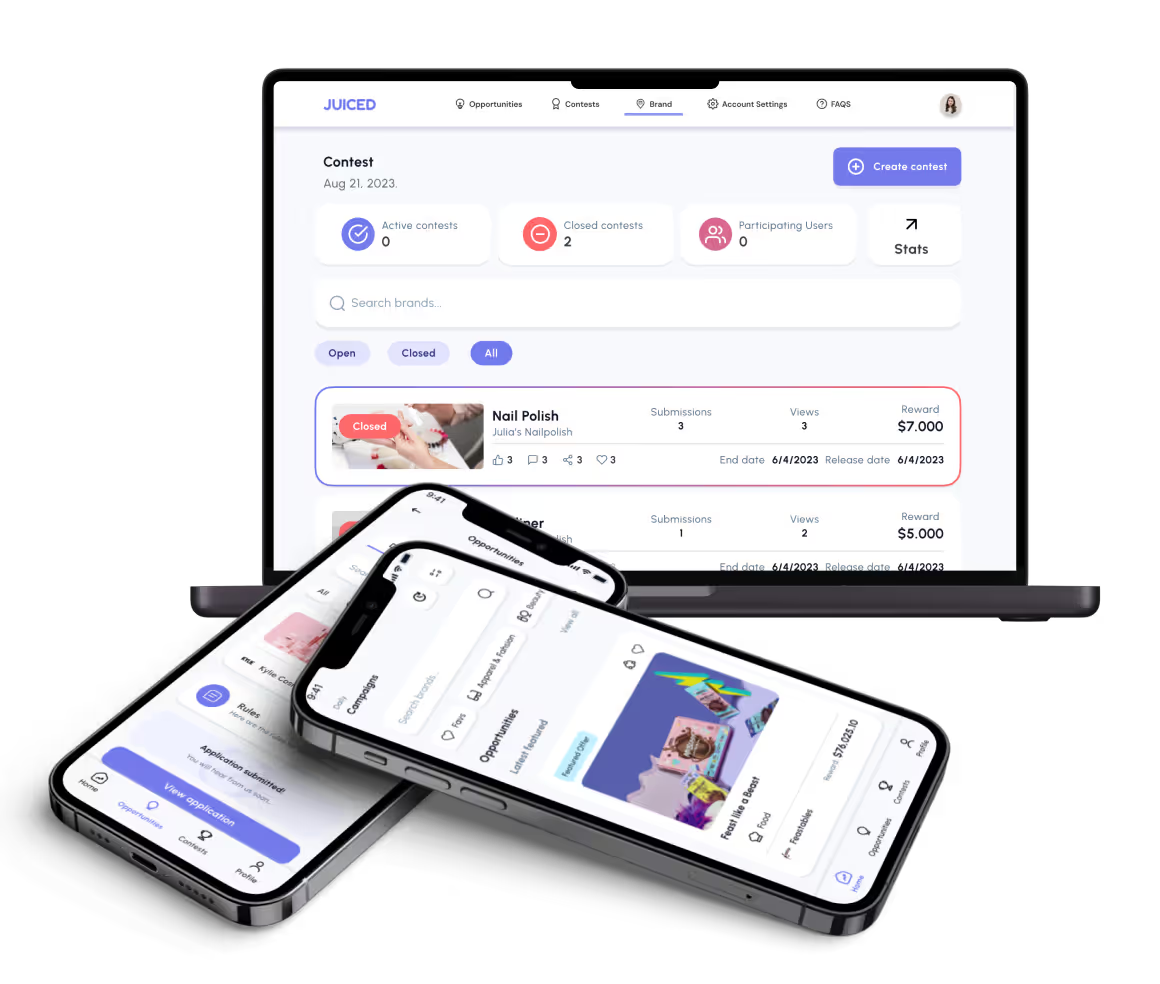
FlutterFlow can build a factory operations dashboard covering real-time KPI panels, shift performance charts, downtime event feeds, multi-line status overviews, role-based views, drill-down detail screens, and alert banners. Raw PLC or SCADA data requires upstream normalisation before FlutterFlow can display it, and true millisecond telemetry requires a custom WebSocket layer.
Most factory dashboards need to run on both wall-mounted tablets and supervisor browsers. Tablet and browser dashboard builds from a single FlutterFlow project make that possible without duplicate development effort.
Real-Time Production KPI Panels
Display units produced, target versus actual output, and OEE scores updated from a live database on configurable refresh intervals.
- KPI card display: Production metrics are shown as cards with current value, target, and variance, updated by a Firestore listener or polling interval.
- OEE score display: Overall Equipment Effectiveness scores can be shown as pre-calculated values written to Firestore by a server-side function.
- Configurable refresh rate: Near-real-time display with 5–30 second refresh intervals is achievable without custom WebSocket infrastructure.
Shift-by-Shift Performance Charts
Render bar and line charts comparing shift performance over days and weeks using FlutterFlow's native chart widgets.
- Bar chart shift comparison: FlutterFlow's native bar chart widget renders shift production comparisons with colour coding by performance threshold.
- Line chart trend display: Multi-day production trends are displayed as line charts using Firestore time-series data pulled by query.
- Historical data access: Supervisors can scroll back through past shifts to review performance patterns without leaving the dashboard screen.
Downtime Event Feed
Show a live scrolling log of machine downtime events with machine ID, reason code, duration, and responsible technician.
- Live event log: Downtime events written to Firestore appear immediately in the feed via a real-time listener, without requiring a page refresh.
- Reason code categorisation: Each downtime event carries a reason code from a predefined list, making aggregation and trend analysis possible from the raw data.
- Technician assignment display: The responsible technician's name or ID is attached to each event, supporting accountability tracking across shifts.
Multi-Line Status Overview
Present a colour-coded grid of production lines with green, amber, and red status indicators drawn from a structured status table in the database.
- Status grid layout: Each production line has a card showing current status, active job, units produced this shift, and any active alerts.
- Colour threshold logic: Green, amber, and red indicators are driven by performance thresholds defined in Firestore configuration records, not hardcoded in the UI.
- At-a-glance operations view: The multi-line grid is typically the first screen supervisors see when arriving for a shift, designed for wall display at a glance.
Role-Based Views
Deliver different dashboard panels to operators, supervisors, and plant managers using FlutterFlow's conditional visibility logic tied to user role fields.
- Operator view: Operators see their specific machine's KPIs, active job details, and downtime reporting form without access to other lines or management data.
- Supervisor view: Supervisors see the full multi-line grid, downtime feed, shift comparison charts, and the ability to reassign technicians or update status flags.
- Plant manager view: Managers see aggregated OEE scores, cross-shift performance trends, and alert summaries without operational detail clutter.
Drill-Down Detail Screens
Allow supervisors to tap any KPI card to open a detail view with historical trend data and recent event logs for that specific machine or line.
- Tap-to-drill navigation: Tapping a KPI card navigates to a detail screen scoped to that machine, showing its trend data, maintenance history, and recent events.
- Historical trend charts: Detail screens display 7-day and 30-day trend charts for the selected metric, pulling from time-stamped Firestore records.
- Event log for the asset: All downtime events, maintenance actions, and quality failures linked to the selected machine are listed on the detail screen.
Alert Banner System
Surface active alerts covering quality failures, equipment faults, and safety incidents at the top of every dashboard screen so they are always visible.
- Persistent alert banner: Active alerts appear in a fixed banner at the top of every screen, dismissible only by authorised supervisors after acknowledgement.
- Alert categorisation: Quality, equipment, and safety alerts are colour-coded and categorised so supervisors can triage severity at a glance.
- Alert acknowledgement log: Every alert acknowledgement is written to Firestore with the acknowledging user and timestamp, creating an audit trail for compliance purposes.
How Long Does It Take to Build a Factory Operations Dashboard with FlutterFlow?
A simple dashboard MVP with 3–5 KPI panels and a single data source takes 3–5 weeks in FlutterFlow. A full factory dashboard with multi-line views, role-based access, drill-down screens, and alerting takes 10–16 weeks. FlutterFlow dashboard builds deploy in roughly half the time of a custom React or Flutter equivalent.
The phased approach works well for factory dashboards. Ship a single-line production KPI display first. Expand to multi-line status, alerting, and drill-downs in phase two.
- Data source complexity: Each additional data source requiring normalisation and API connection adds 1–2 weeks to the build estimate.
- Number of user roles: Each role requires its own view design and conditional visibility logic. Three roles adds more time than two.
- Custom chart requirements: Standard FlutterFlow chart widgets cover most factory use cases. Highly custom visualisations require third-party chart libraries and more build time.
The upstream data pipeline, converting PLC or SCADA output into a format FlutterFlow can consume, is often the longest part of a factory dashboard project and sits outside the FlutterFlow build itself.
What Does It Cost to Build a FlutterFlow Factory Operations Dashboard?
A simple FlutterFlow factory dashboard costs $10,000–$20,000 for a single-source KPI display. A full multi-role, multi-panel factory dashboard built by an agency runs $20,000–$60,000. Tableau or PowerBI embedded dashboard configurations for manufacturing cost $30,000–$100,000 to configure and licence.
FlutterFlow subscription pricing starts low, but a factory dashboard project budget must account for backend infrastructure and integration middleware alongside the platform fee.
- Upstream data normalisation: Converting PLC data into an API-friendly format is often a separate project cost not included in the FlutterFlow build estimate.
- Wall tablet device management: Deploying the dashboard on factory floor tablets requires a device management system and tablet hardware outside the app build budget.
- Chart library licensing: Custom chart libraries beyond FlutterFlow's native widgets may carry commercial licence fees for production deployments.
The comparison with Tableau and PowerBI is relevant for manufacturers evaluating enterprise BI tools. FlutterFlow builds a purpose-built factory dashboard at a fraction of enterprise BI licensing cost, with better mobile and tablet experience.
How Does FlutterFlow Compare to Custom Development or Enterprise Software for Factory Dashboards?
FlutterFlow delivers a factory operations dashboard in 6–16 weeks at 3–4x lower cost than a custom-built or BI-platform equivalent for most mid-market factories. Real-time sub-second machine telemetry and complex aggregations are better handled by dedicated BI tools. Near-real-time KPI dashboards, shift reporting, and operator status boards are FlutterFlow's strong suit.
The decision between FlutterFlow and enterprise BI software is largely a question of whether you need interactive business intelligence or a purpose-built operational display.
- When FlutterFlow wins: Near-real-time KPI dashboards, shift reporting tools, and operator-facing status boards where tablet and mobile access are requirements.
- When custom wins: Live SCADA visualisation with sub-second updates, high-frequency sensor analytics, and regulated process industries requiring certified software.
- When enterprise BI wins: Organisations with existing Tableau or PowerBI licences needing ad-hoc query capability alongside the operational dashboard view.
A review of FlutterFlow versus other builders confirms that FlutterFlow's mobile-first architecture gives it an edge over web-only tools for factory tablet deployments where operators need dashboard access on the floor.
What Are the Limitations of FlutterFlow for Factory Operations Dashboards?
FlutterFlow's key limitations for factory dashboards are real-time data latency, the PLC and SCADA data gap, complex server-side aggregations, and performance under hundreds of simultaneous connections. Each limitation is manageable with the right architecture upstream, but none can be resolved through FlutterFlow's visual editor alone.
Dashboard performance at scale is one of the first technical questions to resolve before committing to FlutterFlow for a multi-line factory environment with many concurrent dashboard connections.
- Real-time data latency: FlutterFlow relies on database listeners or polling intervals. True millisecond streaming requires a custom WebSocket layer that sits outside FlutterFlow's visual editor.
- PLC and SCADA data gap: Raw machine data cannot feed directly into FlutterFlow without an upstream processing and normalisation layer converting it to REST API or Firestore format.
- Complex aggregations server-side: OEE calculations involving multiple inputs and time windows are better computed server-side and surfaced as pre-calculated values, not calculated in the FlutterFlow UI.
- Visual logic complexity at scale: Highly conditional dashboard layouts with many roles and many screens become difficult to maintain cleanly in FlutterFlow's visual editor over time.
- Scale under concurrent connections: Hundreds of simultaneous dashboard connections can stress Firebase Realtime Database without proper indexing, caching, and connection management.
- Vendor dependency: Dashboard layout and data binding logic is coupled to FlutterFlow's platform. Code export reduces this risk but does not eliminate it entirely.
The PLC and SCADA data gap is the most important limitation for manufacturing buyers who assume direct machine connectivity is possible out of the box. It is not. Resolve the upstream data pipeline before designing the FlutterFlow build.
How Do You Get a FlutterFlow Factory Operations Dashboard Built?
For a FlutterFlow factory dashboard, you need a team with FlutterFlow data binding experience, Firebase or Supabase real-time listener expertise, REST API integration skills, and familiarity with upstream data pipeline design. Agencies handle multi-role, multi-source factory platforms better than freelancers for complex deployments.
Partnering with top FlutterFlow development agencies gives factory dashboard projects access to both technical depth and manufacturing domain experience that specialist freelancers rarely combine.
- Data binding experience: Verify the team has built dashboard apps with Firestore real-time listeners and understands the difference between polling and listener-based data updates.
- Pipeline design question: Ask how they approach upstream data normalisation for PLC or SCADA systems. If they have no answer, they have not built for manufacturing before.
- Multi-role dashboard portfolio: Request an example of a dashboard with role-based views. The distinction between operator, supervisor, and manager views is a specific design challenge.
- Red flags when hiring: No experience with real-time data binding, unfamiliarity with data pipeline design, and no questions about data source formats are all disqualifying signals.
- Timeline expectation: Agree on a wire-framed prototype showing live data within the first three weeks of the project. This confirms the data pipeline is connected before the full build begins.
A well-scoped factory dashboard project should deliver a working prototype with live data by week three and a full multi-role dashboard by week 10–16.
Conclusion
FlutterFlow is a practical choice for factory operations dashboards that display near-real-time KPIs, shift performance data, and production line status. The platform delivers these capabilities on tablets, browsers, and mobile at a fraction of the cost and timeline of a custom build or enterprise BI configuration.
It is not a replacement for SCADA or industrial BI platforms handling raw machine telemetry at millisecond intervals. Define your three most critical KPIs, confirm your data sources can expose an API or push to Firebase, and then scope a focused dashboard prototype before committing to a full build.
Building a Factory Operations Dashboard with FlutterFlow? Here Is How LOW/CODE Agency Approaches It.
Most factory dashboard projects run long for the same reason: the upstream data pipeline is more complex than expected, and no one scoped it properly before the FlutterFlow build began. Getting the data architecture right in week one is what keeps the rest of the project on schedule.
At LOW/CODE Agency, we help SMBs compete with AI-powered software built for them — custom web and mobile apps, RAG systems, chatbots, and intelligent agents delivered by a senior development team. We scope the data pipeline, real-time architecture, and role-based dashboard design before any FlutterFlow build begins, so you know exactly what you are getting and when.
- Data pipeline scoping: We audit your existing data sources, identify what normalisation is required, and design the upstream pipeline before the dashboard build starts.
- Real-time architecture design: We determine whether Firestore listeners, polling, or a custom WebSocket layer is the right approach for your specific refresh rate requirements.
- Multi-role dashboard design: We design separate views for operators, supervisors, and plant managers with conditional visibility driven by role-based data in Firestore.
- KPI panel and chart build: We build the production KPI panels, shift comparison charts, OEE displays, and downtime event feeds using FlutterFlow's native chart and data widgets.
- Alert banner and drill-down system: We implement the persistent alert system and tap-to-drill navigation so supervisors can move from overview to detail without leaving the dashboard.
- Post-launch iteration: We stay involved through the first production weeks to refine refresh intervals, chart displays, and role-based views as real operator feedback comes in.
- Full product team: Strategy, UX, development, and QA from a single team with manufacturing and operations software experience.
We have built 350+ products for clients including Coca-Cola, American Express, and Sotheby's. Factory operations dashboards are a known build pattern for our team, and we know where the data pipeline complexity surfaces before it delays your launch.
Related Articles
- How to Build a Financial Dashboard with FlutterFlow
- How to Build a Farmer Marketplace App with FlutterFlow
- How to Build a Farm Management App with FlutterFlow
- How to Build an Events Marketplace Platform with FlutterFlow
- How to Build an Event Ticketing App with FlutterFlow
- How to Build an Equipment Maintenance Scheduler with FlutterFlow
Last updated on
September 24, 2026
.

Jesus is a visionary entrepreneur and tech expert. After nearly a decade working in web development, he founded LOW/CODE Agency to help businesses optimize their operations through custom software solutions.


FAQs
What are the key features of a factory operations dashboard?
How does FlutterFlow simplify dashboard development?
Can I integrate real-time data sources into a FlutterFlow dashboard?
What are common challenges when building dashboards with FlutterFlow?
How do I ensure my dashboard is user-friendly for factory staff?
Is FlutterFlow suitable for large-scale factory operations dashboards?
Related Articles

FlutterFlow
How to Build a Creator Subscription Marketplace with FlutterFlow
Learn how to create a creator subscription marketplace using FlutterFlow with step-by-step guidance and best practices.
FlutterFlow
How to Build a Student Portal with FlutterFlow
Learn how to create a student portal using FlutterFlow with step-by-step guidance and tips for beginners and developers.

FlutterFlow
How to Build Manufacturing Apps with FlutterFlow
Learn how to create efficient manufacturing apps using FlutterFlow with step-by-step guidance and best practices.
FlutterFlow
How to Build a Menu Management System with FlutterFlow
Learn how to create a menu management system using FlutterFlow with step-by-step guidance and best practices for smooth app development.

Why customers trust us for no-code development


