

Hire a Mobile App Agency or Go Alternative?
22 min
read
Not sure if hiring a mobile app agency is the right move? Compare your options and find the best path for your project and budget.

You have a mobile app idea and budget. Now you need to decide who builds it. The choice between a mobile app agency, freelancers, or an in-house team shapes your cost, timeline, quality, and risk.
Deciding whether to hire a mobile app agency or choose an alternative depends on your project complexity, budget, timeline, and long-term plans. Each option carries trade-offs that affect your product for years after launch. This guide compares every path so you can pick the right one.
Key Takeaways
- Mobile app agencies provide the broadest capability set with designers, developers, project managers, and QA working as a coordinated team from day one.
- Freelancers cost less per hour but carry higher project risk because you manage coordination, quality, and continuity yourself.
- In-house teams make sense only at scale since hiring full-time mobile developers for a single app project is financially inefficient.
- Low-code platforms reduce the need for large teams by enabling faster development with smaller, more specialized groups.
- Right choice varies by project stage because early validation, initial build, and ongoing iteration each favor different team structures.
- Mid-project model switches are expensive so making the right call upfront saves more than the cost difference between options.

What Does a Mobile App Agency Actually Provide?
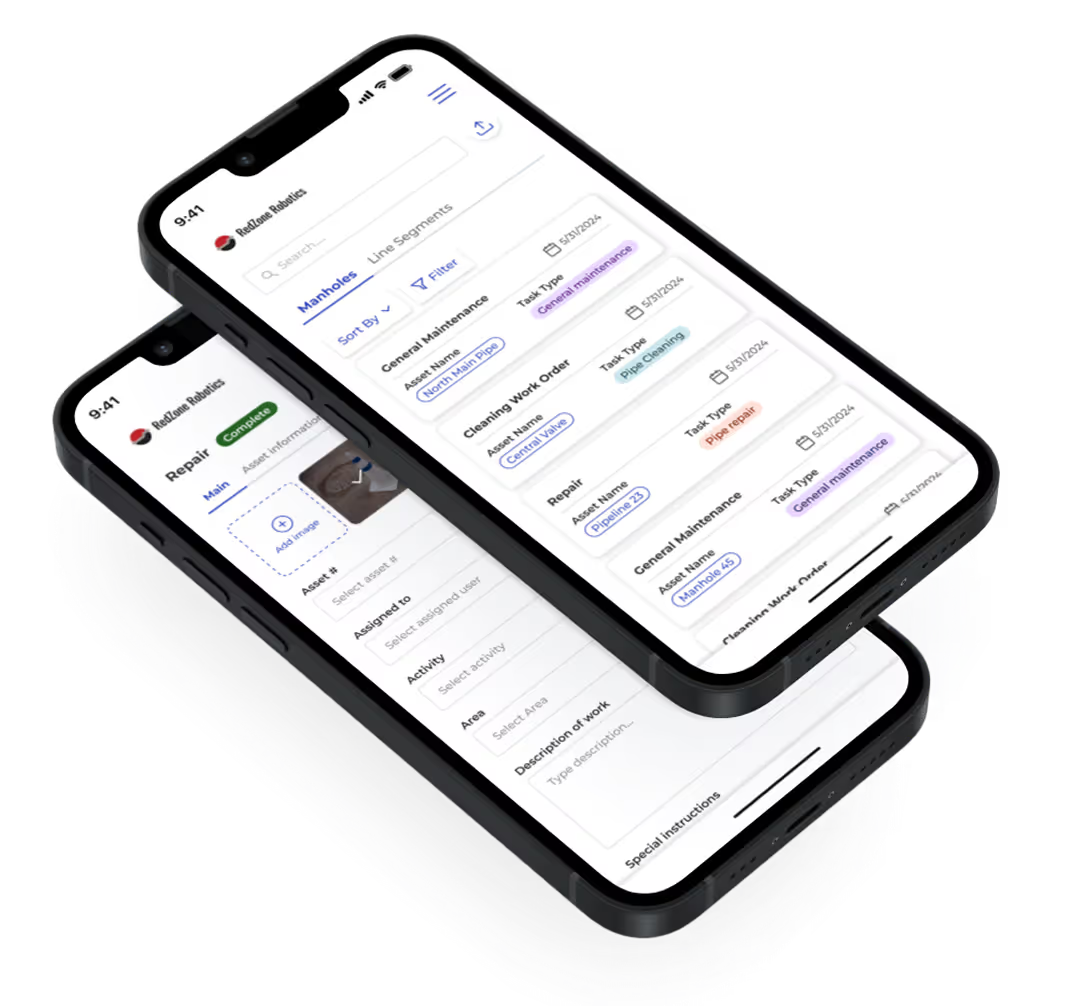
A mobile app agency provides end-to-end product development including strategy, design, development, QA testing, deployment, and post-launch support through a coordinated team that has built dozens or hundreds of similar products.
When you hire a mobile app agency, you are buying a system, not just developers. Agencies have refined their processes across hundreds of projects, which means they anticipate problems you have never encountered.
- Strategy and discovery define what to build with product managers who translate your business goals into technical requirements and user stories
- Design teams create user experiences with dedicated UI/UX professionals who understand platform guidelines and conversion optimization
- Development uses proven architecture patterns because agencies have built similar apps before and know which approaches scale and which do not
- QA testing catches bugs systematically through structured test plans, device labs, and automated testing that individual developers rarely maintain
- Project management keeps everything on track with dedicated coordinators handling timelines, communication, and risk throughout the engagement
- Post-launch support provides continuity through maintenance agreements that keep the team who built your app available for fixes and iteration
When you hire a mobile app agency, you trade a higher price tag for lower risk. The premium you pay covers the systems, processes, and collective experience that reduce the chance of project failure.
How Does Hiring a Mobile App Agency Compare to Freelancers?
A mobile app agency costs 2-3x more than freelancers per hour but delivers faster timelines, lower project risk, broader expertise, and built-in project management that freelancers require you to provide yourself.
The comparison between hiring a mobile app agency versus freelancers comes down to how much management overhead you are willing to absorb. Freelancers are cheaper individually but require you to be the project manager.
If you have strong technical leadership internally, freelancers can work well for defined, smaller projects. For complex apps where you need a team to own the outcome, the case to hire a mobile app agency is much stronger.
When Should You Build an In-House Mobile App Team?
Build an in-house team when your mobile app is your core product, you need continuous iteration beyond the initial build, and you can justify the cost of 3-5 full-time specialists including a designer, iOS and Android developers, and a QA engineer.
In-house mobile app development only makes financial sense when you have enough continuous work to keep a full team productive. Hiring developers for a single app project and then having them idle is the most expensive path available.
- Annual cost for a small mobile team starts at $400,000-$600,000 when you factor in salaries, benefits, tools, and overhead for experienced professionals
- Recruiting takes 2-4 months per position delaying your project start while you search for qualified mobile developers in a competitive market
- In-house teams build deep product knowledge that no external partner can match because they live with the codebase and user feedback daily
- Management overhead falls entirely on you including technical direction, code reviews, architecture decisions, and career development
- Team attrition creates critical knowledge gaps when a key developer leaves and takes their understanding of the codebase with them
For most companies, the decision to hire a mobile app agency makes more financial sense than building in-house until the app generates enough revenue to justify a permanent team.
Is No-Code or Low-Code an Alternative to Hiring a Mobile App Agency?
No-code and low-code platforms like FlutterFlow and Bubble can replace or supplement a mobile app agency for apps with straightforward functionality, reducing both and timeline by 40-60%.
The no-code versus custom development decision depends on your app's complexity. Many apps that used to require full custom development can now be built faster and cheaper with low-code platforms.
- Low-code platforms accelerate development by 3-5x for standard features like authentication, CRUD operations, and integrations
- Visual development tools reduce the team size needed because one developer on FlutterFlow can produce what previously required an iOS and Android developer
- Platform constraints limit highly custom features meaning animations, complex real-time interactions, and unusual UX patterns may still need custom code
- Maintenance is simpler on managed platforms because hosting, security patches, and infrastructure updates are handled by the platform provider
- Vendor lock-in is the primary risk since your app depends on the platform's continued operation and pricing stability
- Hybrid approaches combine low-code and custom code letting you build standard features quickly on the platform while using custom code for unique capabilities
Many founders hire a mobile app agency that specializes in low-code to get the speed benefits of the platform with the strategic guidance of experienced builders. The combination delivers faster, cheaper, and more reliably than either approach alone.
How Do You Evaluate a Mobile App Agency Before Hiring?
Evaluate a mobile app agency by reviewing their portfolio of similar projects, checking client references, understanding their development process, reviewing , and confirming their post-launch support offerings.
The difference between a great mobile app agency and a mediocre one is not their marketing. It is their process, their portfolio, and what their past clients say about working with them.
- Portfolio relevance matters more than portfolio size because building 100 simple websites tells you nothing about their ability to build your specific mobile app
- Client references reveal working style including communication quality, deadline adherence, budget accuracy, and how they handle problems
- Development process transparency builds confidence when the agency can explain their sprint cadence, review gates, and escalation procedures clearly
- Post-launch support offerings predict long-term value because the cheapest agency to build with may be the most expensive to maintain with
- Technical stack expertise should match your needs whether that is native iOS and Android, cross-platform Flutter, or low-code platforms like Bubble
Hire a mobile app agency that treats your project as a product partnership, not a transaction. Agencies that ask deep questions about your business during sales are the ones that deliver the best outcomes.
What Is the Typical Cost to Hire a Mobile App Agency?
A mobile app agency typically charges $30,000-$300,000 for the initial build depending on complexity, with monthly maintenance retainers ranging from $1,500 to $10,000 for ongoing support and iteration.
The cost to hire a mobile app agency varies widely based on app complexity, agency location, technology stack, and the level of strategy and design included in the engagement.
When you hire a mobile app agency, the quoted price should include strategy, design, development, QA, deployment, and a warranty period. If any of these are listed as extras, factor them into your comparison.
How Do You Decide Between a CTO Hire and a Mobile App Agency?
Choose a mobile app agency when you need to ship quickly without building a team, and choose a when you need long-term technical leadership and plan to build an in-house development team eventually.
The CTO versus agency decision is fundamentally about time horizon. A CTO is a long-term investment in technical leadership. An agency is an immediate investment in delivery capacity.
- Agencies deliver faster because the team is already assembled with no recruiting, onboarding, or ramp-up time required before work begins
- A CTO brings strategic technical vision guiding architecture decisions, team building, and technology choices across your entire company
- Agencies cost less for a single project because you pay only for the hours used rather than a six-figure annual salary plus equity
- A CTO manages vendor relationships better when your long-term plan involves coordinating between agencies, freelancers, and in-house developers
- Hybrid approaches work well for many startups where you hire a mobile app agency for the initial build while recruiting a CTO who transitions to managing the codebase
The best approach for many companies is to hire a mobile app agency to build version one while simultaneously searching for the right CTO. The agency's work gives the CTO a functioning product to inherit rather than starting from zero.
What Red Flags Should You Watch for When Evaluating Agencies?
Watch for agencies that guarantee fixed timelines without understanding your requirements, refuse to share client references, lack published apps in their portfolio, and cannot explain their development process clearly.
Spotting red flags before you hire a mobile app agency prevents the expensive mistake of working with a partner who cannot deliver. These warning signs indicate an agency that prioritizes sales over execution.
- No published mobile apps in app stores suggests the agency builds websites or prototypes but has not delivered production mobile products
- Vague or missing case studies mean they either lack results worth showing or have not invested in documenting their successful work
- Fixed-price quotes before understanding your requirements indicate the agency will either cut corners to protect margins or hit you with change orders later
- No structured development process means your project will be managed ad hoc, increasing the risk of delays and miscommunication
- Reluctance to introduce you to past clients suggests their track record does not withstand scrutiny from people who actually worked with them
- High developer turnover during your evaluation signals management problems that will affect your project through inconsistent quality and knowledge loss
Ask tough questions during the evaluation process. A good mobile app agency welcomes detailed inquiry because it demonstrates you are a serious, well-informed client they want to work with.
How Do You Transition from an Agency to In-House Development?
Transition from a mobile app agency to in-house by overlapping teams for 4-6 weeks, requiring comprehensive documentation throughout the engagement, and conducting recorded knowledge transfer sessions before the agency transitions off.
Many companies hire a mobile app agency for the initial build and then bring development in-house once the product generates enough revenue to justify a full-time team. Planning this transition from the start prevents the costly knowledge gaps that derail in-house takeovers.
- Require documentation as a deliverable from day one so architecture decisions, deployment processes, and codebase conventions are captured while context is fresh
- Overlap agency and in-house teams for at least four weeks so new developers can shadow, ask questions, and contribute code with experienced guidance
- Conduct recorded walkthroughs of every major system covering authentication, payments, data models, and third-party integrations in enough detail for a new developer to maintain them
- Transfer all credentials and access immediately including cloud hosting, app store accounts, analytics platforms, and third-party API keys to your company's ownership
- Maintain an advisory retainer with the agency for 3-6 months after transition so your in-house team has a safety net for complex questions the documentation does not cover
- Plan the transition during a low-feature period to minimize delivery disruption while knowledge transfers between the outgoing and incoming teams
The best time to plan an agency-to-in-house transition is before you hire a mobile app agency. Agencies that know you plan to transition eventually structure their work for clean handoffs rather than vendor lock-in.
What Questions Should You Ask Before Hiring a Mobile App Agency?
Ask about their experience with similar projects, their development and communication process, how they handle scope changes, what post-launch support looks like, and who owns the intellectual property upon project completion.
The questions you ask before you hire a mobile app agency reveal more about the agency's capabilities than their sales pitch does. Specific, detailed answers indicate experience. Vague, generic answers indicate they are figuring it out as they go.
- How many apps similar to mine have you built reveals whether they have relevant experience or would be learning on your project
- What does your typical sprint cycle look like shows whether they have a mature development process or work in an ad-hoc fashion
- How do you handle scope changes and cost overruns exposes whether they plan for the unexpected or treat every change as an expensive surprise
- What happens after launch confirms whether they offer structured maintenance or leave you searching for support when issues arise
- Can I speak with three recent clients separates agencies confident in their track record from those who prefer you do not check
The answers to these questions help you hire a mobile app agency that matches your expectations for communication, quality, and long-term partnership.
Conclusion
Whether you hire a mobile app agency, choose freelancers, or build in-house depends on your project complexity, budget, timeline, and how much management overhead you can absorb. For most companies building their first mobile app, an agency provides the lowest-risk path to a quality product.
Watch for red flags during evaluation, ask hard questions about process and references, and evaluate based on relevant portfolio work and post-launch support, not just price.
Ready to Hire a Mobile App Development Partner?
Picking the wrong development partner costs more than the app itself. LowCode Agency is a strategic product team, not a dev shop. We combine agency reliability with startup speed using the right tools for each project.
- Discovery sessions: that define scope, budget, and timeline before development begins
- Full-service delivery: with design, development, QA, and deployment handled by one coordinated team
- Technology stack matched: to your project, from FlutterFlow and Bubble to custom Flutter and React Native
- Transparent pricing: with fixed-scope contracts and no hidden fees
- Post-launch maintenance: mobile app maintenance with structured SLAs and retainer options
- Full IP transfer: and credential handoff included in every engagement
Over 350 projects delivered for clients including Medtronic, American Express, Coca-Cola, Zapier, and Sotheby's.
Start your project conversation. LowCode Agency is the mobile app agency that treats your product like our own.
Last updated on
March 20, 2026
.

Jesus is a visionary entrepreneur and tech expert. After nearly a decade working in web development, he founded LowCode Agency to help businesses optimize their operations through custom software solutions.


FAQs
What are the alternatives to hiring a mobile app agency?
When does hiring a mobile app agency make more sense than alternatives?
Is hiring a mobile app agency more expensive than using freelancers?
What are the risks of not hiring a mobile app agency?
Can a no-code platform replace a mobile app agency?
How do I decide if a mobile app agency is the right choice for me?
Related Articles
Mobile App Development
Mobile App Escrow, Code Ownership & Exit
Who owns your mobile app code? Learn how escrow, IP ownership, and exit clauses work before you sign with any development agency.
Mobile App Development
How to Manage a Mobile App Development Project
Managing a mobile app development project for the first time? Learn how to stay on track, avoid delays, and keep your team aligned.

Mobile App Development
Mobile App Scope Changes & Change Orders Guide
Scope creep can derail any mobile app project. Learn how change orders work and how to manage scope changes without blowing your budget.
Mobile App Development
Future-Proof Mobile App Tech Stack in 2026
Choosing a mobile app tech stack that won't age badly? Learn what technologies to pick in 2026 to keep your app scalable and modern.


Why customers trust us for no-code development


