

Fixed Price vs Retainer for Your Webflow Project
Fixed price or retainer for your Webflow project? This guide breaks down when each model works and which protects your budget.

The Webflow project pricing model you choose matters as much as the agency you pick. Getting it wrong costs time and money on both sides, and neither model is inherently superior to the other.
This article helps buyers understand how each model works, when each is appropriate, and how to structure a contract that protects your budget and your timeline regardless of the model you choose.
For expert Webflow development services, LOW/CODE Agency delivers fast, conversion-focused builds for businesses ready to move off template platforms.
Key Takeaways
- Fixed price suits defined scope: When your brief is complete and requirements are unlikely to shift, fixed price gives budget certainty and clear deliverables.
- Retainers suit ongoing work: Continuous improvement, regular content builds, and evolving marketing sites fit a retainer structure better than discrete projects.
- Scope creep risk differs: Fixed-price contracts expose you to change-request friction; retainers expose you to unclear priorities and hour burn.
- Team size affects model suitability: Large internal marketing teams often need retainer access; lean teams typically benefit from discrete project sprints.
- Hybrid models exist: Many agencies now offer a fixed build phase followed by a lighter monthly retainer for maintenance and iteration.


What does fixed price actually mean for a Webflow project?
Fixed-price engagements give buyers budget certainty in exchange for scope precision. Understanding what you are buying, and what you are not, prevents the most common disappointments.
- How fixed-price proposals are scoped: Agencies itemise deliverables, estimate hours per deliverable, and arrive at a total that assumes requirements will not change materially.
- What happens when requirements change mid-build: Any addition or change beyond the agreed scope triggers a formal change order, billed separately at the agency's standard rate.
- Change request cost implications: Change orders are typically billed at day or hourly rates, and their cumulative cost can significantly inflate a fixed-price contract's final total.
- Projects suited to fixed price: New site builds with a completed brief, redesigns with signed-off designs, and one-time migrations with clear end states are natural fixed-price fits.
- What fixed price does not guarantee: It guarantees the budget for what was scoped, not for what you later decide you also want.
Fixed-price contracts are a tool for scope management, not a protection against all cost growth. Their value is the clarity they enforce on both sides before work begins.
When does fixed price make sense?
Fixed price is the right model when your project has defined endpoints and your requirements are unlikely to evolve during the build.
If you are planning a platform migration, a fixed-price engagement is typically the right structure because migration projects have defined inputs, defined outputs, and a clear completion point.
- Projects with a completed brief and signed-off designs: The fewer open decisions remaining, the lower the change order risk, and the more accurately an agency can quote.
- One-time builds, redesigns, or migrations: These projects have a clear start and end point, making fixed pricing structurally appropriate.
- Teams without ongoing post-launch needs: If your team can manage updates independently, a fixed build with no ongoing retainer is the cleanest arrangement.
- Budget-constrained buyers: Fixed price allows finance teams to approve a defined number, making internal budget approval more straightforward.
The test for fixed price is simple: could you hand the agreed scope document to two different agencies and receive comparable proposals? If yes, you have the clarity that fixed pricing requires.
What does a retainer actually cover?
Retainers exchange budget certainty for flexibility. Understanding what a retainer actually includes prevents misaligned expectations from eroding the working relationship.
Comparing a retainer arrangement to alternatives like a freelancer versus agency comparison helps buyers understand whether ongoing access to a full agency team is worth the premium over hiring an individual.
- Monthly hour allocations: Most retainers define a fixed number of hours per month, with the agency tracking burn and reporting usage at agreed intervals.
- Typical retainer activities: CMS content builds, A/B test page variants, new landing pages, integration updates, and minor design refreshes are common monthly deliverables.
- Rollover policies: Whether unused hours roll to the following month varies by agency; this must be defined in the contract, not assumed.
- Communication cadence: Retainers typically include a weekly check-in or priority-setting call to ensure hours are deployed on the highest-value work.
Retainers typically start at $2,500 to $5,000 per month for a mid-tier Webflow agency, with enterprise retainers often running significantly higher depending on hour volume and team composition.
When does a retainer make sense?
Retainers are the right model when your site is an active, evolving marketing asset rather than a completed project with a defined end state.
- Sites publishing content and campaigns monthly: Teams building new landing pages, case studies, or product update pages monthly need agency access that scales with their output pace.
- Continuous conversion optimization: Businesses running ongoing CRO programs need fast design-to-build cycles that a retainer provides more efficiently than discrete project requests.
- Fast-changing product positioning: SaaS companies iterating on messaging and pricing need the ability to commission and receive page updates within days, not weeks.
- Maintained agency context: Retainer agencies already understand your brand, CMS structure, and integration stack, which eliminates the briefing overhead of new project engagements.
The break-even point for a retainer is the moment when the cost of briefing a new agency on each project exceeds the cost of maintaining ongoing access to one that already knows your site.
How does agency size affect pricing models?
The agency you choose influences which pricing models are available and which are appropriate for your company stage.
Understanding the difference between boutique versus enterprise agency fit helps buyers match their company size and requirements to the right agency tier before negotiating a contract structure.
- Small agencies and freelancers: Often prefer project-based work because retainers require management overhead they may not have capacity for at small team sizes.
- Mid-tier agencies: Typically offer both fixed builds and retainer arrangements, with hybrid models that combine a fixed launch phase with ongoing monthly access.
- Enterprise agencies: Often require minimum retainer commitments and may not take on project-only clients below a certain annual value threshold.
- Matching company stage to agency model: Growth-stage companies with irregular project needs often fit mid-tier agencies better than enterprise agencies with minimum commitments.
`html
| Factor | Fixed Price | Retainer |
|---|---|---|
| Scope clarity required | High: deliverables defined upfront | Low: priorities set monthly |
| Budget certainty | High: agreed total before work starts | Medium: monthly cost known, not annual total |
| Flexibility | Low: changes require formal change orders | High: priorities can shift each month |
| Best for | One-time builds, migrations, redesigns | Ongoing site development and optimization |
| Exit clause risk | Low: project ends at delivery | Higher: minimum commitments typically apply |
`
What questions should you ask before signing?
Contract terms that seem minor in negotiation become significant in delivery. Clarify these before signing anything.
Some buyers who work through these questions find themselves reconsidering whether building your site yourself is more appropriate before entering any agency contract.
- How are out-of-scope requests handled and priced? For fixed contracts, understand the change order rate and approval process before the first change request arrives.
- What is the minimum retainer commitment and exit clause? Three-month minimums are common; six-month commitments require careful consideration of your confidence in the working relationship.
- How are hours reported and can unused time roll over? Monthly reporting and rollover policies must be explicit in the contract, not assumed from previous discussions.
- Who owns the Webflow project files at end of contract? File ownership and transfer terms protect your investment if the agency relationship ends for any reason.
These questions are not adversarial. They are the basis of a contract that works fairly for both sides throughout the engagement.
How do you negotiate the right contract structure?
Negotiation is most productive when both sides understand the other's constraints. These approaches produce fairer, more sustainable agreements.
Before you reach contract negotiation, choosing your development agency through a structured evaluation process means you enter the contract discussion with confidence in the agency's capability.
- Start with a fixed discovery phase: A paid discovery or scoping phase before committing to the full build produces a more accurate scope and builds confidence in the working relationship.
- Milestone-based payment schedules: Tying payments to project milestones in fixed contracts aligns incentives and reduces the risk of payment disputes at the final delivery stage.
- Retainer KPIs and review checkpoints: A retainer without defined success metrics and quarterly review points will drift. Build both into the contract before month one begins.
- Red flags in contract language: Watch for clauses that prevent file transfer, limit your ability to change agencies, or define deliverables so vaguely that disputes are inevitable.
The negotiation goal is a contract that would read as fair and reasonable to a neutral third party if a dispute ever arose. Both sides should be able to sign it with confidence.
Neither model is inherently better. The right choice depends on how clearly defined your requirements are and how frequently your site needs to evolve. Fixed price protects a defined budget; retainers protect your ability to move fast on a living, changing site.
Map your next twelve months of planned website activity before deciding. If most of that activity is a single, defined build project, fixed price is likely right. If most of it is ongoing iteration, a retainer gives you the access you need.
Unsure which model fits your project?
Many Webflow buyers know what they want to build but are uncertain which engagement structure will serve them best. That uncertainty is more common than most agencies admit.
At LOW/CODE Agency, we are a strategic product team, not a dev shop. We offer both fixed-price builds for defined scopes and monthly retainer arrangements for businesses that need ongoing site development and optimization.
- Fixed-price clarity: Every fixed project includes a line-item scope of work with defined deliverables, acceptance criteria, and a milestone-based payment schedule.
- Retainer transparency: Our retainers include monthly hour reporting, a defined priority-setting process, and a quarterly review to align on value delivered.
- Hybrid model option: We regularly structure engagements as a fixed discovery and launch phase followed by a lighter monthly retainer for iteration.
- Change order process: Our change order process is documented, transparent, and agreed before any project starts so there are no surprises.
- File ownership: All Webflow project files transfer to the client at the end of any engagement, regardless of contract type.
- Minimum retainer clarity: We are upfront about minimum commitment terms so clients know what they are agreeing to before they sign.
- Flexible scoping conversations: We will tell you which model fits your project better even if one option generates more revenue for us.
We have built 450+ products for clients including Coca-Cola, American Express, and Sotheby's.
If you want a clear recommendation on which model fits your project, start a conversation with our team.
Last updated on
September 3, 2026
.

Daniel is a Web Developer at LowCode Agency who has been building websites in Webflow since 2022. With a background in graphic design, he turns the design team's concepts into fast, responsive sites built to scale.


FAQs
What is the main difference between fixed price and retainer models?
Which pricing model is better for small Webflow projects?
When should I consider a retainer for my Webflow site?
Are there risks with choosing a fixed price contract?
How does a retainer impact project budgeting?
Can I switch from fixed price to retainer during a Webflow project?
Related Articles

Webflow
How to Plan Your Webflow Website Project
A step-by-step guide to planning a Webflow website project — from scope definition to launch, without the common mistakes.
Webflow
Comparison
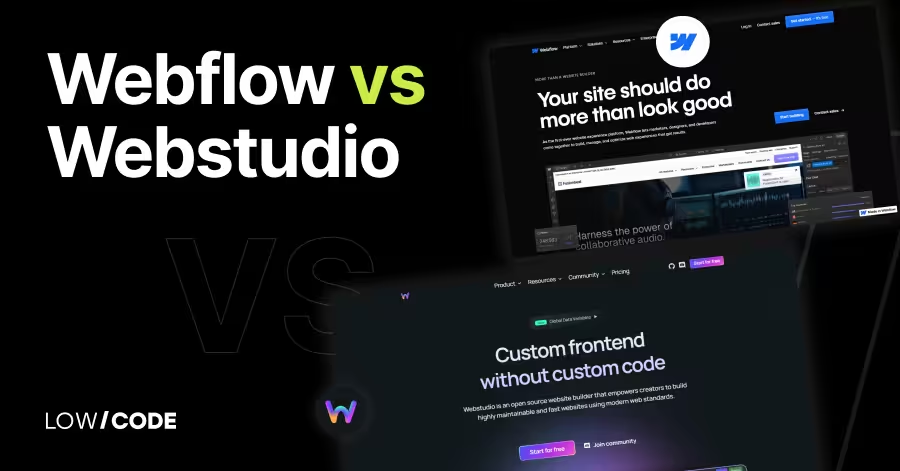
Webflow vs Webstudio | 9 Factors to Decide the Best One
Compare Webflow vs Webstudio across 9 key factors like design, CMS, pricing, and performance to find the right builder for your next project
Webflow
How To Redesign A Wordpress Website
Redesigning a WordPress website without losing SEO or breaking content takes a clear process. Here is how to do it right, step by step.
Webflow
Webflow Maintenance: What Your Site Needs Ongoing
What ongoing Webflow maintenance covers, what breaks without it, and how to decide between DIY and a retainer agency.
.avif)
Why customers trust us for no-code development


