

Business Application Development (How to Build One in 2026)
18 min
read
Learn how to build a business application in 2026. Explore step-by-step development, tools, costs, and best practices to launch faster and scale with confidence.

Business application development in 2026 is not about building software. It is about replacing the disconnected tools, manual processes, and spreadsheet chaos that slow growing businesses down with structured systems their teams actually rely on every day.
The difference between a business that scales efficiently and one that adds headcount to manage operational complexity is almost always the quality of the business applications running underneath it.
This guide tells you what to build, how to build it, and what every business gets wrong before spending on development that needs to be redone.
Key Takeaways
- Build systems, not isolated apps: the most common business application development mistake is building disconnected tools that create new inefficiencies instead of solving existing ones.
- Workflow design comes before feature design: applications built without mapped workflows produce technically functional software that teams find confusing and stop using within months.
- Low-code development suits most business applications: custom enterprise development is necessary for genuinely complex systems; most business applications deliver better outcomes faster on low-code platforms.
- Poor architecture costs more to fix than to prevent: data model mistakes and scalability oversights made at the build stage create expensive rebuilds at the worst possible business moment.
- Business application success is measured by adoption, not launch: an application your team uses daily to run operations is successful; one that launched on time and sits unused is an expensive failure.
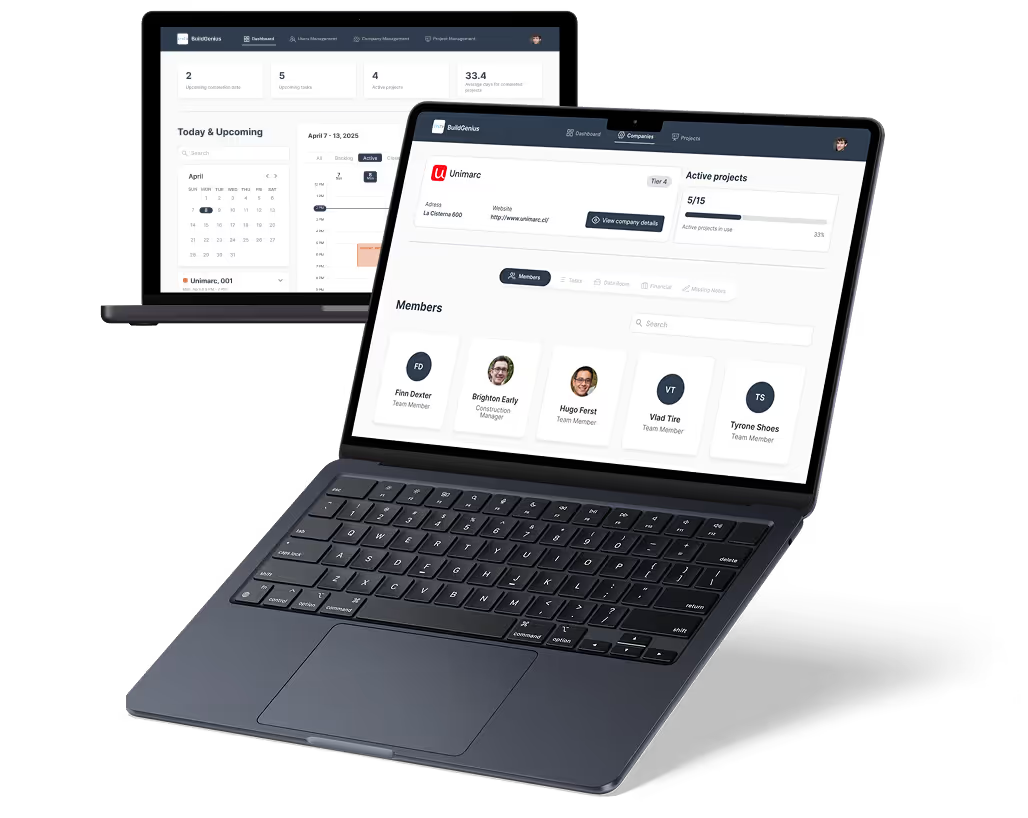

Do You Actually Need a Business Application?
The first question in any business application development process is not what to build. It is whether building anything is the right answer at all.
- When businesses need custom application development: you are managing operations across multiple disconnected tools, relying on manual processes that consume team time, or running on spreadsheets that break under the data volume your business now requires.
- The real problem business apps solve: turning messy operational workflows into structured systems that teams rely on for daily execution without workarounds, manual intervention, or tribal knowledge about how things actually work.
- When you do not need to build anything: if existing off-the-shelf software already solves your problem cleanly, building a custom business application adds development cost and maintenance overhead without proportional operational benefit.
No-code use cases across every business function show where custom application development consistently delivers value that existing software cannot replicate and where it does not.
You Don't Need an App, You Need a System (Critical Mindset Shift)
Most businesses build isolated applications that solve one problem and create three new ones through disconnected data, duplicated workflows, and manual synchronization between tools that were supposed to eliminate manual work.
- Most businesses build the wrong thing: isolated apps that address individual pain points without connecting to the broader operational system create new data silos and manual processes rather than eliminating them.
- What a real business system looks like: CRM data, operational dashboards, workflow automation, and team tools connected into one coherent infrastructure where information flows automatically between every component.
- Why this matters: disconnected business applications do not compound in value over time; every new tool added without integration planning creates a new source of operational confusion that grows more expensive to resolve as the business scales.
What Type of Business Application Should You Build?
Choosing the right application type before starting development prevents the most common and costly category mismatch in business software projects.
- Internal tools and operational systems: applications used by teams to manage workflows, data, and processes; the highest-ROI starting point because requirements are well understood and the value of replacing manual processes is immediately measurable.
- Customer-facing applications: software improving user experience, driving sales, or increasing engagement for external users; higher revenue potential but more complex requirements and higher cost of getting the product direction wrong.
- Hybrid business systems: combinations of internal operational tools and customer-facing layers sharing data infrastructure; the most common architecture for growing businesses with both operational and customer experience requirements.
- Choosing the right type: internal applications optimize for operational efficiency; customer-facing applications optimize for revenue and engagement; the right starting point depends on whether your biggest constraint is internal friction or external growth.
Internal vs Customer-Facing Business Applications (Critical Decision)
The distinction between internal and customer-facing application development affects every decision from platform selection through data architecture, security requirements, and success metrics.
Internal business applications
Internal business applications focus on operational efficiency, workflow automation, and reducing manual work that consumes team time and creates errors.
The users are known, requirements are well understood, and the cost of poor UX is measured in productivity loss rather than customer churn.
Internal tools built on no-code platforms consistently deliver the highest ROI in the shortest time of any business application category.
Customer-facing applications
Customer-facing applications focus on revenue generation, user experience quality, and market engagement where users are external and requirements are validated through usage data rather than internal specification.
The most common business application development mistake is building customer-facing software before internal operations are reliable enough to support the customer volume that successful external products generate.
Build vs Buy vs Hybrid (Most Important Business Application Decision)
Every business application development project starts with a fundamental choice between buying existing software, building custom applications, or combining both approaches into a hybrid system.
- Off-the-shelf software: fast to implement and well-supported; the right choice when standard workflows match your business requirements closely enough that configuration covers the gaps without constant workarounds.
- Custom-built business applications: fully tailored to your specific workflows and operational requirements; the right choice when your processes are specific enough that standard software requires constant adaptation accumulating into genuine operational friction.
- Hybrid development approach: combining existing tools with custom application layers built on low-code platforms; the most practical choice for businesses needing specific customization in some areas while leveraging proven software in others.
- How to decide: based on workflow complexity, budget, team capability, and long-term flexibility requirements; the cheapest implementation option is rarely the cheapest option over a three-year operational horizon.
What Should Your Business Application Actually Do?
Feature lists drive most business application development projects in the wrong direction. Workflow design produces better applications at lower cost with higher adoption rates.
- Start with workflows, not features: map how your business actually operates step by step before designing a single screen; applications built on accurately mapped workflows solve real operational problems while applications built on assumed features solve imagined ones.
- Identify key business processes to improve: focus development investment on the highest-impact operational areas where application support produces measurable efficiency gains in sales, operations, customer onboarding, or approval workflows.
- Avoid feature overload: every feature added beyond the core workflow increases development cost, extends timeline, reduces adoption speed, and adds maintenance overhead; applications doing fewer things excellently outperform those doing many things adequately.
Core Components of Every Business Application
Every production-grade business application shares the same fundamental architectural components regardless of platform, development approach, or specific use case.
- Business logic and workflows: the rules, conditions, and process flows defining how the application handles tasks, routes data, triggers actions, and responds to user inputs across every operational scenario.
- User interface and experience: the screens, navigation patterns, and interaction designs determining whether teams adopt the application as their daily operational tool or find workarounds that replicate the manual processes it was built to replace.
- Data management and integrations: the database architecture, data relationships, and API connections determining how information is stored, processed, and shared between the application and every connected tool in the operational stack.
- Security and access control: user authentication, role-based permissions, and data privacy controls ensuring the right people access the right information without creating compliance risks in systems the business depends on daily.
Choosing the Right Business Application Development Approach
Development approach selection determines build timeline, cost, flexibility ceiling, and long-term maintenance overhead for every business application project.
- Traditional custom development: best for genuinely complex enterprise systems with unique performance requirements, deep compliance needs, and architectural decisions requiring precise engineering control at every stack layer.
- Low-code and no-code development: faster, more flexible, and significantly cheaper for most business applications; traditional development vs no-code covers where the performance and flexibility trade-offs matter and where they do not.
- Hybrid development approach: combines no-code frontend and workflow layers with custom backend development for applications needing both visual building speed and custom code precision at specific architectural points.
- How to choose: based on product complexity, required customization depth, expected scale, integration requirements, and the long-term vision for how the application needs to evolve as the business grows.
Business Application Development Process (Step by Step)
Identify the Problem and Business Goals
Every successful business application development project starts with a problem definition precise enough to evaluate whether the proposed solution actually addresses it. Vague problem statements produce applications that partially solve multiple issues while fully solving none of them.
Define the specific operational friction the application needs to eliminate and quantify the current cost in team time, error rate, or revenue impact where possible.
Applications developed against specific measurable problems produce measurable outcomes that justify the investment and inform every subsequent development decision.
Define Requirements and Map Business Workflows
Requirements definition is the most valuable and most consistently rushed phase of business application development. Teams investing heavily in mapping workflows before building produce applications that fit their operations from day one.
Map every workflow the application needs to support step by step, including exception cases and edge conditions that appear in real operations but rarely appear in initial requirements discussions.
The workflow map becomes the specification that every development decision references and the acceptance criteria that every delivered feature is evaluated against.
Design UX and System Architecture
User experience design for business applications is not cosmetic. It is the difference between software teams adopt as their primary operational tool and software they work around because it is harder to use than the spreadsheet it replaced.
System architecture design defines the data model, integration approach, and technical structure that determines how the application performs, scales, and evolves.
Architecture decisions made here determine how expensive every subsequent development decision becomes and whether the system supports the business at its current size or only at its current size.
Build and Integrate Business Systems
Building follows architecture, not the other way around. Every development session that starts without a clear data model and workflow map produces rework that delays delivery and inflates cost consistently across every business application development project.
No-code automation connecting your business application to payment systems, communication tools, and external data sources configures after the core application logic is stable and tested.
Adding integrations before the core workflow is proven creates dependencies that complicate debugging and slow the iteration speed that early-stage application development requires.
Test and Validate with Real Business Conditions
Testing with real users against real operational data surfaces the usability issues, logic gaps, and integration failures that structured testing environments never fully replicate. Business applications tested only in controlled conditions consistently fail in ways that real usage reveals in the first week of deployment.
Fix only the issues that block core workflow completion before launch. Every other issue is prioritization work that real usage data performs more accurately than pre-launch judgment from the team that built the application and cannot evaluate it through a new user's experience.
Launch and Iterate Based on Real Usage
Launch is not the end of the business application development process. It is the beginning of the iteration cycle that determines whether the application becomes the operational foundation the business depends on or gets replaced by the next tool that promises to solve the same problems.
Plan a structured post-launch iteration period of four to eight weeks where usage data, team feedback, and operational performance metrics drive every development decision.
The applications that become embedded in daily business operations are the ones that respond to real usage patterns quickly enough to correct the gaps between what was built and what the business actually needs.
Integration with Existing Business Systems
No business application operates in isolation. Integration quality determines whether the application adds to the operational stack productively or creates the data silos and manual synchronization work it was built to eliminate.
- Connect current tools and existing data: avoid rebuilding data infrastructure that already exists in connected systems; integrate with what works and replace only what does not.
- Use APIs and automation workflows:business process automation creates smooth data flow between systems automatically, eliminating the manual transfer processes that disconnect operational tools from each other.
- Avoid data silos at the architecture stage: every integration decision made before building is cheaper than every data silo discovered after deployment; plan the full integration map before committing to any data structure.
Scalability and Performance Planning for Business Applications
Scalability planning at the architecture stage costs hours. Scalability rebuilding at the growth stage costs months and significantly more budget than the original application development investment.
- Plan for growth early: your business application should handle the user volume, data complexity, and workflow load you plan to reach rather than the minimum that works on launch day.
- Design flexible architecture: modular system design allows adding new features, integrations, and user roles without breaking existing workflows or requiring structural rebuilds that take production systems offline.
- Avoid short-term thinking:the capabilities and limitations of no-code cover the specific scalability ceilings that business application architecture decisions need to account for before they become operational constraints.
Business Application Development Cost and Timeline
Understanding what drives cost and timeline in business application development prevents the budget surprises and delivery disappointments that consistently affect projects where expectations were set without full information.
- Cost depends on complexity and integrations: data model complexity, number of user roles, workflow logic depth, and integration count all drive cost independently; no-code app development cost covers the real numbers across every business application category.
- Timeline varies from weeks to months: simple internal tools build in one to three weeks professionally; standard business SaaS products with multiple workflows and integrations build in four to eight weeks; complex enterprise systems build in three to six months.
- Focus on value, not just cost: the cheapest business application development option is rarely the cheapest option when maintenance cost, rebuild risk, and adoption failure are included in the total cost of ownership calculation.
Roles Involved in Business Application Development
Successful business application development requires specific roles working together from discovery through launch, not just developers executing a feature list.
- Developers and engineers: build the application, configure workflows, and implement integrations; the execution layer that translates architecture and design decisions into working software.
- Business analysts: define workflows, map requirements, and translate operational needs into technical specifications that developers can build against accurately without constant founder involvement.
- UX designers: ensure the application interface matches how users think about their work rather than how developers think about the data; the role most directly responsible for adoption outcomes.
- Project managers: coordinate execution, manage timeline and scope, and maintain alignment between business requirements and development delivery across every phase of the project.
Common Business Application Development Mistakes to Avoid
- Building apps instead of systems: isolated applications that do not connect to each other create new manual processes rather than eliminating existing ones, producing a more complex operational environment than the spreadsheets they replaced.
- Ignoring workflow design: applications built without mapped workflows produce technically functional software that teams find confusing, work around, and eventually stop using regardless of how much was invested in building them.
- Overbuilding features before validation: adding every requested feature before any user has validated that the core workflow solves the problem wastes development budget on product direction that real usage would have corrected in the first week.
- Skipping proper architecture planning: poor data structure, wrong platform selection, and inadequate integration design made at the build stage determine how expensive the growth stage rebuild becomes for every business application that succeeds.
The Hidden Cost of Poor Business Application Development Decisions
The real cost of poor business application development decisions is not the project fee. It is the rebuild cost, the adoption failure, and the operational debt that compounds through every business decision made on systems that do not work reliably.
- Rebuilding costs more than building correctly: fixing bad architecture after the business depends on it requires rebuilding every workflow sitting on top of the broken foundation at a cost that consistently exceeds the original development budget.
- Poor integrations slow business operations: systems that do not share data cleanly create manual synchronization work that grows proportionally with the business volume running through them rather than staying constant.
- Low adoption eliminates ROI: if teams do not use the application as their primary operational tool, the investment produces no return regardless of how technically well-built the software is or how on-time and on-budget the project delivered.
Post-Launch Reality: What Happens After Business Application Development
Launch is not the end of the business application development investment. It is the beginning of the operational relationship between the software and the business that determines whether the investment compounds in value or depreciates into obsolescence.
- Continuous updates are required: business needs evolve, market conditions change, and team workflows shift in ways that require ongoing application updates to maintain the fit between the software and the operations it supports.
- Systems need ongoing optimization: real usage data reveals performance bottlenecks, workflow gaps, and UX friction that testing environments never fully surface; post-launch optimization based on actual usage patterns is where most adoption improvement happens.
- New features and integrations grow with the business: the application that serves ten users needs different capabilities than the application serving one thousand; planning the evolution roadmap from launch rather than discovering the need for it under growth pressure reduces both cost and disruption.
How no-code agencies support products after launch covers the ongoing iteration and optimization work that determines whether business applications become embedded operational infrastructure or get replaced in the next tool evaluation cycle.
Want to Build a Business Application That Your Team Actually Uses?
LOW/CODE Agency is the AI product development partner built for SMBs. We build and ship web apps, mobile apps, chatbots, RAG systems, and AI agents — end to end, without the enterprise overhead. We are not a dev shop.
- No-code development: our no-code development service covers platform selection, workflow design, data architecture, and full production builds for business applications where speed and operational fit are the priority.
- Bubble development: our Bubble development service handles complex web business applications, internal tools, and workflow-heavy operational systems built to scale within the platform's genuine strengths.
- Automation development: our automation development service designs and builds the workflow automation layer that connects business applications to the operational stack they need to function as integrated systems.
- Custom CRM development: our custom CRM development service builds CRM and customer management systems designed around how your sales and operations teams actually work rather than how SaaS vendors assume they should.
- Architecture before build: we map workflows, design data models, and plan integration architecture before any building starts, preventing the structural mistakes that turn business application investments into expensive rebuilds.
- Long-term partnership: we stay involved after launch, evolving your business applications as your operational requirements, team size, and system complexity grow over time.
We have shipped 350+ products across 20+ industries. Clients include Medtronic, American Express, Coca-Cola, and Zapier.
Related Articles
- n8n Alternatives: Best Tools by Use Case in 2025
- n8n AI Automation: Build AI Workflows Without Code
- Claude Computer Use: What It Does and Who It's For
- 15 Best No-code App Builders (Ranked for Every Use Case)
- Best AI No-code Inventory Management Tools in 2026
- How to Hire No-code Developers (Practical Guide for Founders)
Last updated on
September 28, 2026
.

Jesus is a visionary entrepreneur and tech expert. After nearly a decade working in web development, he founded LOW/CODE Agency to help businesses optimize their operations through custom software solutions.


FAQs
What is business application development?
How much does business application development cost?
How long does it take to build a business application?
Should I build a custom business application or use off-the-shelf software?
What is the most common business application development mistake?
How do I choose the right development approach for my business application?
Related Articles

Business Automation
How to Automatically Create SEO Content Briefs with AI
Learn how to use AI tools to generate SEO content briefs quickly and effectively for better content planning and optimization.
Business Automation
Auto Sync UTM Data to Tracking Spreadsheet Easily
Learn how to automatically sync UTM data to your tracking spreadsheet for accurate campaign analysis and time-saving updates.

Business Automation
How to Document Zapier Automations Effectively
Learn the best ways to document your Zapier automations for easy management and troubleshooting.
Business Automation
Keep Employee Directory Automatically Updated Easily
Learn how to automate updates for your employee directory to ensure accuracy and save time with these effective methods.
Why customers trust us for no-code development


