

How to Build a Wealth Management Platform with Bubble
10 min
read
Launch a wealth management platform with Bubble without coding. Track portfolios, manage clients & visualize assets step-by-step using no-code.


Wealth advisors are building custom client portals in Bubble that replace $50,000-per-year enterprise platforms. They gain full control over the data model and client experience. A wealth management platform built in Bubble gives registered investment advisors and fintech founders a way to deliver portfolio visibility, document sharing, and performance reporting without six-figure custom development costs.
Many RIAs and fintech founders work with a Bubble development for fintech team to get the portfolio data model and integrations right from day one.
Key Takeaways
- Portfolio data model: A well-structured Holding and Portfolio data type is the foundation. Every report, chart, and advisor view derives from it.
- Advisor and client roles: Advisors see all client portfolios. Clients see only their own. Both are enforced through Bubble's privacy rules, not just UI visibility.
- Market data integration: Use the API Connector to pull live or end-of-day pricing from providers like Alpha Vantage or Polygon.io into Holding records.
- Document vault: Clients and advisors upload and access statements, tax documents, and agreements from a secure per-client file repository.
- Compliance notes: A dedicated ComplianceNote data type records suitability assessments and advisor disclosures, linked to each client relationship.
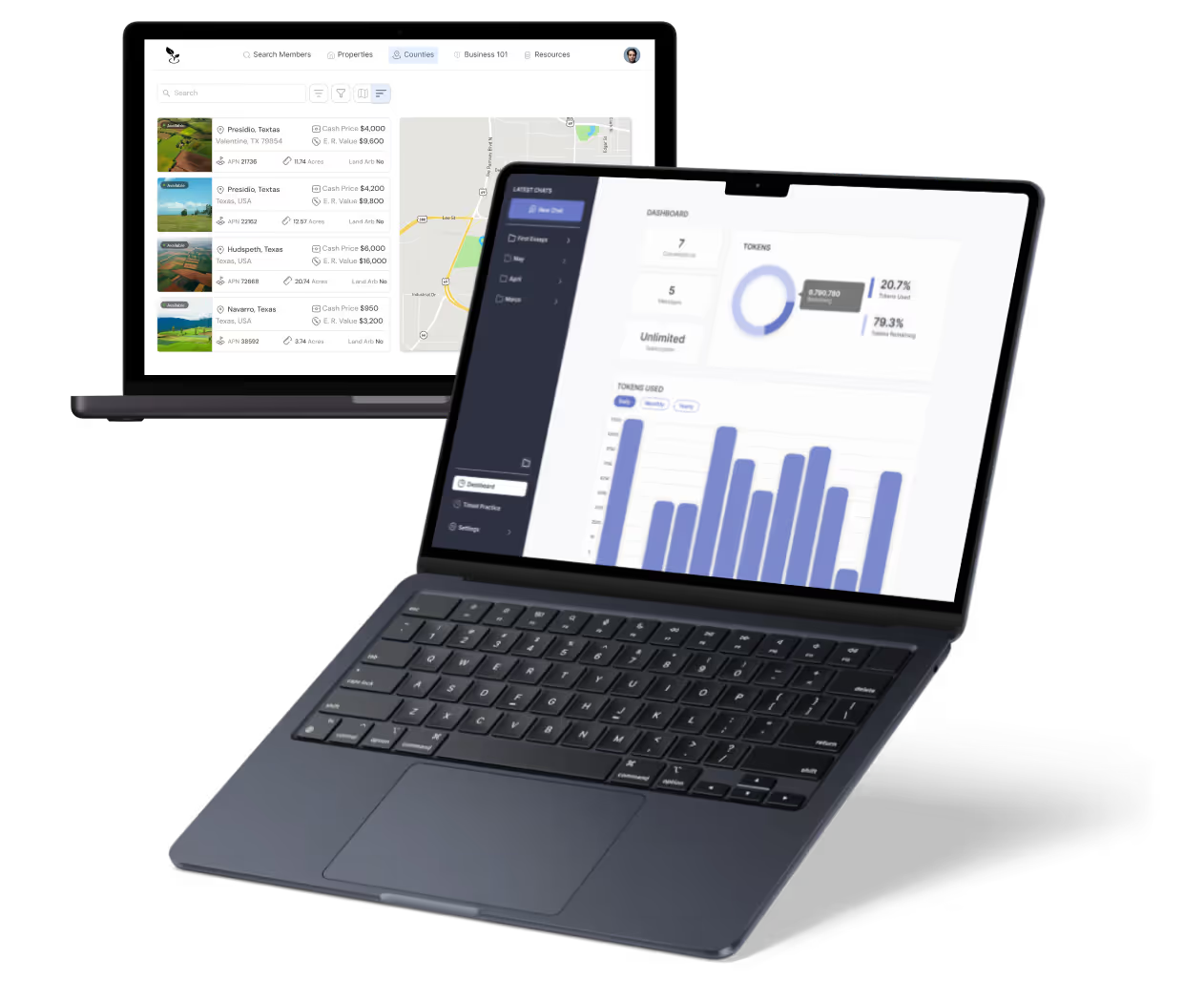

What Is a Wealth Management Platform — and Why Build It with Bubble?
A wealth management platform gives advisors a client portal for portfolio visibility, document sharing, performance reporting, and appointment booking. It replaces the combination of email threads, PDF statements, and generic portals that most independent advisors still use today.
Target users include registered investment advisors (RIAs), family offices, independent financial planners, and fintech startups building advisor-client products.
Bubble fits this use case well: its relational data model handles portfolio-to-holding relationships, role-based access isolates client data, and the API Connector pulls in market data from providers like Alpha Vantage or Polygon.io.
- Honest scope note: Bubble is ideal for the client-facing portal and data management layer. Trade execution and custody integrations require external API partners.
- Cost comparison: Orion, Redtail, and custom React portals cost significantly more to build and maintain than a Bubble-based equivalent.
- Faster iteration: No-code means advisors can request UI changes and new reports without a development sprint.
What Features Should a Wealth Management Platform Include?
The platform serves two distinct users: advisors who manage multiple clients, and clients who want visibility into their own portfolios. Features must be scoped for both.
Define both portal experiences before building so the data model supports all views from the start.
- Client portal: Portfolio summary, holdings breakdown, performance chart, document vault, and upcoming appointments. All in one client-facing dashboard.
- Advisor dashboard: Full client list with AUM totals, recent activity feed, pending tasks, and compliance notes due. Giving advisors a single management view.
- Portfolio management: Advisors create and edit client portfolios, add or remove holdings, and update asset allocation percentages from the advisor side.
- Performance reporting: Time-weighted returns, gain/loss by holding, and portfolio vs benchmark comparisons calculated from Holding field values.
- Document management: Upload, categorize, and share statements, agreements, tax forms, and reports per client. Visibility flags control client access.
- Appointment booking: Advisor availability calendar, client self-scheduling, automated confirmation emails, and reminder emails 24 hours before.
- Compliance notes: Suitability assessment records, KYC documentation status, and advisor disclosure logs linked to each client relationship.
How Do You Structure the Database for a Wealth Management Platform in Bubble?
The database is the most critical architectural decision in this build. Portfolio calculations, performance charts, and compliance records all derive from the relationships defined here.
For platforms managing large transaction histories, reviewing backend options for Bubble apps helps determine whether Bubble's native database is sufficient or an external database is warranted.
- Portfolio data type: Fields include client (User), advisor (User), name (text), inception_date (date), benchmark (text), total_value (number, calculated), and status (option set: Active/Closed).
- Holding data type: Fields include portfolio (Portfolio), ticker (text), asset_name (text), asset_class (option set), shares (number), cost_basis (number), current_price (number), current_value (number, calculated), and last_updated (date).
- Transaction data type: Fields include portfolio (Portfolio), holding (Holding), type (option set: Buy/Sell/Dividend), date (date), quantity (number), price (number), and total (number).
- Document data type: Fields include client (User), advisor (User), file (file), category (option set: Statement/Agreement/Tax/Report), uploaded_at (date), and visible_to_client (yes/no).
- ComplianceNote data type: Fields include client (User), advisor (User), note_type (option set: Suitability/KYC/Disclosure), content (text), date (date), and signed (yes/no).
- Appointment data type: Fields include advisor (User), client (User), date_time (date), duration (number), status (option set), and notes (text).
How Do You Build the Core Workflows for a Wealth Management Platform in Bubble?
Workflows drive portfolio updates, document notifications, appointment booking, and compliance record creation. Most run as backend workflows or scheduled API workflows.
Build the holding price update workflow first. It is the engine that keeps the platform's portfolio data current.
- Portfolio creation: Advisor creates a Portfolio record → system creates the default Holding list structure → SendGrid sends a welcome email to the client.
- Holding price update: A scheduled backend workflow runs nightly → for each Holding, it calls the Alpha Vantage or Polygon.io API via the API Connector → updates current_price → recalculates current_value and Portfolio total_value.
- Performance calculation: When a portfolio page opens, expression math on Holding fields calculates gain/loss and percentage return in real time.
- Document upload: Advisor or client uploads a document → Document record is created with category and visibility flag → notification sent to the other party.
- Appointment booking: Client selects an available slot → Appointment record created → confirmation email sent via SendGrid → reminder email scheduled 24 hours before the appointment.
- Compliance note: Advisor creates a ComplianceNote → linked to the client → if note_type = KYC, system flags client's KYC status as "On File".
What Plugins and Integrations Does a Wealth Management Platform Need?
Plugin selection determines the platform's reporting quality, communication reliability, and document signing capability. Choose plugins before building workflows that depend on them.
Each plugin below solves a specific gap that Bubble's native features cannot cover alone.
- API Connector (built-in): Connects to Alpha Vantage, Polygon.io, or Quandl for live or end-of-day pricing data used in Holding price updates.
- Bubble Chart Element or ApexCharts plugin: Renders portfolio performance charts, asset allocation pie charts, and gain/loss bar charts in the client portal.
- SendGrid plugin: Sends transactional emails for appointment confirmations, document upload notifications, and portfolio report alerts.
- Stripe plugin: Optional billing layer for platforms that charge advisory fees or subscription access to the portal.
- Calendly API via API Connector or native Bubble calendar: Handles advisor availability setup and client self-booking workflows.
- DocuSign plugin or SignWell plugin: E-signature for advisory agreements, suitability assessments, and client onboarding documents.
How Do You Handle Security and Compliance Requirements for a Wealth Management Platform?
Understanding Bubble security architecture is the first step before configuring privacy rules for a financial advisory platform.
Financial data requires strict access controls. A client seeing another client's portfolio is not just a UX bug. It is a regulatory and trust failure.
- Portfolio and Holding privacy rules: Records are readable only by the linked client and their assigned advisor. Cross-client data leakage is prevented at every level.
- ComplianceNote access: ComplianceNote records are readable only by the authoring advisor and Admin. Clients do not have read access to their own compliance notes.
- HTTPS and SSL: Bubble enforces HTTPS by default. Verify the custom domain SSL certificate is active before going live with client data.
- Data encryption: Bubble stores data encrypted at rest; for highly sensitive financial data, consider encrypting specific fields using the API Connector with an encryption service.
- SEC/FINRA considerations: The platform does not execute trades, which reduces regulatory burden. Compliance notes and KYC documents should be retained per applicable recordkeeping rules.
- SOC 2 note: Bubble as a platform holds SOC 2 Type II compliance. Document this for client due diligence requirements.
LOW/CODE Agency addresses privacy rule configuration and compliance record workflows as part of every financial platform build.
How Long Does It Take and What Does It Cost to Build a Wealth Management Platform with Bubble?
A fintech platform built for multiple advisors effectively operates as a SaaS product. Working with a Bubble SaaS development agency accelerates delivery and ensures the multi-tenant architecture is correct.
Timeline and cost scale with the depth of API integrations and the complexity of the reporting layer.
- MVP timeline: Client portal, portfolio holdings, document vault, and appointment booking take 6–8 weeks for an experienced developer.
- Full scope timeline: Adding performance charts, market data integration, compliance notes, advisor dashboard, and e-signature extends the build to 10–16 weeks.
- Bubble plan: Growth plan minimum; Production plan is recommended for financial platforms due to enhanced uptime SLA.
- Developer cost: $10,000–$25,000 for MVP; $25,000–$60,000 for a full platform depending on API integration complexity and reporting depth.
- Ongoing costs: Bubble subscription, Alpha Vantage or Polygon.io API fees, SendGrid volume charges, and plugin license fees.
Conclusion
Bubble enables RIAs and fintech founders to deliver portfolio visibility, compliance tracking, and client reporting without enterprise software costs or custom development timelines.
Define the Portfolio and Holding data types first, then configure advisor and client privacy rules. The data structure drives every report and workflow in the platform.
Ready to Build a Wealth Management Platform in Bubble?
Most Bubble wealth management builds fail at the data layer. Misconfigured privacy rules expose client portfolio data across accounts, and shallow data models break performance reporting at scale.
At LOW/CODE Agency, we started as builders and that has not changed. Today we build AI-powered products — web apps, mobile apps, RAG systems, chatbots, and AI agents — specifically for SMBs that want real software, not a SaaS subscription. We build financial advisory portals and wealth management platforms in Bubble for RIAs, family offices, and fintech founders. We design the portfolio data architecture, integrate market data APIs, configure compliance record workflows, and deliver a production-ready platform without the six-figure custom development cost.
- Requirements scoping: We map every portfolio type, report, and user role before designing the data model.
- Database design: We define Portfolio, Holding, Transaction, ComplianceNote, and Document data types with all required field relationships.
- Workflow build: We configure nightly price update jobs, document notifications, appointment booking flows, and compliance note workflows.
- Plugin and API integration: We integrate Alpha Vantage or Polygon.io for market data, ApexCharts for portfolio visualization, and DocuSign for e-signatures.
- HIPAA and compliance config: We configure privacy rules so advisors and clients see only their authorized data. No cross-account exposure.
- Testing and QA: We verify every price update workflow, performance calculation, and privacy rule against real portfolio scenarios.
- Post-launch support: We extend reporting features and add new asset classes as your advisory practice grows after launch.
We have built 450+ products for clients including Coca-Cola, American Express, and Medtronic.
Related Articles
Last updated on
September 3, 2026
.

Jesus is a visionary entrepreneur and tech expert. After nearly a decade working in web development, he founded LOW/CODE Agency to help businesses optimize their operations through custom software solutions.


FAQs
Can you build a wealth management platform without coding using Bubble?
How do you display client portfolio holdings in a Bubble wealth management platform?
How do you manage financial goals in a Bubble wealth management platform?
How do you build a client-facing portal in a Bubble wealth management app?
How do you handle document management in a Bubble wealth management platform?
How do you generate performance reports for clients in Bubble?
Related Articles
Bubble
How to Build a Coaching Platform App with Bubble
Launch a co-living management app with Bubble no coding required. Manage tenants, payments, and bookings step-by-step without code.
Bubble
How to Build an Audit Management App with Bubble
Simplify audits with Bubble. Build a no-code audit management app step-by-step schedule audits, track findings & ensure compliance without coding.

Bubble
How to Build a Vendor Management App with Bubble
Streamline vendor relationships with Bubble. Build a no-code vendor management app step-by-step track contracts, payments & performance fast.
Bubble
How to Build a Quality Inspection App with Bubble
Build a quality inspection app in Bubble without coding. Log defects, track standards, and generate reports fast with this no-code step-by-step guide.

Why customers trust us for no-code development


