

How to Build a Restaurant Analytics App with Bubble
14 min
read
Build a restaurant analytics app with Bubble no coding needed. Track sales, monitor trends, and optimize performance with this no-code step-by-step guide.


Most restaurant operators are sitting on operational data they cannot easily read. Sales data lives in the POS, labor data lives in a scheduling app, inventory data lives in a spreadsheet. Connecting them for a real view of profitability requires hours of manual work every week.
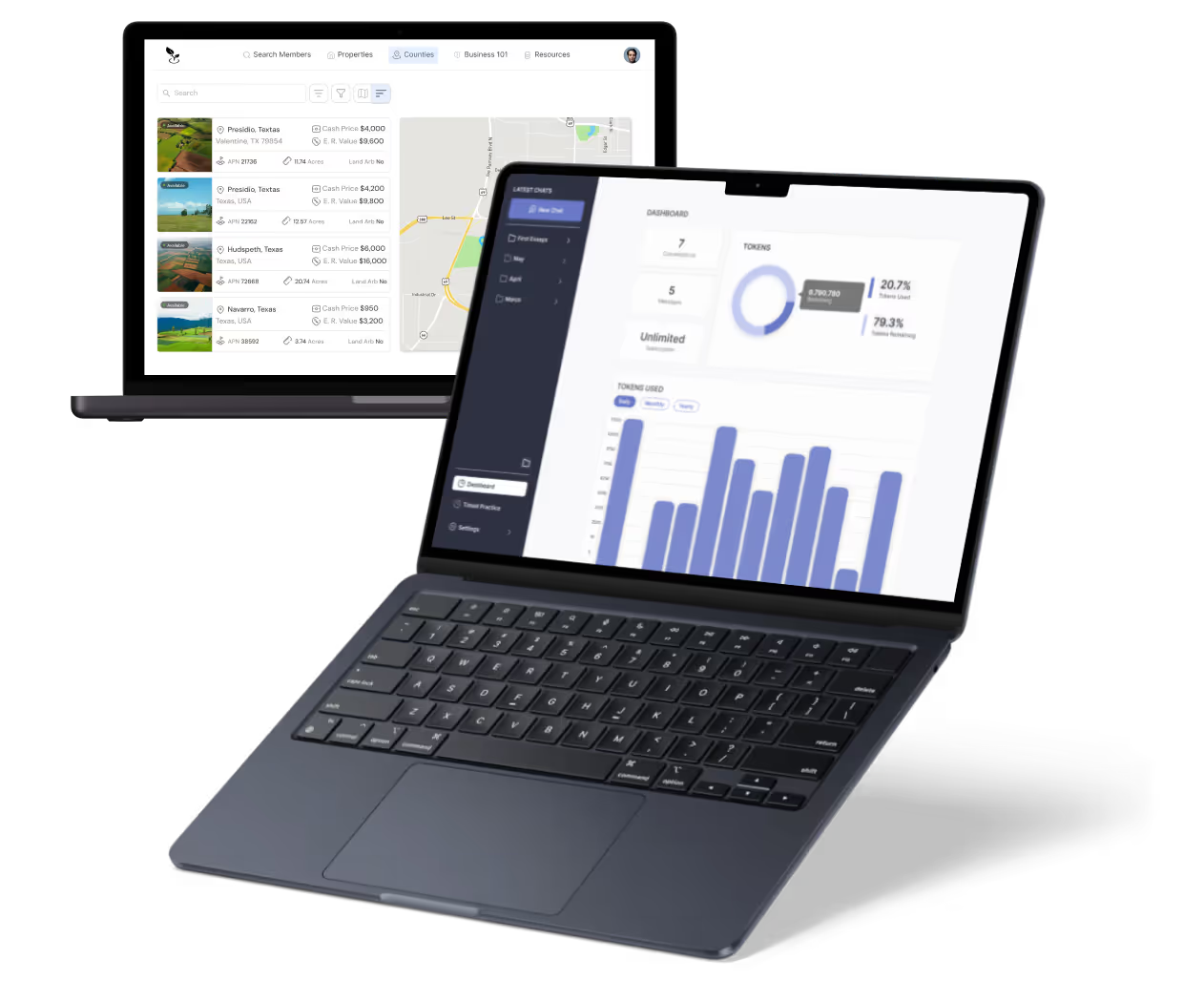
A restaurant analytics app built on Bubble consolidates these data sources into a single dashboard layer. It calculates food cost percentage, labor cost percentage, and revenue per cover automatically, without a dedicated data analyst.
Key Takeaways
- Bubble aggregates sales, labor, inventory, and guest data into a unified analytics layer
- Core data types include SalesRecord, LaborEntry, MenuItemPerformance, InventorySnapshot, KPIReport, and TableSession
- Calculated KPIs include food cost percentage, labor cost percentage, revenue per cover, and table turn time
- Charts use Bubble's built-in chart elements for most views, with Chart.js plugin for advanced visualization
- Scheduled backend workflows generate daily KPI snapshots automatically for trend tracking
- A restaurant analytics app on Bubble typically costs $20,000-$42,000 and takes 8-12 weeks

What Is a Restaurant Analytics App — and Why Build It with Bubble?
A restaurant analytics app is a custom reporting and visualization layer that ingests sales, labor, inventory, and guest data. It calculates operational KPIs and presents trend analysis in dashboards tailored to how a specific restaurant measures performance.
Reviewing the range of apps you can build with Bubble confirms that data aggregation and dashboard applications are a strong fit for Bubble's architecture. The relational database and dynamic expression system are well-suited to calculated fields and filtered data views.
- Sales trend analysis: SalesRecord entries aggregate by day, week, and month to show revenue trends, average check size, and transaction volume patterns that inform staffing and menu decisions.
- Labor cost tracking: LaborEntry records capture hours worked and hourly rates per staff member, allowing the system to calculate labor cost as a percentage of daily and weekly sales in real time.
- Menu item performance: MenuItemPerformance records track units sold, revenue contribution, and food cost per item, identifying which menu items drive the most profit and which are cost-inefficient.
- Table turn analysis: TableSession records capture seating and clearing timestamps for each table, calculating average turn time by day part, table size, and server to identify throughput bottlenecks.
- Food cost visibility: Linking SalesRecord, MenuItemPerformance, and InventorySnapshot data enables a rolling food cost percentage calculation that updates as new sales and inventory data enters the system.
Bubble allows each of these analytical views to be built as dynamic expressions referencing the underlying data types. No external BI tool or data warehouse required for a restaurant-scale dataset.
What Features Should a Restaurant Analytics App Include?
A restaurant analytics app needs a sales dashboard, labor cost tracker, menu performance report, table turn analysis, food cost percentage dashboard, and data export tools for period reporting.
The audience for each feature determines its design. Owners need high-level financial KPIs. Managers need operational detail. Designing dashboards that serve both without a single cluttered page requires role-based views.
- Sales performance dashboard: Displays daily, weekly, and monthly gross sales, net sales, transaction count, and average check size with trend indicators showing percentage change against the prior period.
- Labor cost tracker: Shows total labor hours, total labor cost, and labor cost as a percentage of sales by day and week, with staff-level breakdowns for managers reviewing individual productivity.
- Menu performance report: Ranks all menu items by revenue contribution, units sold, food cost percentage, and gross profit margin, highlighting high-volume/low-margin items for menu engineering decisions.
- Table turn analysis dashboard: Displays average table turn time by day part (Lunch, Dinner, Late Night), by day of week, and by table size, with trend analysis over selected date ranges.
- Food cost percentage tracker: A rolling calculation page shows food cost percentage by category and by period, comparing against target thresholds set by the owner and flagging periods where actual exceeds target.
- Scheduled KPI snapshot reports: Daily and weekly KPI reports sent via email at configurable times, ensuring managers and owners receive key metrics even when they do not log into the app.
- Export and reporting tools: PDF and Google Sheets exports of any dashboard view for period-end reporting, investor presentations, or accountant submissions.
Feature design decisions should be validated with the actual restaurant operators who will use the dashboard before the build begins. Analytical features built around assumed behaviors often go unused.
How Do You Structure the Database for a Restaurant Analytics App in Bubble?
The database requires at minimum eight data types: SalesRecord, SalesLineItem, LaborEntry, Staff, MenuItemPerformance, InventorySnapshot, KPIReport, and TableSession, designed to support efficient aggregate queries.
Analytics databases face a different design challenge than transactional databases. The data must be structured for fast aggregate queries across large date ranges, not just for individual record retrieval.
- SalesRecord: Fields include sale_date (date), day_part (option set: Breakfast, Lunch, Dinner), gross_sales (number), net_sales (number), transaction_count (number), covers (number), location (Location), and list of SalesLineItems.
- SalesLineItem: Fields include menu_item (MenuItem), quantity (number), unit_price (number), total (number), parent SalesRecord, and discount_applied (number), providing item-level detail for menu performance analysis.
- LaborEntry: Fields include staff (Staff), work_date (date), hours_worked (number), hourly_rate (number), total_cost (number), role (text), and location (Location) for labor cost aggregation.
- MenuItemPerformance: Fields include menu_item (MenuItem), period (text), units_sold (number), total_revenue (number), food_cost_total (number), food_cost_percent (number), and gross_profit (number), updated by scheduled workflows.
- InventorySnapshot: Fields include snapshot_date (date), total_inventory_value (number), cost_of_goods_sold (number), location (Location), and notes (text), used for period-level food cost calculations.
- KPIReport: Fields include report_date (date), period (text), location (Location), food_cost_percent (number), labor_cost_percent (number), revenue_per_cover (number), avg_table_turn_min (number), and is_daily_snapshot (yes/no).
- TableSession: Fields include table_number (text), party_size (number), seated_time (date), cleared_time (date), turn_duration_min (number), server (Staff), day_part (option set), and location (Location).
Storing pre-calculated KPI values in KPIReport records, rather than recalculating them on every dashboard page load, is the key performance optimization for analytics apps in Bubble. Dynamic aggregations across hundreds of records slow page rendering noticeably.
How Do You Build the Core Workflows for a Restaurant Analytics App in Bubble?
Core workflows handle daily data entry or import, KPI calculation, nightly KPI snapshot creation, menu performance aggregation, and weekly trend report generation via scheduled backend workflows.
Bubble's scalability for analytics apps depends on how aggregations are executed. Calculating totals from raw SalesRecord searches on every page load creates performance issues. Storing calculated values in KPIReport records and refreshing them on a schedule solves this at scale.
- Sales data entry or import: Managers enter daily SalesRecord data through a structured form, or data arrives via API connector from an existing POS system. Either path creates a SalesRecord with all required fields for downstream aggregation.
- Daily KPI calculation workflow: A scheduled backend workflow runs nightly after close, queries SalesRecord, LaborEntry, and InventorySnapshot data for the day, calculates food cost percentage, labor cost percentage, and revenue per cover, and creates a KPIReport record with all values stored.
- Menu performance aggregation: A weekly scheduled workflow queries all SalesLineItems from the past week, aggregates units sold and revenue by menu item, calculates food cost percentage for each, and updates or creates MenuItemPerformance records for the period.
- Table turn calculation: When staff mark a table as cleared in the table management interface, a workflow calculates turn_duration_min as the difference between cleared_time and seated_time, stores it on the TableSession record, and updates a running average on the Location record.
- Trend comparison workflow: The analytics dashboard uses Bubble's dynamic expressions to compare the current period's KPIReport values against the prior period's stored values, displaying percentage change indicators without additional workflow steps.
- Weekly KPI email report: A Monday morning scheduled workflow queries the prior week's KPIReport records, formats the key metrics with comparison to the prior week, and emails the summary to Owner and Manager role users via SendGrid.
The nightly KPI calculation workflow is the engine of the entire analytics app. It must run reliably every night. Build error logging into the workflow so that a missed calculation triggers an alert to the app administrator.
What Security and Data Requirements Apply to a Restaurant Analytics App?
Privacy rules must restrict kitchen and service staff from accessing financial KPIs and labor cost data while giving managers operational metric access and owners full financial visibility.
An analytics app contains the most financially sensitive data in a restaurant's operations. Labor costs, food margins, and profitability figures should be accessible only to the roles that have a direct need for them.
- Owner-level financial access: KPIReport, LaborEntry, and food cost dashboard data are restricted to Owner-role users through privacy rules that check the current user's role before allowing search access to these data types.
- Manager operational access: Manager-role users access sales totals, table turn metrics, and menu performance data, but LaborEntry hourly rate fields and KPIReport profitability margins are hidden from manager-level privacy rules.
- Staff data restrictions: Kitchen and service staff have no access to any analytics data types. Their access is restricted to operational tools relevant to their role, enforced through privacy rules rather than page redirects.
- Data source integrity: SalesRecord and LaborEntry records are set to read-only for all roles after creation, with corrections requiring a separate correction record linked to the original, preserving audit trails for financial review.
- Multi-location isolation: For multi-restaurant operators, all analytics data types carry privacy rules that filter search results by the current user's linked Location, preventing cross-location financial data exposure.
Securing data in Bubble is especially critical in analytics apps because the data represents the financial state of the business. Privacy rules must be tested for every role combination before launch.
What Plugins and Integrations Does a Restaurant Analytics App Need?
A restaurant analytics app needs SendGrid for scheduled KPI reports, PDF Conjurer for period-end report exports, and Bubble's native chart elements for most visualizations. A POS API connector is needed for high-volume restaurants to avoid manual data entry.
The integration decision that matters most for a restaurant analytics app is how sales data enters the system. Manual entry is viable for small operations. POS API import eliminates reconciliation burden at scale.
- SendGrid API Connector: Delivers daily and weekly KPI email reports to owners and managers at configured send times, formatted with key metrics and trend indicators for at-a-glance review.
- PDF Conjurer Plugin: Generates formatted period-end analytics reports for ownership review, investor presentations, or accounting submissions with charts and KPI tables in a professional layout.
- Bubble Native Charts: Renders sales trend lines, labor cost bar charts, and food cost percentage gauges directly on dashboard pages using Bubble's built-in chart element, avoiding the overhead of an external charting plugin.
- Chart.js Plugin: Used for advanced visualizations not supported by Bubble's native charts, such as multi-axis combination charts overlaying sales and labor cost trends on the same timeline.
- POS API Connector: For restaurants with an existing POS system (Toast, Square, Lightspeed), a scheduled API connector workflow imports daily sales summary data automatically, eliminating manual SalesRecord entry.
- Google Sheets API Connector: Exports KPIReport and MenuItemPerformance data to Google Sheets for period-over-period analysis in spreadsheet format preferred by many accountants and operations consultants.
Choosing between Bubble's native charts and Chart.js depends on the visualization complexity required. Start with native charts and add Chart.js only when a specific visualization cannot be achieved natively.
How Long Does It Take and What Does It Cost to Build a Restaurant Analytics App with Bubble?
A restaurant analytics app MVP covering sales, labor, and food cost dashboards takes 8-10 weeks and costs $20,000-$30,000. A full build with POS integration, menu performance analytics, and table turn analysis runs 10-14 weeks at $30,000-$45,000.
Analytics apps require more scoping time upfront than transactional apps because every KPI calculation must be defined precisely before the data types are designed. Ambiguity in KPI definitions creates rework in the workflow engineering phase.
- Discovery and KPI definition: 1-2 weeks to define all KPIs, their calculation methods, data sources, and update frequencies with the client before any data type design begins.
- Database architecture: 2-3 weeks to build all data types, option sets, and privacy rules, with particular attention to the KPIReport pre-calculation structure.
- Workflow engineering: 3-4 weeks for all scheduled workflows, KPI calculation logic, data entry forms, and POS API integration if required.
- Dashboard front end: 2-3 weeks for the owner dashboard, manager dashboard, menu performance report, and table turn analysis page with all chart elements.
- QA and launch: 1-2 weeks for KPI calculation accuracy testing, privacy rule validation, and scheduled workflow timing tests.
A restaurant analytics app that surfaces food cost percentage, labor cost trends, and menu performance in one dashboard can drive 1-3 points of margin improvement through better operational decisions. On a $1 million annual revenue restaurant, that is $10,000-$30,000 per year.
Conclusion
Bubble enables restaurant operators to replace disconnected spreadsheets and POS exports with a unified analytics layer that calculates food cost, labor cost, and menu performance automatically.
The KPI pre-calculation architecture is the implementation priority. Store computed values in KPIReport records rather than recalculating on every page load. Dashboard performance depends on that decision from day one.
Ready to Build Your Restaurant Analytics App on Bubble?
KPI pre-calculation workflows that skip error logging silently fail nightly, leaving owners making decisions on stale data. POS API integrations built without retry logic drop records when the external endpoint is temporarily unavailable.
At LOW/CODE Agency, we started as builders and that has not changed. Today we build AI-powered products — web apps, mobile apps, RAG systems, chatbots, and AI agents — specifically for SMBs that want real software, not a SaaS subscription. We scope the architecture, engineer the workflows, and stay involved through launch and beyond.
- Data architecture: We design your data types, option sets, and privacy rules before writing a single element on the canvas.
- Workflow engineering: We build backend workflows, scheduled jobs, and API integrations with proper logic and error handling.
- Plugin configuration: We select and configure the right Bubble plugins for your feature set without unnecessary bloat.
- Role-based access: We implement privacy rules at the database level, not just conditional UI visibility.
- Integration setup: We connect your Bubble app to Stripe, SendGrid, Twilio, and other services correctly from day one.
- Pre-launch testing: We test against real data before deployment so every workflow performs correctly under live conditions.
- Post-launch support: We stay involved after go-live to optimize as real usage data shapes the app.
We have built 350+ products for clients including Coca-Cola, American Express, Sotheby's, and Medtronic. We know exactly where Bubble builds fail and we address those problems before they surface.
Related Articles
- How to Build a Restaurant Management App with Bubble
- How to Build a Restaurant Inventory App with Bubble
- How to Build a Restaurant CRM App with Bubble
- How to Build a Rental Management App with Bubble
- How to Build a Rehabilitation Management App with Bubble
- How to Build a Regulatory Compliance App with Bubble
Last updated on
September 24, 2026
.

Jesus is a visionary entrepreneur and tech expert. After nearly a decade working in web development, he founded LOW/CODE Agency to help businesses optimize their operations through custom software solutions.


FAQs
Can you build a restaurant analytics app without coding using Bubble?
How do you track daily sales in a Bubble restaurant analytics app?
How do you identify top-selling menu items in a Bubble restaurant analytics app?
How do you track server performance in a Bubble restaurant analytics app?
How do you analyze customer visit frequency in a Bubble restaurant analytics app?
How do you visualize hourly sales trends in a Bubble restaurant analytics app?
Related Articles
Bubble
Comparison
Bubble vs Appsheet | 10 Factors to Decide the Best One
Compare Bubble vs AppSheet for building web or mobile apps. Learn which no-code tool fits your app goals, design needs, and workflow logic in 2025

Bubble
How to Build a Facility Inspection App with Bubble
Build a driver management app with Bubble without coding. Onboard drivers, assign routes, and monitor performance step-by-step fast.

Bubble
How to Build a Donation Platform App with Bubble
Build a doctor appointment booking app with Bubble no coding needed. Let patients self-schedule, send reminders, and manage slots fast.

Bubble
How to Build a Status Report How to Builder App with Bubble
Build a status report builder with Bubble. Auto-generate updates from live project data and share with stakeholders — no manual reporting, no code.


Why customers trust us for no-code development


