

How to Build a Membership Management App with Bubble
11 min
read
Grow your community with a Bubble membership app no coding needed. Manage signups, renewals, and perks step-by-step on one no-code platform.


Managing members across spreadsheets, email threads, and disconnected tools creates gaps that cost organizations money and time. Bubble gives you a single platform to build a fully custom membership app without hiring a development team.
Whether you run a professional association, a gym, or a nonprofit, Bubble handles tiered plans, automated renewals, and gated content in one place.
Key Takeaways
- Bubble supports tiered memberships, automated renewals, and gated content without writing custom code
- Core data types include Member, MembershipPlan, Subscription, Payment, and Event
- Stripe handles recurring billing, plan upgrades, and webhook-triggered status updates
- Privacy rules at the database level control what each membership tier can access
- Realistic build time is 6 to 10 weeks at a cost of $8,000 to $18,000
- Required plugins include Stripe, SendGrid, PDF Conjurer, and Air Date/Time Picker
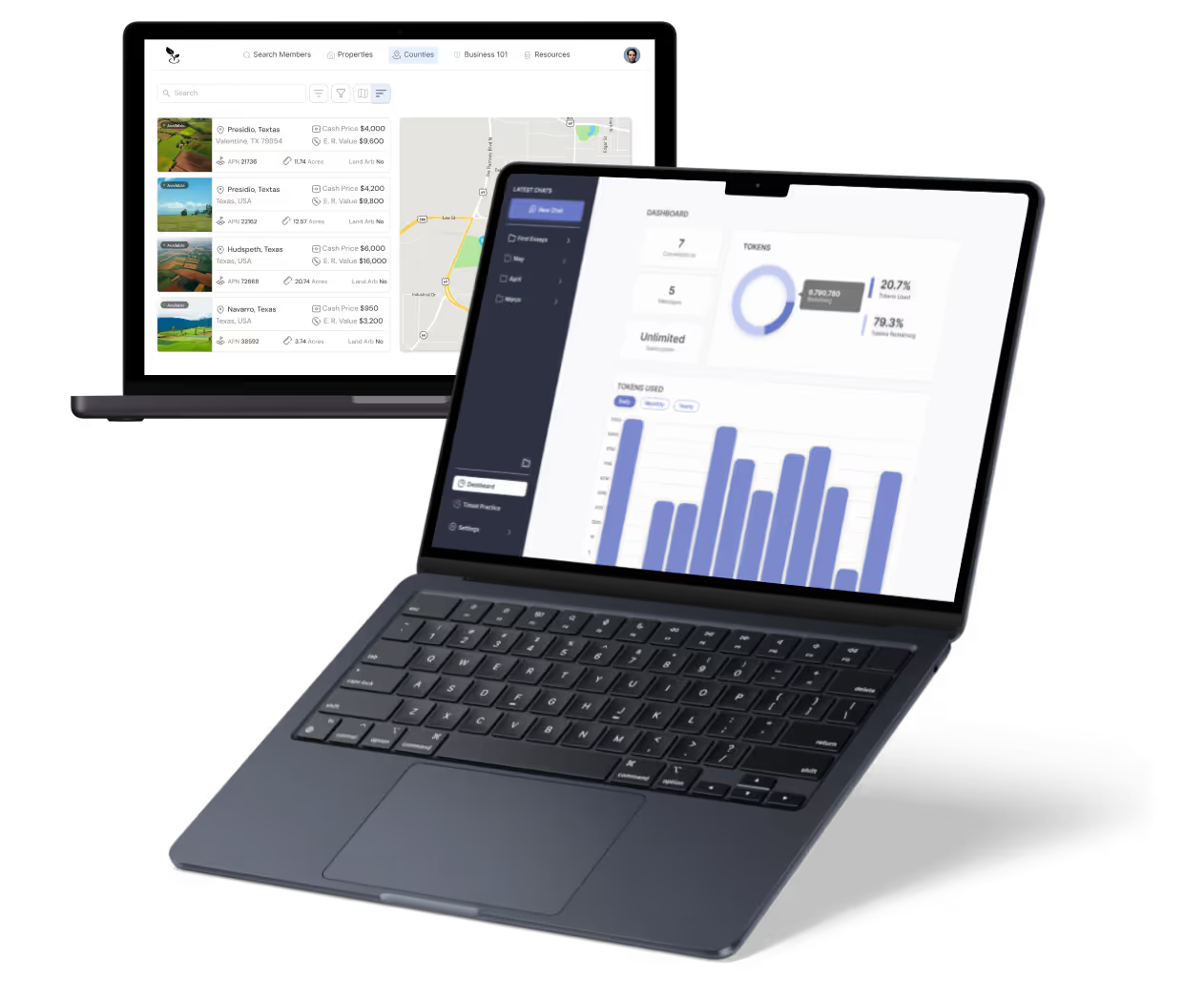

What Is a Membership Management App — and Why Build It with Bubble?
A membership management app is a platform that handles member records, plan assignments, billing, access control, and communications in one system. Bubble is a strong fit because it combines a visual database, workflow engine, and UI builder in a single no-code environment.
Associations, gyms, nonprofits, and professional communities all manage recurring relationships with members. Generic CRM tools force workarounds, and spreadsheets break under volume. A custom Bubble app matches your exact membership logic from day one.
- Member self-service portal: Members update profiles, view renewal dates, and download certificates without contacting staff.
- Tiered access control: Different membership plans unlock different content, events, or features automatically.
- Automated renewal cycle: Subscription status drives email reminders and access gating without manual intervention.
- Event registration: Members register for events tied to their plan tier with capacity and waitlist management.
- Admin dashboard: Staff see member counts, revenue totals, and upcoming renewals in a single reporting view.
Bubble handles the full lifecycle of a member relationship, from signup through renewal, without custom backend code.
What Features Should a Membership Management App Include?
A membership management app needs member-facing self-service, admin controls, billing automation, and reporting in one cohesive system. The exact feature set depends on your organization type, number of tiers, and how members interact with your content.
Start with the features that remove the most manual work first.
- Member registration and onboarding: New members sign up, select a plan, and complete payment in a single flow.
- Plan and tier management: Admins create and edit membership plans with pricing, duration, and access permissions.
- Renewal automation: Scheduled workflows trigger reminder emails at 30, 14, and 3 days before expiration.
- Payment processing: Stripe handles one-time and recurring payments with automatic receipt emails via SendGrid.
- Gated content and event access: Pages and events display or restrict based on the current user's active plan.
- Reporting and exports: Admins filter members by status, plan, or renewal date and export to CSV for reporting.
For a broader view of what you can build on this platform, see the full list of apps you can build with Bubble.
Prioritize the member portal and billing automation in your first build. Add event management and advanced reporting in a second phase.
When scoping features, separate what members need from what admins need. Member-facing features drive retention and reduce support requests. Admin-facing features reduce operational overhead. Both matter, but a poorly designed member portal kills engagement faster than any missing admin tool.
How Do You Structure the Database for a Membership Management App in Bubble?
The database needs five core data types: Member, MembershipPlan, Subscription, Payment, and Event. Each type maps to a distinct entity in your membership lifecycle, and the relationships between them drive your workflows and privacy rules.
Get the data model right before touching the canvas.
- Member (User): Stores profile fields, role (member/admin/guest), and a linked Subscription record.
- MembershipPlan: Stores plan name, price, billing interval (monthly/annual), and a list of access permissions as an option set.
- Subscription: Links a Member to a MembershipPlan with start date, end date, status (active/expired/cancelled), and Stripe subscription ID.
- Payment: Records each transaction with amount, date, status, and a link to the Subscription and Member.
- Event: Stores event details, capacity, registration list (list of Members), and a required plan tier field.
- EventRegistration: Junction type linking Member to Event with registration date and attendance status.
The Subscription data type is the most critical. Every access rule in your app traces back to a member's current Subscription status and linked MembershipPlan.
How Do You Build the Core Workflows for a Membership Management App in Bubble?
Four workflow categories power a membership app: signup and plan selection, payment processing, renewal automation, and access gating. Each category requires a distinct set of Bubble actions and logic.
Map these workflows before building any pages.
- Signup and plan selection: On signup, create a User record, then trigger a workflow to create a linked Subscription record with the selected MembershipPlan and a pending status.
- Stripe payment workflow: Use the Stripe plugin's charge action to process payment. On success, update Subscription status to active and set the end date based on plan interval.
- Stripe webhook handling: Configure a Bubble API endpoint to receive Stripe webhook events. On
invoice.payment_succeeded, update Subscription end date. Oninvoice.payment_failed, set status to past_due and trigger a member notification. - Renewal reminder scheduled workflow: Use Bubble's backend scheduler to run daily. Filter Subscriptions where end date is within 30, 14, or 3 days and status is active. Trigger a SendGrid email workflow for each matching record.
- Access gating: Use conditional visibility on page elements and groups. Show premium content only when Current User's Subscription's MembershipPlan contains the required access permission. Redirect unauthenticated users from protected pages.
- Plan upgrade workflow: When a member selects a higher tier, call the Stripe API to update the subscription, then update the linked Subscription record with the new MembershipPlan and adjusted end date.
Building on Bubble's infrastructure means your workflows scale as membership grows. For context on how the platform handles load, review Bubble's scalability before finalizing your architecture.
Webhook handling is where most Bubble membership apps break. Build and test the Stripe webhook endpoint before going live with any billing.
What Security and Data Requirements Apply to a Membership Management App?
A membership app stores personal data, payment references, and access permissions. Privacy rules at the database level are mandatory. UI-only visibility conditions are not sufficient security.
Configure privacy rules before building any pages.
- Role-based privacy rules: Set Bubble privacy rules so Members can only view and edit their own records. Admins get full read/write access. Guest users see no Member data.
- Subscription data isolation: Members can read their own Subscription record. Only the backend workflow (not the client-side user) can write status changes triggered by Stripe webhooks.
- Payment data handling: Never store raw card numbers. The Stripe plugin tokenizes card data client-side. Your Bubble database stores only Stripe charge IDs and transaction metadata.
- GDPR compliance: Provide a data export workflow that compiles a member's profile, payment history, and event records into a downloadable file. Include a data deletion workflow that anonymizes records on request.
- Admin access logging: Create an AuditLog data type that records admin actions (plan changes, manual overrides, data exports) with a timestamp and admin user reference.
For a full breakdown of how to configure access controls and data protection, review Bubble's security configuration.
Privacy rules in Bubble are powerful but require deliberate setup. Test each role's access with a fresh user account before launch.
What Plugins and Integrations Does a Membership Management App Need?
Four plugins cover the core functionality. Additional integrations depend on your communication preferences and reporting needs.
Select plugins before you build workflows that depend on them.
- Stripe plugin: Handles one-time and recurring billing, plan upgrades, cancellations, and webhook events. Essential for any paid membership tier.
- SendGrid plugin: Powers transactional and bulk email. Use for welcome emails, renewal reminders, payment receipts, and event confirmations.
- PDF Conjurer: Generates membership cards, certificates, and receipts as downloadable PDFs. Triggered by a backend workflow on subscription activation.
- Air Date/Time Picker: Provides a polished date input for event scheduling and renewal date display in the admin interface.
- Zapier integration (optional): Connects your membership app to external tools like Mailchimp, Google Sheets, or Slack for reporting or notification workflows outside Bubble.
- Google Sheets API (optional): Allows admins to export member lists and payment summaries directly to a Google Sheet for board reporting.
Keep the plugin count lean. Each plugin adds dependencies to your app. Add plugins only when a native Bubble action cannot achieve the same result.
A common mistake in membership app builds is adding plugins for features Bubble already handles natively. Audit your feature list against Bubble's default capabilities before selecting plugins. Stripe, SendGrid, and PDF Conjurer cover the vast majority of membership platform requirements without adding unnecessary complexity to the build.
How Long Does It Take and What Does It Cost to Build a Membership Management App with Bubble?
A standard membership management app with tiered plans, Stripe billing, and an admin dashboard takes 6 to 10 weeks and costs between $8,000 and $18,000. Complexity increases with the number of membership tiers, event management features, and third-party integrations.
The biggest cost drivers are Stripe webhook logic, multi-tier access rules, and custom reporting.
The Bubble Growth plan at $119/month handles most membership app workloads. High-volume organizations with thousands of active members should budget for the Team plan at $349/month to accommodate concurrent users and workflow capacity.
Organizations planning to migrate existing members from another platform should budget additional time for data migration and dual-running the old and new systems during transition. Importing existing member records, mapping subscription statuses, and preserving renewal date history adds complexity that is not captured in the phase estimates above.
Conclusion
Bubble handles the full member lifecycle — signup, billing, access control, and renewal — without custom backend code. The Stripe integration and visual workflow engine remove most of the complexity that makes membership software expensive to build from scratch.
Plan your data model and privacy rules before touching the canvas. Getting the membership tier and access permission structure right from the start prevents costly rework later.
Ready to Build Your Membership Management App?
Recurring billing, webhook reliability, and multi-tier access rules interact in ways that create real problems when built without proper architecture. Getting these wrong breaks the app at renewal time.
At LOW/CODE Agency, we build AI-powered products for SMBs — custom web apps, mobile apps, chatbots, RAG systems, and AI agents, delivered with the depth and standards of a specialist software team. We scope the architecture, engineer the workflows, and stay involved through launch and beyond.
- Data architecture: We design your data types, option sets, and privacy rules before writing a single element on the canvas.
- Workflow engineering: We build backend workflows, scheduled jobs, and API integrations with proper logic and error handling.
- Plugin configuration: We select and configure the right Bubble plugins for your feature set without unnecessary bloat.
- Role-based access: We implement privacy rules at the database level, not just conditional UI visibility.
- Integration setup: We connect your Bubble app to Stripe, SendGrid, Twilio, and other services correctly from day one.
- Pre-launch testing: We test against real data before deployment so every workflow performs correctly under live conditions.
- Post-launch support: We stay involved after go-live to optimize as real usage data shapes the app.
We have built 350+ products for clients including Coca-Cola, American Express, Sotheby's, and Medtronic. We know exactly where Bubble builds fail and we address those problems before they surface.
Related Articles
- How to Build a Microlearning Platform App with Bubble
- How to Build a Menu Management App with Bubble
- How to Build a Mental Health Platform App with Bubble
- How to Build a Medical Inventory App with Bubble
- How to Build a Medical Device Tracking App with Bubble
- How to Build a Medical Billing App with Bubble
Last updated on
September 24, 2026
.

Jesus is a visionary entrepreneur and tech expert. After nearly a decade working in web development, he founded LOW/CODE Agency to help businesses optimize their operations through custom software solutions.


FAQs
Can you build a membership management app without coding using Bubble?
How do you manage membership types and benefit tiers in a Bubble membership app?
How do you automate membership renewals and dues collection in Bubble?
How do you manage member event registration in a Bubble membership app?
How do you build a member directory in a Bubble membership management app?
How do you track member engagement in a Bubble membership management app?
Related Articles

Bubble
How to Build a Recipe Management App with Bubble
Build a recipe management app in Bubble without coding. Store, organize, and share recipes effortlessly with this easy no-code step-by-step guide.

Bubble
How to Build a Restaurant Inventory App with Bubble
Create a restaurant inventory app with Bubble no code required. Track stock, reduce waste, and cut costs fast with this no-code step-by-step guide.

Bubble
How to Build an Org Chart App With Bubble
Build an org chart app with Bubble. Auto-generate visual hierarchies, update in real time, and share across your company — no dev team required.

Bubble
How to Build a Proposal Management App with Bubble
Build a proposal management app with Bubble. Create, send, and track proposals with e-sign and version control — no code, faster deal cycles.


Why customers trust us for no-code development


