

How to Build an Agent Management App with Bubble
12 min
read
Build an agent management app with Bubble without coding. Track agents, commissions & performance step-by-step using powerful no-code tools.


Building an agent management app with Bubble gives real estate agencies a purpose-built platform for tracking leads, deals, tasks, and commissions across their entire agent team.
Most agencies lose deals not because their agents perform poorly, but because there's no system tracking who owns which lead, deal, or follow-up task.
Key Takeaways
- Agent management apps are CRM-plus systems: They combine lead tracking, task assignment, deal pipeline, and performance reporting in one place, not just a contact list.
- Bubble handles the full feature set: Pipelines, dashboards, commission calculators, and document workflows are all achievable without custom code.
- Data model centres on Agent and Deal: All other records link back through these two types for reporting accuracy and access control.
- Role separation drives usability: Agent, team lead, and admin roles need distinct dashboards, not just different button visibility.
- Performance tracking is a key differentiator: Built-in leaderboards, commission calculators, and activity logs make agent management apps genuinely useful at scale.
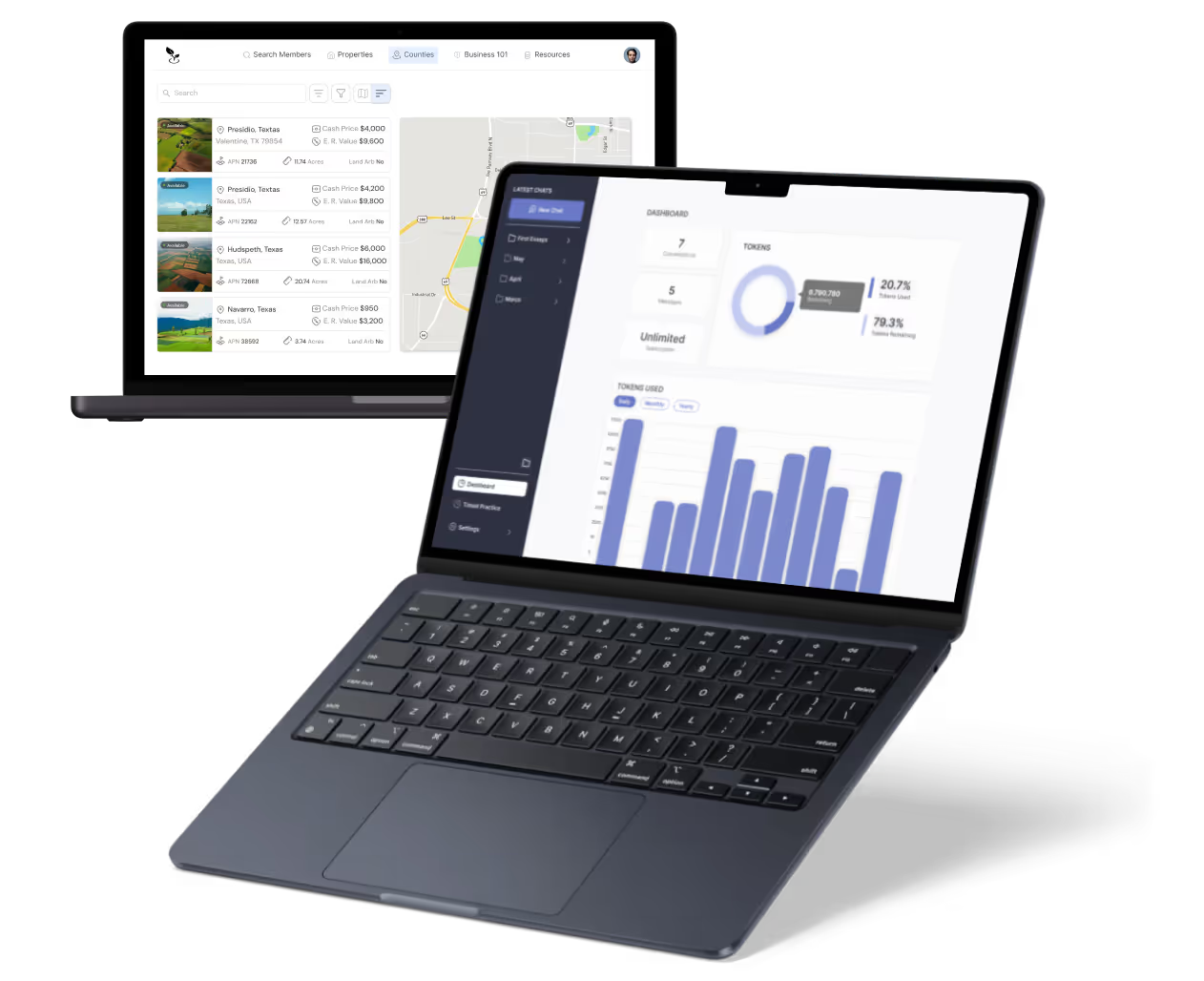

What Is an Agent Management App — and Why Build It with Bubble?
An agent management app is a platform for managing real estate agents: tracking their leads, deals, tasks, commissions, and performance from a single centralised dashboard.
Generic CRM tools like Salesforce or HubSpot are built for horizontal use cases. Real estate agent management has specific commission structures, pipeline stages, and compliance requirements they don't serve well.
- Purpose-built pipeline stages: A real estate deal pipeline has distinct stages, prospect, active, under-offer, exchanged, completed, that generic CRM tools require heavy customisation to support.
- Commission tracking integration: Bubble lets you link commission calculations directly to deal values and agent profiles without a separate payroll or finance tool.
- Multi-team visibility control: Team leads can see their agents' pipelines; agents can't see colleagues' leads. This role logic is straightforward in Bubble's privacy rules.
- Custom reporting: Performance dashboards show exactly the KPIs real estate managers track: conversion rates, average deal value, days-to-close, and pipeline coverage.
Agent management platforms are among the most high-value apps you can build with Bubble for real estate operators who've outgrown generic CRM tools and need a system built around their actual workflow.
What Features Should an Agent Management App Include?
An MVP agent management app needs agent profiles, lead intake and assignment, a deal pipeline, task management, and a basic performance dashboard in one role-aware interface.
Commission tracking and document management can be added in phase two. Prioritise the features agents use daily over reporting features managers use monthly.
- Agent profile management: Stores personal details, license number, team assignment, join date, commission rate, and linked User account for each agent.
- Lead intake and assignment: Captures inbound leads from web forms, phone, or third-party sources and assigns them to agents based on territory, specialty, or availability.
- Deal pipeline with stages: A Kanban or list view shows deals across prospect, active, under-offer, and completed stages with drag-and-drop or button-based stage updates.
- Task management per deal: Agents create and track tasks linked to specific deals - viewings, calls, document submissions - with due dates and priority levels.
- Commission tracking and calculator: When a deal completes, the system calculates commission based on deal value and the agent's rate, creating a Commission record for finance to process.
- Performance dashboard: Shows each agent's deals closed, conversion rate, pipeline value, and average days-to-close for a selected period.
- Document storage per deal: Offer letters, contracts, ID documents, and inspection reports attach to the Deal record with version tracking and upload notifications.
- Activity log per deal: Every status change, document upload, and communication is logged with a timestamp to create a complete deal history.
Clear feature prioritisation prevents agent management apps from becoming over-engineered before the first agent has used them in a live deal.
How Do You Structure the Database for an Agent Management App in Bubble?
The database needs seven types: Agent, Lead, Deal, Task, Commission, Activity Log, and Document, with Deal as the central record most workflows read from and write to.
Every performance metric, commission calculation, and permission check depends on the Agent and Deal relationship being correctly defined at the data layer.
- Agent: Fields include display name (text), license number (text), team (text or linked Team data type), join date (date), commission rate (number as percentage), and linked User (User).
- Lead: Fields include contact name (text), phone (text), email (text), lead source (option set: web/referral/portal/cold), property interest description (text), status (option set), and assigned agent (Agent).
- Deal: Fields include linked Lead (Lead), property address (text), deal value (number), pipeline stage (option set: prospect/active/under-offer/exchanged/completed/lost), assigned agent (Agent), and expected close date (date).
- Task: Fields include description (text), due date (date), priority (option set: low/medium/high/urgent), completion status (yes/no), linked Deal (Deal), and assigned to (Agent).
- Commission: Fields include deal value (number), commission rate applied (number), calculated amount (number), payment status (option set: pending/approved/paid), linked Deal (Deal), and agent (Agent).
- Activity Log: Fields include action description (text), timestamp (date), performed by (User), and linked Deal (Deal). This record is created by workflows only, never by direct user input.
- Document: Fields include file (file), document category (option set: offer/contract/ID/inspection/other), upload date (date), linked Deal (Deal), and uploaded by (User).
Separating Activity Log as its own data type rather than a text field on the Deal record makes log entries searchable and filterable. They are also far easier to display in a timeline view.
How Do You Build the Core Workflows for an Agent Management App in Bubble?
Core workflows handle lead assignment, pipeline stage transitions, task creation, commission calculation, performance aggregation, and overdue task alerts.
The pipeline stage update workflow is the most important to get right. It drives notifications, commission triggers, and audit logs across the entire system.
- Lead assignment: A backend workflow triggered on new Lead creation checks each agent's active lead count using "count of" aggregation and assigns the lead to the agent with the lowest current load.
- Pipeline stage update: When a Deal stage changes, a workflow logs the change to Activity Log with a timestamp, triggers a SendGrid email if stage is "under-offer" or "completed", and updates the Lead status accordingly.
- Task creation from Deal: An "Add Task" button on the Deal detail page opens a popup; on submit, a workflow creates the Task record linked to the current Deal and sends a Twilio SMS to the assigned agent.
- Commission calculation: When Deal stage is set to "completed", a backend workflow creates a Commission record using Deal value multiplied by the assigned Agent's commission rate field.
- Weekly performance aggregation: A scheduled weekly backend workflow runs "do a search for Deals" filtered by agent and date range, calculates KPIs, and writes the results to summary fields on each Agent record for fast dashboard display.
- Document upload notification: On file upload, a workflow creates the Document record, logs it to the Activity Log, and sends a SendGrid email to all deal participants listing the new document category.
- Overdue task alerts: A nightly scheduled workflow searches for Tasks where due date is before today and completion status is "no", then sends a SendGrid email to each assigned agent with their overdue task list.
Bubble's "do a search for" with "count" aggregation makes round-robin lead assignment possible without custom code. The key is ensuring the count query runs before the assignment, not after.
What Security and Data Requirements Apply to an Agent Management App?
Privacy rules must ensure agents see only their own leads and deals, team leads see their team's data, and commission records are visible only to the agent and admin roles.
An agent accidentally viewing a colleague's deal pipeline is a trust issue; an agent viewing a colleague's commission details is an HR incident. Both are preventable with correct privacy rules.
- Lead privacy rule: A Lead record is visible when "Current User is the linked Agent's User OR Current User's role is team-lead and the Agent's team matches the Current User's team OR Current User's role is admin."
- Deal privacy rule: Same team-scoped logic as Lead - agents see own deals, team leads see their team's deals, admin sees all. Pipeline stage and deal value fields included.
- Commission privacy rule: Commission records visible only when "Current User is the Agent's linked User OR Current User's role is admin or finance". Team leads should not see individual commission amounts.
- Activity Log privacy rule: Visible to all participants on the linked Deal - the agent, team lead in the same team, and admin. No user can create or modify Activity Log records directly.
- API endpoint security: Every backend API workflow that creates or updates records is restricted to authenticated users only with role validation as the first workflow step.
Bubble's security configuration ensures agents can only access their own leads and deals rather than browsing the full pipeline of colleagues or other teams.
What Plugins and Integrations Does an Agent Management App Need?
An agent management app needs chart visualisation, notifications, calendar sync, e-signature, and lead import integrations as core additions to Bubble's native functionality.
Avoid integrating every system at once. A phased approach that starts with SendGrid and chart plugins before calendar sync and e-signature keeps the initial build stable.
- Bubble Chart Element (native): Renders agent performance bar charts, pipeline funnel diagrams, and deal volume trend lines directly from Bubble data without external charting services.
- SendGrid plugin: Sends task due reminders, pipeline stage change notifications, commission payment alerts, and new lead assignment emails with per-type templates.
- Twilio plugin: Delivers SMS alerts for urgent notifications - new lead assignments, overdue high-priority tasks, or same-day viewing confirmations.
- Google Calendar API (via API Connector): Syncs viewing appointments and task due dates from Bubble to the agent's Google Calendar, with two-way sync for cancellation handling.
- DocuSign or HelloSign (via API Connector): Sends offer letters and contracts for e-signature directly from the Deal page; signed document URLs save back to the Document data type.
- Air PDF Conjurer: Generates formatted commission statements and deal summary PDFs from Bubble data for finance team use and agent records.
- Zapier or Make (via API Connector): Pushes inbound leads from Facebook Lead Ads, website contact forms, and portal enquiry webhooks directly into the Lead data type in Bubble.
- Stripe plugin: Optional for SaaS models - collects monthly platform subscription fees from agencies using the app if deployed as a multi-tenant product.
How Long Does It Take and What Does It Cost to Build an Agent Management App with Bubble?
A focused agent management MVP takes 6 to 12 weeks; a full multi-team platform with performance analytics, calendar sync, and e-signature takes 14 to 18 weeks.
Commission logic and performance aggregation are the two areas that consistently take longer than expected. Both involve calculations across multiple related data types.
- Solo MVP build: 8 to 12 weeks at 150 to 220 hours; covers agent profiles, lead intake, deal pipeline with stage updates, basic task management, and SendGrid notifications.
- Agency build: 6 to 10 weeks with a team; includes commission tracking, performance dashboards with charts, document workflows, role-based access, and Zapier lead import.
- Full multi-team platform: 14 to 18 weeks; adds multi-office support, advanced KPI reporting, Google Calendar sync, DocuSign integration, and optional Stripe subscription billing.
- Bubble plan recommendation: Growth plan at $119/month for single-team deployments; Team plan at $349/month when multiple editors are building simultaneously or data volume grows.
- SendGrid costs: Free tier (100 emails/day) is sufficient for early agency use; scales to paid plans as notification volume increases with agent and deal count.
- Twilio costs: Approximately $0.0079 per SMS in the US; a team of 20 agents receiving daily alerts stays well within $50/month.
- DocuSign costs: Individual plans start at approximately $10 per user per month for standard e-signature; API access for automated sending requires a business or enterprise plan.
Understanding Bubble's capabilities and limitations helps you plan where the agent management platform needs external integrations, like calendar sync or document generation, versus what Bubble handles natively.
Conclusion
Bubble gives real estate agencies a purpose-built agent management platform that outperforms generic CRM software at a fraction of the custom development cost.
Map your deal pipeline stages and commission structure before opening Bubble. Those two decisions shape every data type and workflow in the build.
Need Help Building Your Agent Management App on Bubble?
Agent management builds fail when commission calculations are hard-coded into deal workflows instead of agent profile data, and when team-scoped privacy rules are applied only at the UI level.
Both issues become expensive to fix once agents are actively working deals in the system.
At LOW/CODE Agency, we build AI-powered products for SMBs — custom web apps, mobile apps, chatbots, RAG systems, and AI agents, delivered with the depth and standards of a specialist software team. We scope the architecture, engineer the workflows, and stay involved through launch and beyond.
- Data architecture: We design your data types, option sets, and privacy rules before writing a single element on the canvas.
- Workflow engineering: We build backend workflows, scheduled jobs, and API integrations with proper logic and error handling.
- Plugin configuration: We select and configure the right Bubble plugins for your feature set without unnecessary bloat.
- Role-based access: We implement privacy rules at the database level, not just conditional UI visibility.
- Integration setup: We connect your Bubble app to Stripe, SendGrid, Twilio, and other services correctly from day one.
- Pre-launch testing: We test against real data before deployment so every workflow performs correctly under live conditions.
- Post-launch support: We stay involved after go-live to optimize as real usage data shapes the app.
We have built 350+ products for clients including Coca-Cola, American Express, Sotheby's, and Medtronic. We know exactly where Bubble builds fail and we address those problems before they surface.
Related Articles
Last updated on
September 24, 2026
.

Jesus is a visionary entrepreneur and tech expert. After nearly a decade working in web development, he founded LOW/CODE Agency to help businesses optimize their operations through custom software solutions.


FAQs
Can you build an agent management app without coding using Bubble?
How do you assign leads to agents in a Bubble agent management app?
How do you track agent commission in a Bubble agent management app?
How do you manage agent performance metrics in a Bubble app?
How do you handle agent onboarding workflows in a Bubble app?
How do you build a territory management feature in a Bubble agent app?
Related Articles

Bubble
How to Build an Impact Tracking App with Bubble
Measure what matters with Bubble. Build a no-code impact tracking app step-by-step log outcomes, visualize data & report results without coding.

Bubble
How to Build a Health Screening App with Bubble
Organize winning hackathons with a Bubble app no coding needed. Manage teams, submissions, and judging effortlessly on one no-code platform.

Bubble
How to Build an OKR Tracking App with Bubble
Build an OKR tracking app with Bubble. Connect company goals to team output and measure progress in real time — no code, no bloated software.

Bubble
How to Build a Conference Management App with Bubble
Launch a compliance training app with Bubble no coding required. Deliver courses, track completions, and certify staff step-by-step.


Why customers trust us for no-code development


