

White Label Mobile Apps: Are They Worth It?
13 min
read
Considering a white label mobile app? Learn the pros, cons, hidden costs, and limitations before choosing it over custom development.


Building a mobile app from scratch takes months and costs tens of thousands of dollars. White label mobile apps promise a shortcut by letting you rebrand and customize an existing platform instead of starting from zero.
But shortcuts come with trade-offs. This guide explains how white label mobile apps work, when they make sense, and when you should choose a different approach to mobile app development.
Key Takeaways
- White label apps save time and money by providing a pre-built foundation you customize with your branding, colors, and content.
- Customization has real limits because white label platforms restrict how much you can change the user experience and feature set.
- Best for proven business models where the workflow is standard enough that a template approach covers 80 percent of your needs.
- Vendor lock-in creates long-term risk since your app depends on a third-party platform you do not own or control.
- Not ideal for unique products because competitive differentiation requires custom features that white label platforms cannot deliver.
- Due diligence on providers matters since the quality, reliability, and longevity of your app depends entirely on the vendor behind it.
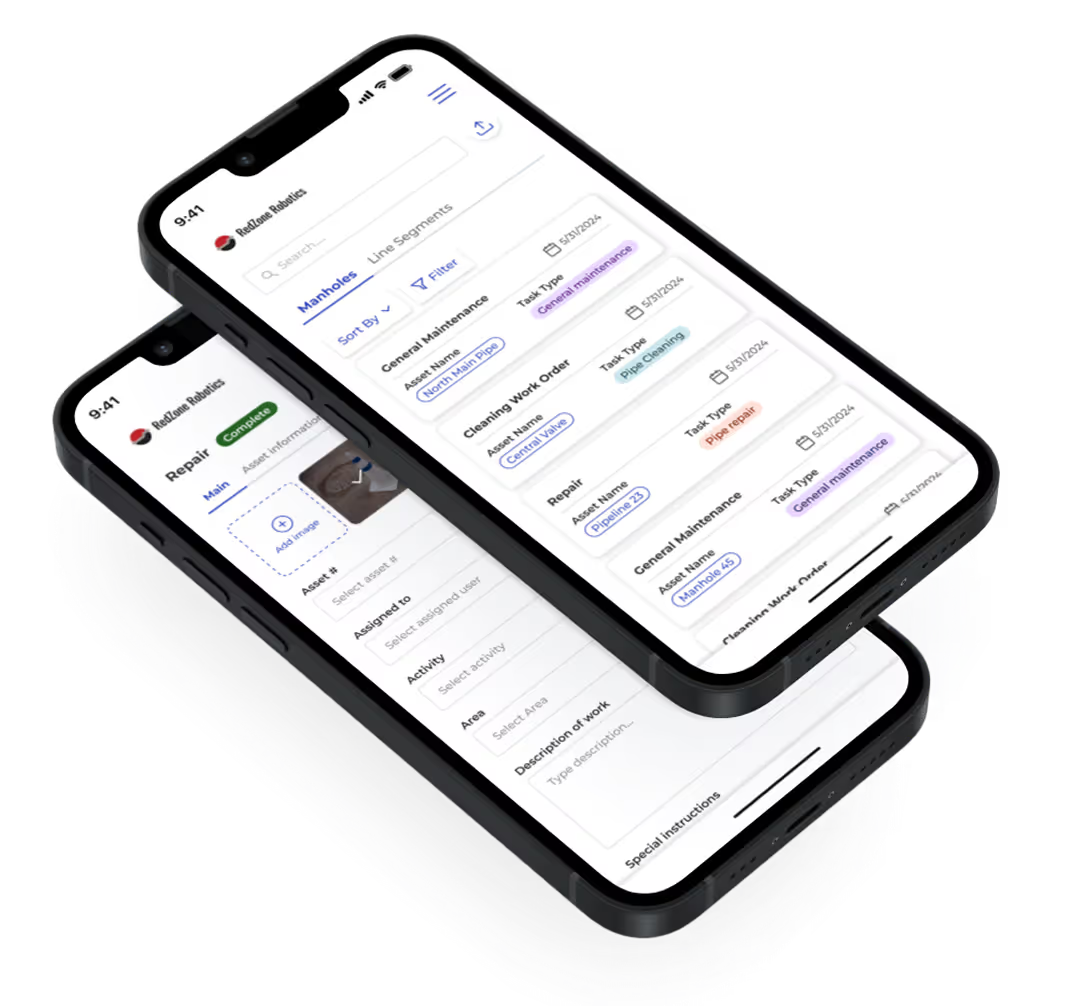

What Is a White Label Mobile App?
A white label mobile app is a pre-built application created by one company and sold to other businesses who rebrand it with their own logo, colors, content, and domain.
White label mobile apps work like private-label products in retail. Someone else builds the core product, and you put your brand on it. The end user never knows another company built the underlying technology.
- Core functionality is pre-built including standard features like user authentication, content management, push notifications, and payments.
- Branding customization is included so you add your logo, color scheme, fonts, and marketing copy to make the app look uniquely yours.
- App store submission is handled with the app published under your developer account and brand name on iOS and Android stores.
- Backend infrastructure is shared across all clients using the same white label platform, reducing hosting and maintenance costs.
- Updates come from the vendor who maintains the codebase, fixes bugs, and releases new features for all clients simultaneously.
White label mobile apps appeal to businesses that need a mobile presence quickly without the investment of custom development. They work well for industries with standardized workflows and predictable feature needs.
When Should You Choose a White Label Mobile App?
Choose white label when your business model follows a standard pattern, your timeline is tight, your budget is limited, and your competitive advantage comes from service quality rather than unique technology.
White label mobile apps are not for everyone. They work best in specific situations where speed and cost matter more than customization and long-term ownership of the technology platform.
- Standard business models fit best because industries like restaurants, fitness studios, and salons have predictable app requirements.
- Tight timelines demand speed since white label apps can launch in weeks compared to months for custom mobile app development.
- Limited budgets need efficiency because white label apps cost a fraction of custom builds, often starting under $10,000.
- Technology is not your differentiator when your competitive advantage comes from your product, service, or brand rather than your app's features.
- Testing market demand quickly before investing in custom development lets you validate that customers actually want a mobile experience.
- Seasonal needs justify temporary solutions when you need an app for a specific event-based period and cannot justify custom development costs.
If your app needs match what a white label platform offers, the approach saves significant time and money. But if your product requires unique features, hiring a mobile app development agency for custom work is the better investment.
What Are the Limitations of White Label Mobile Apps?
White label limitations include restricted customization, shared infrastructure, vendor dependency, limited scalability, and the inability to build features that differentiate your product from competitors using the same platform.
Understanding limitations before committing prevents expensive surprises later. Every white label platform has boundaries, and hitting those boundaries after launch creates frustrating constraints on your business growth.
- Feature customization is restricted because you can only configure what the platform allows, not build entirely new functionality.
- Design flexibility has hard ceilings since changing layouts, navigation patterns, or user flows beyond template options is usually impossible.
- Shared infrastructure limits performance because your app shares servers and databases with every other client on the same platform.
- Vendor dependency creates business risk since the platform shutting down, raising prices, or changing terms directly impacts your app.
- SEO and discoverability suffer when multiple businesses run nearly identical apps that search engines and app stores recognize as duplicates.
These limitations matter more as your business grows. What works at launch may become a constraint within a year when you need features, performance, or customization the platform cannot deliver.
How Much Do White Label Mobile Apps Cost Compared to Custom?
White label mobile apps cost $5,000 to $30,000 upfront with monthly fees of $200 to $2,000. Custom mobile app development ranges from $50,000 to $300,000 with separate maintenance costs.
The cost comparison between white label and custom development looks straightforward at first glance. But the real comparison requires factoring in long-term costs, limitations, and opportunity costs over time.
- White label upfront costs stay low with setup fees covering branding customization, content configuration, and app store submission.
- Monthly subscription fees add up since paying $500 to $2,000 monthly for years can exceed the cost of a custom build over time.
- Custom development costs more upfront but gives you full ownership of the code, design, and infrastructure without recurring platform fees.
- Hidden white label costs emerge when you need features outside the platform's capabilities and must pay for custom add-ons or workarounds.
- Three-year ownership often favors custom development for businesses that plan to grow and differentiate their mobile experience over time.
Understanding mobile app development cost in both models helps you make the right decision. Compare three-year total cost, not just first-year spend, to see which approach delivers better value.
What Industries Benefit Most From White Label Mobile Apps?
Industries with standardized customer workflows benefit most from white label apps. Restaurants, fitness studios, salons, real estate, and local service businesses see the strongest results from template-based approaches.
White label mobile apps work best when the customer journey is predictable and does not require unique features. The industries that benefit most share common patterns in how users interact with their mobile products.
- Restaurants use white label for ordering with menu display, online ordering, payment processing, and loyalty programs on standard templates.
- Fitness studios deploy booking apps that handle class scheduling, membership management, and push notification reminders for sessions.
- Salons and spas offer appointment booking with service menus, staff selection, and automated reminders that follow industry-standard patterns.
- Real estate agents list properties with search filters, saved listings, and contact forms that follow established user experience patterns.
- Local service businesses handle bookings for cleaning, landscaping, and home maintenance with scheduling and payment on simple templates.
- Churches and nonprofits distribute content through apps with event calendars, donation processing, and media libraries on standard platforms.
These industries benefit because their app requirements are well-understood and widely served by white label platforms. Industries with unique workflows or complex integrations usually need custom development instead.
If your business falls into one of these categories and you need a mobile presence quickly, white label is worth serious consideration as a first step before committing to custom development.
What Risks Should You Consider Before Choosing White Label?
Key risks include vendor lock-in, limited intellectual property ownership, data security concerns, inability to scale beyond platform limits, and brand dilution from competitors using the same underlying application.
White label mobile apps carry business risks that are easy to overlook when the speed and cost savings are attractive. Understanding these risks upfront helps you mitigate them or choose a different path.
- Vendor lock-in traps your business because migrating away from a white label platform often means rebuilding the entire app from scratch.
- IP ownership stays with the vendor since you license the software rather than owning it, limiting your exit options and asset value.
- Data security depends on the vendor because your customer data lives on their infrastructure under their security practices and policies.
- Scalability hits platform ceilings when your user base, transaction volume, or feature needs outgrow what the white label supports.
- Brand perception suffers when competitors in your market use the same white label platform and customers notice identical experiences.
Evaluate these risks against your business timeline and growth plans. For short-term needs with limited growth expectations, white label risks may be acceptable. For long-term products, they usually are not.
When Should You Migrate From White Label to Custom Development?
Migrate from white label to custom when the platform limits your growth, competitors using the same template erode your differentiation, feature requests exceed platform capabilities, or total costs approach custom development pricing.
Many businesses start with white label mobile apps and eventually outgrow them. Recognizing when to migrate prevents you from staying on a platform that constrains your product and frustrates your customers.
- Feature requests consistently hit platform limits when customers ask for functionality the white label cannot support or customize.
- Revenue justifies the investment once your app generates enough income to fund custom development and ongoing maintenance comfortably.
- Competitors have identical experiences when multiple businesses in your market use the same white label and users cannot tell them apart.
- Performance bottlenecks affect user experience when shared infrastructure cannot handle your traffic volumes during peak usage periods.
- Data portability becomes urgent when you need customer data in formats or integrations the white label provider does not support.
- Strategic value requires ownership when investors, acquirers, or partners need to see proprietary technology as part of your business assets.
Plan your migration as a phased project, not a sudden switch. Run both platforms in parallel during transition to avoid service disruptions that alienate your existing users.
Budget for the migration to take three to six months depending on your app's complexity and user base size, and communicate the transition plan to customers well in advance.
How Do You Evaluate White Label App Quality Before Committing?
Evaluate quality by testing the provider's demo app on real devices, checking app store ratings for existing clients, reviewing their update frequency, measuring load performance, and verifying their security practices and compliance certifications.
Choosing a white label provider based on a sales presentation is a mistake many businesses make. The gap between what a demo shows and what the production app delivers can be significant.
- Device testing on your actual target hardware catches performance, layout, and usability issues that vary across different screen sizes and OS versions.
- App store ratings for other clients using the platform reveal real-world issues with reliability, speed, and user satisfaction.
- Release history shows update cadence because infrequent updates signal a platform that may fall behind OS requirements.
- Performance benchmarks and uptime data show whether shared infrastructure meets your speed requirements given how the provider manages capacity.
- Security certifications and data handling practices must be verified especially if your app will handle payment information or personal customer data.
- Industry references let similar businesses share honest feedback about limitations you might encounter on the platform.
Due diligence before signing a white label agreement saves you from discovering quality issues after your brand is already attached to a subpar product. Spend at least two weeks evaluating a provider before committing.
The time invested upfront prevents months of frustration with a platform that cannot deliver the experience your customers deserve.
How Do You Choose a White Label Mobile App Provider?
Choose a provider by evaluating their platform reliability, customization options, pricing transparency, , data ownership terms, and track record with businesses in your industry.
Not all white label providers are equal. The wrong choice leads to a poor-quality app that reflects badly on your brand and creates technical debt you cannot easily escape.
- Platform uptime and performance history shows whether the provider can deliver the reliability your customers expect from your brand.
- Customization depth beyond branding determines whether you can adjust workflows, features, and user experiences to fit your specific needs.
- Pricing transparency prevents surprises when all fees, including setup, monthly, overage, and feature add-on costs are disclosed upfront.
- Data portability terms protect your business by ensuring you can export customer data and content if you decide to leave the platform.
- Industry-specific experience matters because providers who serve your industry understand the features and workflows your customers expect.
- Contract flexibility allows exit through reasonable terms that do not lock you into multi-year agreements with steep cancellation penalties.
Review agency pricing models and white label provider terms side by side. Sometimes the cost difference between white label and a lean custom build is smaller than you think.
Ready to Decide Between White Label and Custom Mobile App Development?
White label mobile apps solve real problems for the right businesses. They fail when used as permanent solutions for products that need to grow, differentiate, and evolve beyond template limitations.
At LOW/CODE Agency, we help SMBs compete with AI-powered software built for them — custom web and mobile apps, RAG systems, chatbots, and intelligent agents delivered by a senior development team. We help businesses evaluate whether white label, low-code, or custom development is the right approach for their specific situation and growth plans.
- Discovery assesses your real needs so the recommendation is based on your business model, audience, and growth trajectory.
- Design creates differentiated experiences that set your product apart from competitors regardless of the underlying technology approach.
- Build uses the right platform from FlutterFlow and Bubble for speed to custom Flutter when full control is required.
- Scalability is planned into the architecture so your app handles growth without hitting platform ceilings that force painful migrations.
- Delivery includes full store deployment with optimized listings and compliance handling for both iOS and Android marketplaces.
- Partnership provides honest guidance on when to use templates, when to go custom, and when to transition from one to the other.
Over 350 projects delivered for clients including Medtronic, American Express, Coca-Cola, Zapier, and Sotheby's. We build across FlutterFlow, Bubble, Glide, Webflow, Make, n8n, and Zapier.
Our team at LOW/CODE Agency will help you choose the right approach and execute it with confidence.
Related Articles
Last updated on
September 3, 2026
.

Jesus is a visionary entrepreneur and tech expert. After nearly a decade working in web development, he founded LOW/CODE Agency to help businesses optimize their operations through custom software solutions.


FAQs
What is a white label mobile app?
What are the advantages of white label mobile apps?
What are the limitations of white label mobile apps?
When does a white label mobile app make sense over custom development?
How much do white label mobile apps cost?
Can I switch from a white label mobile app to a custom-built one later?
Related Articles

Mobile App Development
How to Validate Your Mobile App Idea First
Don't build a mobile app nobody wants. Learn how to validate your idea with real users before spending time and money on development.

Mobile App Development
Top Mobile App Development Agencies
Find the top mobile app development agencies in 2026. Compare leading firms by expertise, pricing, and client results to choose the right partner for your app.

Mobile App Development
Mobile Developer Hourly Rates (Is Offshore Really Cheaper?)
Mobile developer hourly rates explained by region and experience. Compare offshore vs onshore costs and see if offshore is truly cheaper long term.
Mobile App Development
Business Mobile App Development Guide
Learn how to develop a business mobile app that boosts sales, improves engagement, and streamlines operations. Complete step-by-step guide included

Why customers trust us for no-code development


