

Top Vendor Dashboard Features in Marketplace Apps
16 min
read
Discover key vendor dashboard features that improve management and sales in marketplace apps for better vendor experience and efficiency.


Most marketplace builds spend 80% of the design effort on the buyer experience and treat the vendor dashboard as an afterthought. This is backwards. Vendor churn kills marketplace liquidity before buyer acquisition has a chance to work.
This guide maps every vendor dashboard feature a marketplace must include, with clear distinctions between what is required at MVP and what belongs at the scale stage.
Key Takeaways
- Retention tool first: Vendors who can manage listings, track orders, and see earnings stay on the platform. Vendors who cannot leave, regardless of buyer-side quality.
- Four categories define completeness: Listing management, order operations, performance analytics, and payout management must all be present for a vendor to operate without external tools.
- Analytics is underbuilt most often: Vendors who cannot see conversion rates or listing performance have no basis for improving their offering, which reduces GMV across the board.
- Payout visibility is non-negotiable: Financial opacity is the fastest way to lose vendor trust, and trust lost at the payment layer is the hardest kind to recover.
- MVP can be minimal, not absent: At minimum, a vendor must be able to list products, receive order notifications, fulfil orders, and receive payment. Below this threshold, the vendor cannot operate.
- Design for vendor workflows: A dashboard that looks like a buyer account with extra menu items will frustrate sellers whose daily workflow is fundamentally different.

What Is a Vendor Dashboard and Why Does It Matter?
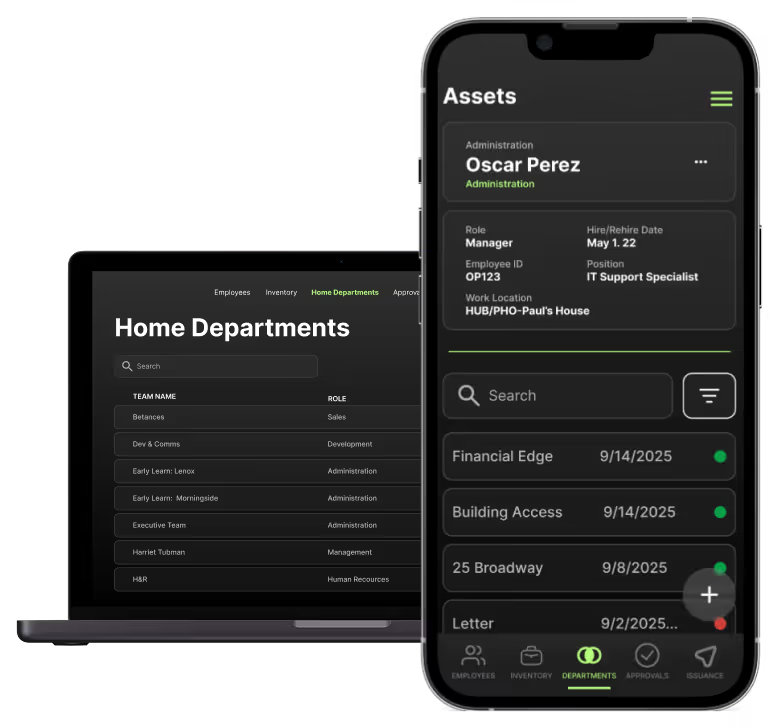
A vendor dashboard is the operational control centre for sellers on a marketplace, giving them tools to manage listings, process orders, track performance, and receive payment. It is a distinct product from the buyer experience and must be designed around vendor workflows, not adapted from buyer account screens.
The complete marketplace feature requirements map covers every layer of a marketplace app beyond the vendor-side experience.
Vendor dashboard quality directly affects marketplace health through a supply-side retention loop.
- Listing friction compounds: Vendors who find listing creation slow or error-prone create fewer, lower-quality listings, which reduces buyer selection and conversion.
- Order visibility gaps hurt buyers: Vendors who miss orders or cannot track fulfilment status generate more disputes and buyer dissatisfaction, damaging platform NPS.
- Financial opacity drives churn: Vendors who cannot reconcile their gross sales to their net payout lose confidence in the platform's financial reliability.
- Self-sufficiency is the design goal: A vendor dashboard should allow a seller to manage their entire marketplace presence, from listing to payout, without external tooling.
The supply-side retention loop matters as much as the buyer acquisition funnel. Vendor churn reduces listing supply, which reduces buyer selection, which reduces GMV, which reduces platform ability to attract and retain vendors.
What Listing Management Features Must a Vendor Dashboard Include?
Listing management is the primary day-to-day vendor activity. The features in this section determine whether vendors can build and maintain a high-quality marketplace presence efficiently.
Each sub-area below covers a distinct layer of the listing management experience.
Listing Creation Interface
At minimum, every vendor needs title, rich text description, multi-image upload with reordering, category selection, pricing controls, stock quantity management, and listing status control (draft, active, paused).
Bulk listing import via CSV or API is a scale feature for vendors with large catalogues.
- Rich text descriptions: Vendors need formatting control to write clear, structured descriptions that convert, not a plain text field.
- Status controls: Draft, active, and paused states let vendors manage listing visibility without deleting and recreating listings.
- Bulk import at scale: CSV or API import becomes essential once any vendor manages more than 50 active listings simultaneously.
Listing creation friction directly reduces listing volume. Every additional required step that does not add buyer value is a step that reduces the number of listings on the platform.
Listing Management and Editing
Vendors must be able to edit live listings without taking them offline, duplicate listings for similar products, and manage variants within a single listing.
A management view should show all active, paused, and draft listings with status indicators and quick-action controls.
- Live editing: Forcing vendors to unpublish before editing creates supply gaps that reduce buyer discovery during high-traffic periods.
- Listing duplication: Vendors with similar products should be able to create a listing once and duplicate it, rather than rebuilding from scratch.
- Variant management: Size, colour, and material variants within a single listing prevent catalogue fragmentation and simplify the buyer's selection experience.
A clean management view reduces the time vendors spend on administrative tasks, which increases the time they spend on listing quality and inventory growth.
Image and Media Management
Product images are a primary conversion driver on consumer marketplaces. The listing interface must support multi-image upload, image reordering with cover image selection, and ideally image quality guidance.
Image optimisation (compression, WebP conversion) should be handled by the platform, not the vendor.
- Cover image selection: The first image in search results determines click-through rate. Vendors need control over which image appears in that position.
- Quality guidance at upload: Showing resolution requirements and aspect ratio recommendations at upload prevents poor-quality images from reaching buyers.
- Platform-side optimisation: Requiring vendors to compress and convert images before upload creates friction and inconsistent image quality across the catalogue.
Platforms that enforce image quality at upload consistently show higher buyer engagement and lower listing abandonment rates than those that moderate image quality post-publication.
Category and Attribute Management
Vendors must assign listings to the correct categories and populate category-specific attributes that buyers use for filtering. The attribute system should surface relevant fields based on the selected category.
Showing every possible attribute on every listing form creates noise and increases listing creation time.
- Dynamic attribute fields: Surfacing only the attributes relevant to the selected category reduces cognitive load and increases attribute completion rates.
- Buyer-facing filter alignment: Attributes vendors fill in during listing creation are the same attributes buyers use to filter search results. Completeness directly affects discoverability.
- Category suggestion assistance: Auto-suggesting the correct category based on listing title keywords reduces miscategorisation, which is a common cause of zero-result searches.
Attribute completion rate is a useful proxy metric for listing quality. Platforms that make attribute entry easier see higher completion rates and better search conversion.
Listing Performance Preview
Before publishing, vendors should be able to preview how their listing appears to buyers, including the listing page view, search result snippet, and mobile view.
This reduces poor-quality listings that drive buyer dissatisfaction.
- Search snippet preview: Vendors can see how their title and primary image appear in search results before going live, enabling pre-publication optimisation.
- Mobile view preview: Most buyer traffic is mobile. Vendors need to see the mobile layout to catch formatting issues that desktop previews do not reveal.
- Reduced post-publication remediation: Problems identified in preview cost minutes to fix. Problems identified after a listing receives buyer traffic cost listing performance to correct.
Preview capability reduces the support overhead of vendors asking why their listings are underperforming. The answer is often visible in the preview.
What Order Management Features Must a Vendor Dashboard Include?
Order management features determine whether vendors can fulfil orders reliably and maintain buyer satisfaction. Gaps in this layer produce disputes, negative reviews, and buyer churn.
Each sub-area covers a distinct part of the vendor order management workflow.
Order Notification and Alert System
Vendors must be notified of new orders immediately. Email notification is the MVP baseline. In-app notification and mobile push notification are production requirements.
An unnoticed order is a delayed fulfilment. A delayed fulfilment is a negative review and a potential dispute.
- Email notification at MVP: Email remains the most reliable fallback channel for order alerts, ensuring notification delivery even when vendors are not in-app.
- Push notification at production: Mobile push notifications reduce order response time from hours to minutes for vendors managing their business from their phone.
- Alert configuration options: Vendors with high order volumes need control over notification frequency to avoid alert fatigue while maintaining coverage.
Alert system reliability is not a UX feature. It is an operational requirement. Every missed order notification is a vendor performance problem and a buyer satisfaction problem simultaneously.
Order Queue and Status Management
A clear order queue showing all active orders, organised by status (new, accepted, in progress, shipped, completed, disputed) is non-negotiable. Vendors must be able to update order status and mark orders complete.
Order filtering by status, date, and buyer is a production-stage addition.
- Status-organised queue: Grouping orders by status (new, in progress, completed) lets vendors prioritise their workflow without manually tracking fulfilment state.
- Tracking information entry: For product marketplaces, vendors need a field to enter shipping tracking numbers that buyers can access directly from their order view.
- Filtering at scale: Once a vendor processes more than 20 orders per day, filtering by status and date becomes essential for operational efficiency.
The order queue is the vendor's primary operational interface. Poor queue design at launch is one of the most common causes of vendor complaints in early marketplace operations.
Order Detail View
Each order must have a dedicated detail view showing buyer information, ordered items and quantities, payment confirmation, fulfilment deadline, buyer communication thread, and order timeline.
The order detail view is the primary dispute prevention tool.
- Buyer communication thread: Centralised message history within the order detail view prevents vendors from losing track of buyer instructions or special requests.
- Order timeline visibility: A timestamped timeline of order events (placed, accepted, shipped, delivered) gives vendors and buyers a shared reference point for any dispute.
- Payment confirmation visibility: Vendors who can confirm payment status from within the order detail view do not need to contact support to verify whether an order is paid.
Vendors with full order visibility generate fewer disputes. Disputes cost both vendor time and platform support overhead. Prevention is significantly cheaper than resolution.
Dispute and Return Management
Vendors must be able to respond to buyer disputes and return requests from within the dashboard. At minimum: dispute notification, evidence submission, response submission, and outcome visibility.
Dispute resolution itself is an admin function. Vendor access is to participate, not to resolve disputes unilaterally.
- Dispute notification: Vendors must be alerted immediately when a buyer raises a dispute, giving them the opportunity to respond before an escalation to admin is triggered.
- Evidence submission: Vendors need to upload text and image evidence (proof of shipping, communication records, product condition photos) directly from the dispute interface.
- Outcome visibility: Once a dispute is resolved, vendors must see the outcome and any financial adjustment from within their dashboard, not via a separate email.
The technical architecture behind order and commission management, including state machine design, commission calculation logic, and payout triggers, is covered in depth in that guide.
What Vendor Analytics Features Should a Marketplace Dashboard Include?
Vendor analytics features determine whether sellers can understand their performance and improve their marketplace business. Without this layer, vendors have no feedback loop for optimising listings, which means the platform carries the full cost of listing quality improvement.
Each sub-area covers a distinct analytics layer.
Performance Overview
At minimum, every vendor needs total sales (lifetime and period), order count, average order value, and listing count. These are the baseline metrics vendors check first.
Display these as summary cards at the top of the dashboard with period selectors (last 7 days, last 30 days, last 12 months).
- Period comparison: Showing current period versus previous period enables vendors to identify whether their performance is improving or declining without manual calculation.
- Summary card design: Placing key metrics above the fold ensures vendors see their performance state on every dashboard visit, not only when they actively look for it.
- Average order value tracking: AOV is the simplest indicator of whether a vendor's pricing and product mix strategy is working over time.
A vendor who checks their summary metrics regularly is a vendor who is engaged with the platform. Dashboard design that makes metrics easy to access increases the frequency of that engagement.
Listing-Level Analytics
Vendors need to see which listings are performing and which are not. At minimum: views per listing, conversion rate (views to purchases), and average rating.
This data allows vendors to improve low-performing listings and understand what drives purchases.
- Views per listing: A listing with high views and low conversion indicates a pricing or trust problem. A listing with low views indicates a discoverability problem. Different interventions apply.
- Conversion rate by listing: Conversion rate is the most actionable metric a vendor has. It points directly at the listing elements that are preventing purchase decisions.
- Average rating per listing: Per-listing rating data lets vendors identify which products generate negative buyer experiences, rather than only seeing their overall seller rating.
Listing-level analytics increase GMV without any platform investment. Vendors who can identify and fix underperforming listings improve the platform's overall conversion rate as a side effect.
Search Visibility Metrics
If the platform surfaces search ranking data, vendors can see how often a listing appears in search results and where it ranks. This is a production-stage feature that requires search infrastructure logging impression and ranking data.
It is a high-value vendor retention tool when built.
- Impression volume: Vendors who see their impression counts understand whether their discoverability problem is a search ranking issue or a conversion issue after the impression.
- Ranking position data: Showing vendors where their listings rank for relevant searches enables targeted listing optimisation, which improves platform-wide search quality.
- Search visibility as retention: Vendors who can see and act on their search performance are less likely to abandon the platform for a competitor, because they have a clear optimisation path.
Search visibility metrics are a significant investment to build, but they return value in reduced vendor churn, improved listing quality, and reduced support inquiries about listing visibility.
Revenue and Earnings Reporting
Vendors need a clear view of their earnings history: gross sales, platform commission deducted, net earnings, and payout schedule.
Period filtering and downloadable CSV reports are strong additions for vendors managing marketplace income in accounting software.
- Commission deduction visibility: Showing gross sale, commission amount, and net earnings in a single row lets vendors verify every transaction without contacting support.
- Downloadable transaction history: CSV export of earnings history is a frequently requested vendor feature, particularly for sellers filing taxes or reconciling accounting records.
- Payout schedule visibility: Showing the next payout date and amount in the earnings report reduces payment-related support tickets, which are among the most common vendor support requests.
The architecture behind vendor ratings and review data, including fraud detection, display logic, and seller response systems, is covered in that guide.
For the full analytics framework, including platform-level metrics that context-set vendor performance data, the marketplace analytics and KPIs guide covers the measurement layer in full.
What Financial and Payout Management Features Must a Vendor Dashboard Include?
Financial transparency is the single most trust-sensitive area of the vendor dashboard. Vendors who cannot reconcile their earnings, see their pending payouts, or understand fee deductions lose confidence in the platform faster than they would lose it for any other reason.
Each sub-area covers a distinct layer of financial management.
Payout Setup and Bank Account Management
Vendors must be able to connect their payout account securely from the dashboard. At minimum: bank account or payment provider connection via Stripe Connect or equivalent, account verification status, and ability to update payout details.
This must be completed during onboarding.
- Stripe Connect or equivalent: Using an established payment infrastructure provider for payout account management reduces compliance risk and development time for the platform team.
- Verification status visibility: Vendors need to see whether their payout account is verified, pending verification, or flagged, so they know whether payouts will process correctly.
- Update capability without support: Vendors who can update their payout account independently do not need to raise a support ticket when their banking details change.
Vendors who cannot connect a payout account during onboarding cannot receive earnings. A friction-free payout setup flow is as important as the listing creation flow.
Earnings and Payout Dashboard
At minimum: pending balance, available balance, payout history (date, amount, destination account), and upcoming payout schedule. This is the single most trust-sensitive page in the vendor dashboard.
Any ambiguity on this page generates support tickets and churn.
- Pending versus available balance distinction: Vendors need to understand which earnings are clearing versus which are ready to withdraw, to avoid confusion about why a balance has not arrived.
- Payout history with transaction detail: Each payout history entry should link to the transactions included in that payout so vendors can reconcile the amount independently.
- Upcoming payout schedule: Showing the next payout date and expected amount reduces "when will I be paid?" support tickets, which are a disproportionate share of vendor support volume.
The earnings and payout page warrants design investment proportionate to its trust impact. A confusing layout here is more damaging to vendor retention than almost any other design problem on the platform.
Commission and Fee Transparency
Every platform deduction from vendor earnings must be visible and explainable: platform commission (percentage of sale price), payment processing fee (if passed to the vendor), and any listing fees.
Vendors who cannot reconcile gross sales to net payout with a clear fee breakdown lose confidence in the platform's financial fairness.
- Line-item fee breakdown: Showing each fee as a separate line item in the transaction record makes commission structures transparent and eliminates the most common vendor dispute trigger.
- Commission rate visibility: Vendors should be able to see their applicable commission rate from within the dashboard without needing to consult external documentation.
- Fee change communication: When the platform changes commission rates or fee structures, affected vendors must receive advance notice with clear before-and-after figures.
Financial opacity is not a minor inconvenience. Vendors who feel unclear about how their earnings are calculated are the most likely to explore competing platforms, regardless of how well other parts of the dashboard perform.
Tax Documentation
Vendors operating at meaningful transaction volumes need tax documentation support, including annual earnings summaries and, where applicable, 1099 forms (US) or equivalent documentation in EU and UK jurisdictions.
This is a legal requirement for platforms above threshold transaction volumes in many jurisdictions.
- Annual earnings summaries: A downloadable summary of gross income, platform fees, and net earnings for the tax year is the minimum viable tax document for vendor self-filing.
- 1099 generation for US platforms: US platforms with vendors earning above $600 per year are required to generate 1099-K forms. Automating this removes a significant compliance burden as the platform scales.
- Jurisdiction-aware documentation: EU VAT registration thresholds and UK Making Tax Digital requirements create documentation obligations that vary by vendor geography. The platform must account for these at the architecture level.
Tax documentation is frequently deferred from MVP and then becomes an urgent engineering task when the platform crosses a transaction volume threshold. Plan for it before the threshold arrives.
How Does the Vendor Dashboard Relate to the Admin Panel?
The vendor dashboard and the admin panel are complementary systems, not parallel ones. They must be scoped together, because the boundary between vendor self-service and admin intervention is a deliberate design decision with direct consequences for platform governance and vendor satisfaction.
Vendors control their own listings, order status updates, payout account setup, and buyer communication. Admins control vendor approval and suspension, listing moderation, dispute final resolution, commission rate configuration, and platform-wide reporting.
- Over-permissioning risk: Giving vendors admin-level control over their own accounts creates governance gaps. Vendors may modify data or settings in ways that bypass platform policies.
- Under-permissioning friction: Requiring admin action for routine operations (editing a listing, updating bank details) creates support overhead and vendor frustration that drives churn.
- Shared data dependency: If the admin panel is built without reference to vendor dashboard data, admins work blind. If the vendor dashboard is built without admin oversight capabilities, the platform cannot enforce its own policies.
- Permission boundary documentation: The line between vendor and admin permissions must be documented before either interface is built, not resolved during development.
The relationship between vendor-facing controls and admin-facing oversight is a design decision. Admin panel design for marketplaces covers how to scope the admin layer that sits above the vendor experience.
Conclusion
The vendor dashboard is not a secondary feature. It is the interface that determines whether sellers stay on the platform long enough for the marketplace to work.
A vendor who can list efficiently, track orders reliably, understand their performance, and receive payment transparently is a vendor who stays. Audit your current vendor dashboard specification against the four categories in this guide. Missing features in the payout or order operations categories are the highest-priority items to address before launch.
Building a Marketplace? The Vendor Dashboard Is Where Retention Starts.
Vendor churn rarely announces itself early. It shows up in GMV decline after the platform has grown enough for supply-side gaps to hurt buyer experience. By then, rebuilding the vendor dashboard is an expensive retrofit.
At LOW/CODE Agency, we started as builders and that has not changed. Today we build AI-powered products — web apps, mobile apps, RAG systems, chatbots, and AI agents — specifically for SMBs that want real software, not a SaaS subscription. We scope vendor dashboard features as a connected system across all four layers before development begins. That means the listing management, order operations, analytics, and payout features are designed to work together, not bolted on sequentially.
- Vendor workflow mapping: We map the full vendor journey from sign-up to payout before recommending any feature set or technical architecture.
- Feature layer scoping: We define MVP-required features versus scale-stage additions for each dashboard layer so development budget is spent in the right order.
- Payout architecture design: We design earnings, commission, and payout flows using Stripe Connect or equivalent so financial transparency is built in from the first release.
- Admin-vendor boundary design: We scope the permission boundary between vendor self-service and admin oversight before either interface is built, preventing governance gaps.
- Analytics layer specification: We define the specific metrics, period selectors, and data models for vendor-facing analytics so the data infrastructure is built correctly from the start.
- Mobile-first dashboard design: We design vendor dashboards for mobile-first use, because many vendors manage their marketplace business from their phones, not a desktop.
- Full product team delivery: Strategy, UX design, development, and QA from a single team, so the vendor dashboard ships as a coherent product, not a collection of independent features.
We have built 450+ products for clients including Coca-Cola, American Express, and Sotheby's.
Related Articles
- How to Build a 3D Model Marketplace
- Claude for Small Business Explained (2026 Launch)
- Effective Vendor Management for Marketplace Apps
- Vendor Agreements & Terms for Marketplace Apps
- Effective Vendor Acquisition Strategy for Marketplace Apps
- Top Types of Marketplace Apps Explained
Looking to build a mobile app? Our mobile app development services cover the full build lifecycle.
Last updated on
September 28, 2026
.

Jesus is a visionary entrepreneur and tech expert. After nearly a decade working in web development, he founded LOW/CODE Agency to help businesses optimize their operations through custom software solutions.


FAQs
What are essential features of a vendor dashboard in marketplace apps?
How does a vendor dashboard improve sales performance?
Can vendors customize their dashboard in marketplace apps?
What security measures are important for vendor dashboards?
How do vendor dashboards handle payment and commission tracking?
Are vendor dashboards mobile-friendly in marketplace apps?
Related Articles

Marketplace
Marketplace App Architecture Explained
Discover key components and best practices for designing scalable marketplace app architecture efficiently.

Marketplace
How to Build a Music Teacher Marketplace
Learn step-by-step how to create a successful music teacher marketplace with key features, platform choices, and marketing tips.

Marketplace
How to Build an Automation Specialist Marketplace
Learn key steps to create a successful marketplace connecting automation specialists with clients efficiently and securely.

Marketplace
How to Build a Merchandise Printing Marketplace
Learn step-by-step how to build a successful merchandise printing marketplace with key features and best practices.


Why customers trust us for no-code development


