

How to Build a Fleet Services Marketplace
Learn key steps to create a successful fleet services marketplace with expert tips on features, technology, and user experience.


How to build a fleet services marketplace means solving a problem that costs fleet operators hours every week. Fleet operators spend those hours sourcing maintenance, fuel, insurance, and repair vendors through fragmented channels: phone calls, spreadsheets, and one-off supplier relationships that have no central record.
A fleet services marketplace consolidates all of that into a single platform where operators find, compare, book, and pay for services across their entire fleet. This article gives you the complete architecture, features, and build sequence to create that platform correctly.
Key Takeaways
- B2B complexity demands purpose-built architecture: Fleet services marketplaces serve business accounts with multi-vehicle fleets, purchase orders, and approval workflows. Standard B2C templates will not accommodate these requirements without significant rework.
- Vendor verification is non-negotiable: Fleet operators need certified mechanics, licensed fuel suppliers, and insured service providers. A credentialing and compliance layer must be built into onboarding from the start.
- Payment flows are more complex here: Fleet accounts require invoice-based billing, credit terms, multi-vehicle job tracking, and split payments across cost centers. Standard checkout flows fail at these requirements.
- Search and matching are the core product: Fleet operators search by service type, geographic radius, vehicle compatibility, and turnaround time. The matching engine determines whether the platform is actually useful.
- Commission plus subscription hybrid works best: Transaction fees on service bookings combined with tiered vendor subscription plans produce more stable revenue than either model alone.
- Build for mobile from day one: Fleet managers and drivers access the platform from the road. A mobile-first interface is a product requirement, not a nice-to-have feature.

What Makes a Fleet Services Marketplace Different from a B2C Platform?
Understanding B2B marketplace development fundamentals is the right starting point before designing any architecture specific to fleet services. The structural differences between a fleet services marketplace and a standard consumer platform determine what you actually need to build.
Fleet customers are business accounts managing multiple vehicles with cost centers, approval hierarchies, and purchase order requirements.
- Business account model: Fleet customers manage multiple vehicles and have procurement requirements that individual consumers do not. The user model is fundamentally different from a B2C platform.
- Service complexity: Fleet services span maintenance scheduling, fuel management, tire replacement, compliance checks, insurance, and emergency roadside. The category breadth requires a structured service taxonomy.
- Geography and availability: Fleet operators need service providers within specific operational corridors, with SLA-based availability for breakdown cover. Location logic and availability windows are core to the matching function.
- B2B purchasing logic: Corporate accounts negotiate rates, require invoicing with NET payment terms, and need consolidated billing across multiple vehicles and cost centers. None of this exists in a B2C checkout flow.
A founder who approaches fleet services as a consumer marketplace will spend six months discovering why their payment system, approval flow, and vendor credentialing all need to be rebuilt. Design for B2B from the start.
What Features Does a Fleet Services Marketplace Need?
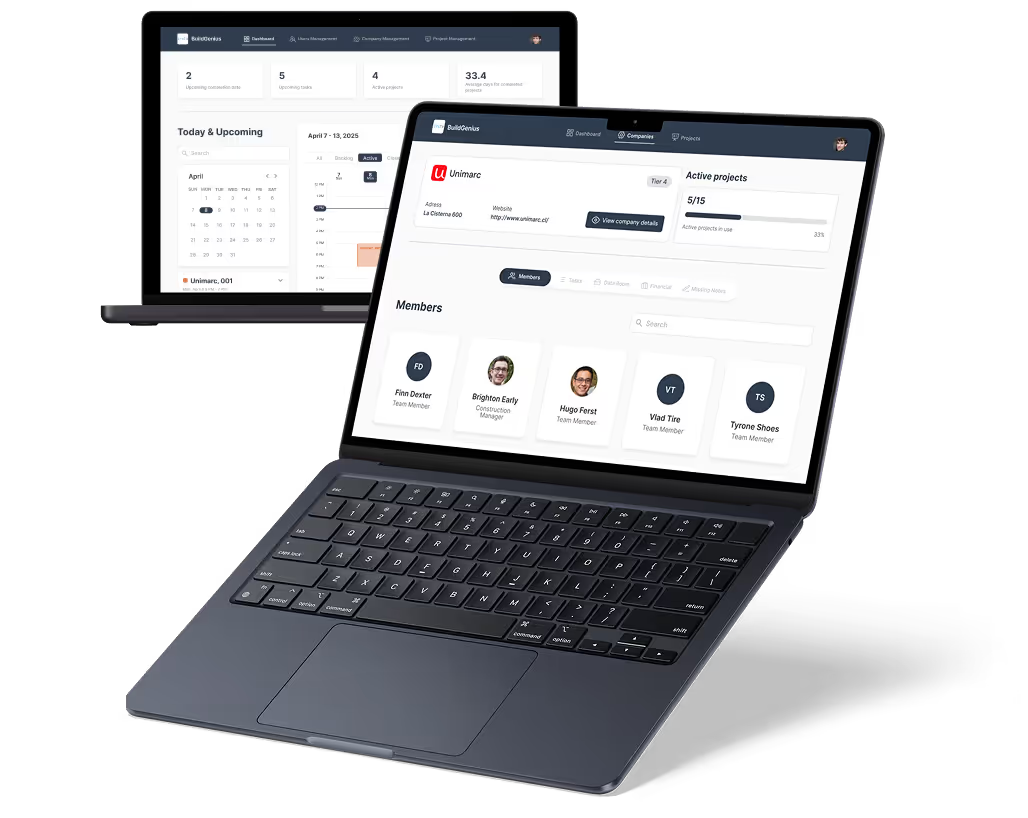
While core marketplace app features apply across all marketplace types, fleet services adds a layer of B2B-specific functionality that consumer-focused feature lists do not capture. The feature set divides into seven distinct modules.
Fleet Operator Dashboard
Account management for multiple vehicles, driver assignments, service history per vehicle, maintenance schedules, and cost reporting by cost center or vehicle. This is the command layer that fleet account managers use daily.
Service Provider Profiles
Verified credentials, service categories, geographic coverage zones, vehicle type compatibility, availability calendar, pricing structure, and verified customer ratings. Profile completeness directly affects search ranking and booking conversion.
Advanced Search and Matching Engine
Filter by service type, vehicle make and model, geographic radius, turnaround time, price range, and certification status, with real-time availability confirmation. The matching engine is the platform's primary value proposition for fleet operators.
Booking and Scheduling System
Real-time slot selection, job assignment to specific vehicles and drivers, automated confirmation and reminder workflows, and estimated completion time tracking. Fleet operators book on behalf of specific vehicles and need this detail in the confirmation.
Quote and Approval Workflow
Multi-step approval routing for jobs above a defined spend threshold, quote comparison across multiple providers, and purchase order generation integrated with the client's procurement system.
Ratings and Reviews System
Post-service ratings tied to specific vehicles and job types, flagging system for compliance breaches, and provider performance metrics visible to fleet account managers reviewing vendor relationships.
Invoicing and Billing Module
Consolidated invoicing across multiple jobs, NET payment term support, cost center allocation, and integration with common fleet management and accounting systems. This module determines whether enterprise fleet accounts will adopt the platform at all.
How Do You Onboard and Manage Fleet Service Providers?
The principles of managing marketplace vendors at scale apply directly here, but fleet services adds credentialing and compliance layers that most marketplace vendor guides do not address in enough depth.
A rigorous vendor onboarding system is what makes the platform safe for fleet operators to depend on.
- Credentialing requirements: Service providers must submit trade certifications, insurance certificates, regulatory licenses, and vehicle type qualifications. Automated verification workflows reduce onboarding time without lowering the compliance bar.
- Geographic coverage configuration: Vendors define their service radius, availability windows, and vehicle type capabilities. This data feeds the matching engine directly and must be structured, not free-text.
- Performance monitoring: Track completion rates, response time to bookings, customer satisfaction scores, and compliance incident rate. Build automated alerts that flag underperforming vendors before fleet operators experience the problem.
- Tiered vendor status: Standard, preferred, and certified tiers based on performance history and volume. Preferred status unlocks better placement in search results and access to enterprise fleet accounts.
- Offboarding and dispute resolution: Define clear criteria for vendor suspension or removal, build a dispute resolution workflow for contested jobs, and ensure the vendor contract includes the platform's removal rights explicitly.
Proactive performance monitoring is more valuable than reactive dispute resolution. Build the alerting system before you have disputes to resolve.
What Payment Architecture Does a Fleet Marketplace Require?
Standard marketplace payment systems handle consumer transactions well. Fleet services requires a significant extension of that architecture to support B2B payment flows that most payment guides never address.
The B2B payment requirements for fleet services span the entire job lifecycle.
- Invoice-based billing with NET terms: Fleet accounts typically require NET 30 or NET 60 payment terms. The platform must support delayed settlement to the vendor while extending credit to the fleet operator, which requires a float or financing partnership.
- Cost center allocation: Large fleet accounts allocate service costs to specific vehicles, departments, or projects. The payment system must capture this allocation at the point of booking, not retrospectively.
- Split payments and multi-vehicle jobs: A single service run covering ten vehicles may involve different service providers and cost centers. The payment engine must handle this without manual reconciliation after the fact.
- Purchase order integration: Enterprise fleet accounts raise POs before authorising payment. The platform needs a PO reference field, PO matching on invoice, and the ability to hold payment until PO confirmation is received.
- Escrow for high-value jobs: Major maintenance or fleet retrofit jobs should use escrow to protect both parties, with funds held and released on job completion confirmation.
The payment architecture for fleet services is the section most B2B marketplace builds underestimate. Build it correctly at the start or plan to rebuild it when the first enterprise account asks for NET terms.
How Do You Make Money From a Fleet Services Marketplace?
Evaluating fleet marketplace monetization options before you build prevents architecture decisions that are hard to reverse. The payment and billing system needs to support your revenue model from day one, not be retrofitted to it.
Five revenue streams apply at different platform maturity stages.
- Commission on service bookings: 8 to 15 percent transaction fee on each completed service booking. Lower than B2C rates because B2B accounts are price-sensitive and have negotiating leverage at volume.
- Vendor subscription tiers: Monthly or annual plans for service providers covering basic listing, featured placement, and enterprise access to large fleet accounts, typically $99 to $499 per month.
- Fleet operator subscription: Premium accounts for large fleet operators that unlock consolidated billing, API integration with fleet management software, and advanced reporting, typically $199 to $999 per month per fleet account.
- Lead generation fees: Vendors pay a fixed fee per qualified lead sent to them, useful for new vendor acquisition campaigns before they have enough bookings to benefit from commission alone.
- Data and analytics products: Anonymised fleet servicing data has commercial value for parts suppliers, insurers, and industry benchmarking products, a revenue stream available at scale.
Commission-first at launch, then introduce vendor subscription tiers once the platform has proven booking volume. Data products come last, after you have enough transaction history to make the benchmarking valuable.
What Is the Right Technology Stack for a Fleet Services Marketplace?
Tool choice directly affects how quickly you reach a working platform and how much you need to rebuild when enterprise accounts arrive with their specific requirements.
Build and tech decisions have direct consequences for timeline, cost, and long-term scalability.
- Low-code route (fastest to market): Bubble, Adalo, or a configured n8n plus Stripe stack can produce a functional MVP in 6 to 10 weeks, best for validating demand before committing to a full build.
- Custom build route (maximum control): React or Next.js frontend, Node.js or Python backend, PostgreSQL for relational fleet data, Google Maps API for geographic matching, and Stripe Connect for multi-party payments. Realistic 4 to 6 month build timeline for a production-ready platform.
- Key integrations to plan from day one: Fleet management software like Samsara or Fleetio, accounting systems like Xero or QuickBooks, and telematics data feeds. These integrations are what enterprise fleet accounts will ask for before signing.
- Mobile requirements: A React Native or Flutter app for drivers and on-site fleet managers. Web-only platforms lose ground quickly in a market where drivers need job notifications and service updates on their phone.
- Scalability considerations: Geographic expansion requires multi-region database architecture and routing logic that scales. Build with this in mind from the start, not as a retrofit.
How Do You Launch and Grow a Fleet Services Marketplace?
The cold-start problem in fleet services is significant. A platform with no vendors has negative value for fleet operators who arrive to no coverage. Solve supply first.
Growth follows a specific sequence that most fleet marketplace founders get backward.
- Supply before demand: Recruit and credential 20 to 30 service providers in a single city before opening to fleet operators. A platform with no vendors is worse than no platform at all.
- Target fleet operators directly: Corporate fleet managers are concentrated in logistics, utilities, construction, and local government. Direct outreach and partnership with fleet management software vendors accelerates operator acquisition.
- Use guaranteed SLAs to win first enterprise accounts: Offer the first 10 enterprise fleet accounts a guaranteed response time SLA backed by platform credits. This removes the risk perception of switching from an existing vendor relationship.
- Key metrics in the first 90 days: Vendor response rate to booking requests above 85 percent, average time from booking to confirmation under 2 hours, and repeat booking rate per fleet account above 60 percent within 60 days.
- Referral and account expansion: Fleet operators manage vehicles across multiple sites. A single satisfied account is the fastest path to multi-site expansion. Build referral incentives into the account management flow.
Conclusion
Building a fleet services marketplace is a more structurally complex project than a standard B2C platform. The B2B payment architecture, vendor credentialing system, and geographic matching logic all need to be right before the platform is genuinely useful to fleet operators.
Fleet services is a highly fragmented market with significant pain, and the operators who find a reliable platform tend to become high-retention, high-volume accounts. Map your target service categories and the geographic corridor where you will launch, then identify the 20 to 30 service providers you need to credential before opening to fleet operators.
Building a Fleet Services Marketplace? Start With the Architecture That Scales.
Most fleet services marketplace builds stall because the B2B payment complexity and vendor credentialing requirements are underestimated at the scoping stage. By the time the first enterprise account arrives with its actual requirements, the platform needs to be rebuilt.
We are LOW/CODE Agency — an AI product development company for SMBs. We build across the full stack: web apps, mobile apps, AI chatbots, RAG pipelines, and autonomous agents. Custom software, built by experts. We design B2B marketplace platforms with the vendor credentialing system, B2B payment architecture, and geographic matching logic that corporate fleet accounts require before they commit to a platform relationship.
- Platform architecture scoping: We map the complete feature set, data model, and payment flow for a fleet services marketplace before any code is written or platform is configured.
- Vendor credentialing build: We design and build the onboarding verification workflow, credential document storage, expiry monitoring, and automated suppression logic for vendor compliance management.
- B2B payment infrastructure: We implement NET terms billing, cost center allocation, PO integration, split payments across multi-vehicle jobs, and escrow for high-value service contracts.
- Fleet operator dashboard: We build the multi-vehicle account management, service history tracking, and cost center reporting that enterprise fleet accounts expect from a platform they will use daily.
- Search and matching engine: We build the geographic radius search, vehicle compatibility filtering, certification status matching, and real-time availability confirmation that makes the platform genuinely useful.
- Mobile app build: We deliver the driver and fleet manager mobile interface in React Native or FlutterFlow so the platform works from the road, not just from a desk.
- Full product team: Strategy, UX, development, and QA from one team across the complete build, with post-launch support through the first enterprise account onboarding.
We have built 350+ products for clients including Coca-Cola, American Express, and Sotheby's. We know what enterprise B2B marketplace accounts expect and we build to those standards before they ask.
Related Articles
Last updated on
September 28, 2026
.

Jesus is a visionary entrepreneur and tech expert. After nearly a decade working in web development, he founded LOW/CODE Agency to help businesses optimize their operations through custom software solutions.


FAQs
What are the essential features of a fleet services marketplace?
Which technology stack is best for developing a fleet services platform?
How can I attract both fleet owners and customers to my marketplace?
What legal considerations should I keep in mind when building this marketplace?
How do I ensure secure transactions on a fleet services marketplace?
What are common challenges when launching a fleet services marketplace?
Related Articles

Marketplace
How to Build a Student Project Marketplace
Learn step-by-step how to create a student project marketplace with essential features, platform choices, and tips for success.

Marketplace
How to Build a Printing and Design Marketplace
Learn key steps to create a successful printing and design marketplace with expert tips on platform features, marketing, and user experience.

Marketplace
How to Build a Language Teacher Marketplace
Learn key steps to build a successful language teacher marketplace with effective features and strategies for growth and user engagement.

Marketplace
How to Build a Photography Marketplace
Learn key steps to create a photography marketplace platform that connects photographers and buyers effectively.

Why customers trust us for no-code development


