

How Manual Processes Impact Business Time Costs
Discover how much time manual processes cost your business and ways to improve efficiency.


Manual processes costing your business time rarely appear on a profit and loss statement, which is exactly why most businesses underestimate the damage until they calculate it properly. The cost hides in payroll, error correction, and missed opportunities rather than appearing as a named line item.
This guide gives you the calculation framework to find your real number, along with the tools to eliminate it.
Key Takeaways
- The true cost is invisible: Manual process costs hide in payroll, error correction, and missed opportunities rather than as a visible line item in your accounts.
- Average loss is significant: Studies consistently show employees spend 40 to 60% of their working week on tasks that could be partially or fully automated.
- Error multiplies cost: Each manual error requiring correction adds 30 to 200% of the original task time, compounding the real cost substantially.
- Opportunity cost is the largest component: The most expensive thing about manual work is what your skilled people are not doing while copying data between spreadsheets.
- Automation ROI is fast: Most businesses recover the cost of a proper Zapier setup within four to eight weeks of deployment.

What Are the Warning Signs Your Processes Are Broken?
The signs processes need automation are often visible long before a business quantifies the actual cost: recognizing them early makes the calculation worthwhile before the damage compounds further.
- Regular overtime just to keep up: When team members consistently work overtime to complete administrative tasks that are simply volume-based, that is an automation signal.
- Data errors appearing repeatedly: Recurring errors in reports, invoices, or customer records are a direct symptom of manual data handling and the transcription mistakes it introduces.
- Delayed responses that should be instant: Customers or colleagues waiting for replies that should be triggered automatically: order confirmations, lead acknowledgments, invoice receipts.
- Disconnected, manually updated spreadsheets: Information living in spreadsheets that are out of date within hours of being updated is a classic manual process symptom.
- New hire onboarding to manual workarounds: When new employees need two weeks to learn the workarounds "everyone just knows," those workarounds are the real process, and they should be automated.
The warning signs compound. Businesses that recognize three or more of these patterns consistently are typically spending significantly more on manual processes than they realize.
How Do You Calculate the Real Cost of Manual Work?
Calculating your real manual process cost requires five steps. Apply each to your actual situation to produce a defensible annual figure.
- Step 1: List repetitive tasks: Identify every task that follows the same steps repeatedly: data entry, report copying, notification sending, record updating, and record weekly time per person.
- Step 2: Apply loaded hourly cost: Multiply hours by the loaded hourly rate (salary plus employer contributions plus benefits divided by annual working hours) for each person performing the task.
- Step 3: Add error correction overhead: Add 20 to 40% to the base task time to account for errors that require correction: manual entry error rates run at 1 to 5% per data point under normal working conditions.
- Step 4: Add management supervision time: Include hours spent by managers reviewing, correcting, and following up on manual processes: thisis frequently 15 to 25% of the task time itself.
- Step 5: Add delayed response cost: Estimate the value of leads not followed up quickly, invoices sent late, approvals delayed: thesehave a revenue and relationship cost beyond the direct time cost.
The result is typically two to three times higher than business owners expect when they first run the calculation.
What Does Manual Data Entry Actually Cost Per Year?
Worked examples make the calculation framework tangible. These figures are illustrative: apply your own numbers to the same structure.
- Sales rep admin is typically the largest cost: A five-person sales team spending five hours each per week on CRM admin represents over $45,000 per year before error correction.
- Finance manual reconciliation is consistently underestimated: Two hours daily of invoice reconciliation compounds to over $13,000 per year for a single team member.
- Error correction adds a predictable premium: At a 25% rework rate, a business with $67,860 in base manual task cost carries an additional $17,000 in error-related time annually.
- The combined total for a 20-person business: Illustrative calculations consistently produce figures in the $85,000 to $150,000 per year range for businesses at this scale.
- These are recoverable costs: Unlike fixed infrastructure costs, manual process time is largely recoverable through automation: theannual figure represents the accessible ROI.
What Is the Opportunity Cost of Manual Work?
The direct cost of manual processes is only the first layer. Opportunity cost: whatyour team could create if freed from repetitive work: is often the larger number.
- Sales rep time misallocation: A rep spending 10 hours per week on CRM admin instead of selling is using 25% of their productive capacity on work that delivers zero revenue.
- Customer success relationship loss: A customer success manager manually sending onboarding emails instead of building relationships with at-risk customers amplifies churn risk directly.
- Operations manager rebuilding spreadsheets: Time spent reconstructing a broken spreadsheet each week is time not spent improving the processes that drive actual business performance.
- Morale and retention cost: High-performing employees leave roles dominated by low-complexity manual work: recruitment and onboarding costs from preventable turnover are real.
- Strategic decision latency: When data arrives late because it was entered manually, strategic decisions get made on stale information: theopportunity cost is measured in decisions, not just hours.
How Do Errors in Manual Processes Compound the Cost?
Manual processes do not just cost time: theyintroduce errors that multiply the real cost. Industry research places manual data entry error rates at 1 to 5% per entry at standard working pace.
- Downstream error impact is disproportionate: A wrong address on an invoice triggers a correction cycle involving accounts, the client, and potentially the delivery team: one error creates four to six correction steps.
- Customer-facing errors carry relationship cost: Wrong pricing, missed order details, and delayed confirmations damage customer confidence in ways that cannot be measured purely in correction time.
- Detection delay amplifies correction cost: Most manual errors are not caught at source: theysurface later, when correction is most expensive and the business consequence most significant.
- Error volume scales with transaction volume: A 2% error rate on 100 monthly records means 2 corrections. The same rate on 1,000 records means 20 corrections per month: thecost scales with growth.
- Automation eliminates the error category: Automation does not catch errors better than humans: itremoves the human step where errors originate, eliminating the error category entirely from the workflow.
Which Tasks Should You Automate First?
Identifying the tasks Zapier can handle in your specific business is the first practical step after calculating how much the manual version is costing you.
- Prioritize by frequency times time: The highest-priority automation candidates are the tasks that occur most often and take the most time per occurrence: thisproduces the fastest payback.
- Lead routing and CRM entry: Manual lead capture from web forms, paid ads, and events is the most universally applicable automation win for sales teams at any size.
- Invoice sending and reconciliation: Finance teams typically recover the most time per person from automating invoice generation, sending, and payment matching.
- Report generation and sharing: Marketing and operations teams spending weekly hours compiling and distributing data reports recover significant capacity from a single automation.
- The 80/20 rule applies: The top five automations in most SMEs eliminate 80% of the manual overhead: you do not need to automate everything to dramatically reduce the cost.
How Does Zapier Eliminate Manual Work?
Understanding what Zapier does at a mechanical level helps business owners see exactly which manual steps get replaced and which still require human handling.
Zapier monitors trigger events in connected apps and fires actions in others automatically. The moment a form is submitted, a payment is received, or a record is updated, the workflow fires: without any human polling, checking, or copying.
- No human polling required: Zapier watches for trigger events continuously: team members do not need to check tools periodically to see if action is required.
- Multi-step workflows replace manual sequences: A new form submission can trigger CRM entry, sales rep notification, and a welcome email in a single Zap: replacing a sequence that previously required three manual steps across three tools.
- Filters eliminate manual sorting: Zapier filters ensure automation only fires when conditions are met: routing logic that previously required human judgment runs automatically.
- Real-time execution: A new lead submission processed by Zapier reaches the CRM, the sales rep notification, and the lead's inbox within seconds: notthe 15 to 60 minutes a manual process requires.
- Zero transcription errors: Data moves from source to destination via Zapier exactly as it appears in the trigger tool: no re-typing, no field confusion, no format translation by a human.
Which Automation Tool Fits Your Budget?
Comparing Zapier versus Make costs reveals that the right choice depends on workflow complexity and monthly task volume rather than platform quality alone.
- Zapier: $19.99 to $449 per month depending on task volume: best for ease of setup, the broadest app library, and teams without technical configuration experience.
- Make: $9 to $299 per month: better for complex workflows at lower per-operation cost; more configuration required but more powerful for high-volume, multi-path automations.
- Power Automate: Included in many Microsoft 365 plans: zero incremental cost for Microsoft-native teams, with deep integration into Teams, SharePoint, and Dynamics.
- n8n self-hosted: $10 to $30 per month for hosting: unlimited tasks but requires technical setup and self-managed infrastructure maintenance.
- Automation wins on cost at all meaningful scales: At any task volume above minimal usage, automation platform cost is a small fraction of the manual labor cost it replaces.
What If You Already Have Microsoft Tools?
For businesses already paying for Microsoft 365, Power Automate alternative assessment often reveals that meaningful automation is already available at no additional cost.
- Power Automate is included in Microsoft 365 Business Standard and above: Teams paying for M365 already have access to a capable automation platform: mostdo not know it or use it.
- Microsoft ecosystem integration is unmatched: Teams, SharePoint, Dynamics, and Outlook integration depth within Power Automate is not replicated by any third-party tool.
- Approval workflows and notifications: The most common first Power Automate use cases: document approvals, Teams notifications, and Outlook-triggered actions: are straightforward to configure without any additional spend.
- When Zapier is still needed: Non-Microsoft app integrations: Stripe, HubSpot, Shopify, Typeform: oftenlack native Power Automate connectors, making Zapier necessary alongside Power Automate.
- Both tools can coexist: Microsoft-native workflows in Power Automate, non-Microsoft cross-tool automation in Zapier: many businesses use both depending on the apps involved.
Want Help Quantifying and Eliminating Your Manual Process Costs?
The cost of manual processes is real, calculable, and almost always larger than business owners expect. The first step is doing the math, not buying a tool.
At LOW/CODE Agency, we build AI-powered products for SMBs — custom web apps, mobile apps, chatbots, RAG systems, and AI agents, delivered with the depth and standards of a specialist software team. We help businesses calculate their actual manual process cost, identify the highest-value automation opportunities, and build Zapier workflows that convert manual overhead into competitive advantage.
- Process cost audit: We help you calculate your real annual manual process cost using the framework in this article, with your actual numbers, not illustrative ones.
- Automation prioritization: We identify which five automations will recover the most time and eliminate the most errors in your specific business context.
- Full-stack Zapier builds: From simple lead capture Zaps to multi-step CRM and finance automation workflows, we build what your team needs to eliminate the manual overhead.
- Error handling by default: Every workflow we build includes explicit error paths so failures are caught and resolved before they cause business damage.
- ROI documentation: We calculate and document the expected return from every automation so you can present the investment case to leadership with confidence.
- Ongoing maintenance: Monthly retainer options cover API updates, workflow improvements, and new automation builds as your business and stack evolve.
- Rapid deployment: Most SME automation programs start delivering time savings within the first two weeks of engagement.
We have built 450+ products for clients including Coca-Cola, American Express, and Zapier.
Related Articles
- How to Prioritize Processes for Zapier Automation
- How to Plan Your Zapier Automation Project Effectively
- How to Map Business Processes Before Automating with Zapier
- How to Justify Zapier Investment to Leadership
- Is Zapier the Best Automation Tool for Your Business?
- How to Choose the Best Zapier Development Agency
Last updated on
September 3, 2026
.

Jesus is a visionary entrepreneur and tech expert. After nearly a decade working in web development, he founded LOW/CODE Agency to help businesses optimize their operations through custom software solutions.


FAQs
What are the hidden time costs of manual business processes?
How can manual workflows affect employee productivity?
What is the average time lost due to manual data entry in businesses?
How do manual processes impact customer service response times?
Are there risks associated with relying on manual processes in business?
What are effective ways to reduce time lost in manual business tasks?
Related Articles
Business Automation
No-code/Low-code
Best 12 No-code Automation Tools (How to choose the best one)
Compare the best no-code automation tools like Zapier, Make, and n8n. Learn use cases, limits, costs, and how to choose the right tool.
Business Automation
35 Low-code Automation Ideas Using Make for BPA
Discover 35 low-code automation ideas using Make to solve BPA challenges, automate workflows, reduce manual work, and scale operations faster.
Business Automation
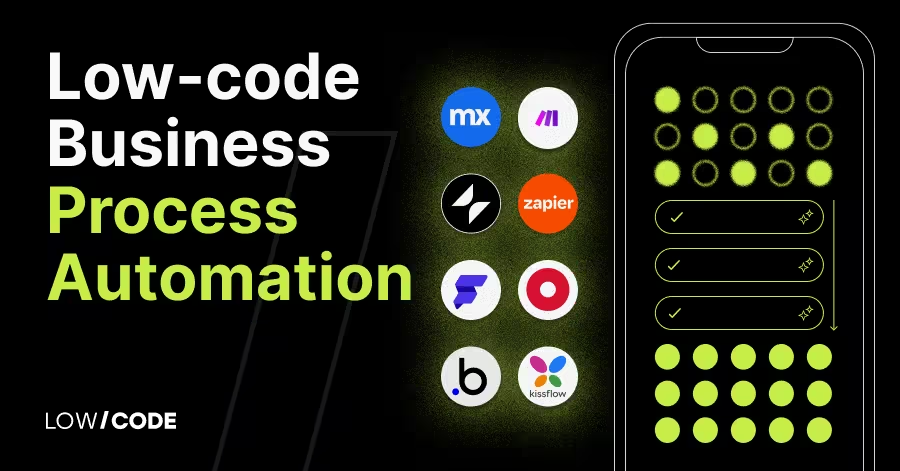
Guide to Low-code Business Process Automation
What is low-code business process automation? Understand how it works, why it matters, and how it compares to traditional automation methods

Business Automation
How to Hire a Zapier Developer for Your Team
Learn the best steps to hire a skilled Zapier developer to automate workflows and boost your team's productivity effectively.


Why customers trust us for no-code development


