

How to Build a Product Catalog App with FlutterFlow
16 min
read
Learn how to create a product catalog app using FlutterFlow with step-by-step guidance and tips for beginners.


What if your sales team could browse every product, variant, and spec on their phone with data that is always current? A FlutterFlow product catalog app makes that possible without custom development, but large SKU counts and multi-language requirements define the platform's real boundaries.
FlutterFlow handles the browsing experience, search, and real-time data layer well. This article covers exactly what it builds, what it costs, realistic timelines, and where architecture decisions matter before you commit to a build.
Key Takeaways
- Catalog-ready features are native: Product grids, variant detail pages, search, filtering, barcode scanning, and PDF spec sheets are all achievable without custom code.
- Real-time data updates instantly: Firestore keeps catalog content live so price or spec changes reflect immediately across all user devices without manual cache clearing.
- No ecommerce layer required: A pure catalog app without checkout is built faster and with simpler architecture than a combined catalog-plus-store solution.
- B2B and B2C both fit: Product catalog apps serve field sales reps, trade buyers, and consumer browsing use cases equally well from a single FlutterFlow build.
- Large catalog search needs a dedicated layer: Catalogs with tens of thousands of SKUs require Algolia or Typesense integration because Firestore full-text search does not scale to that volume.
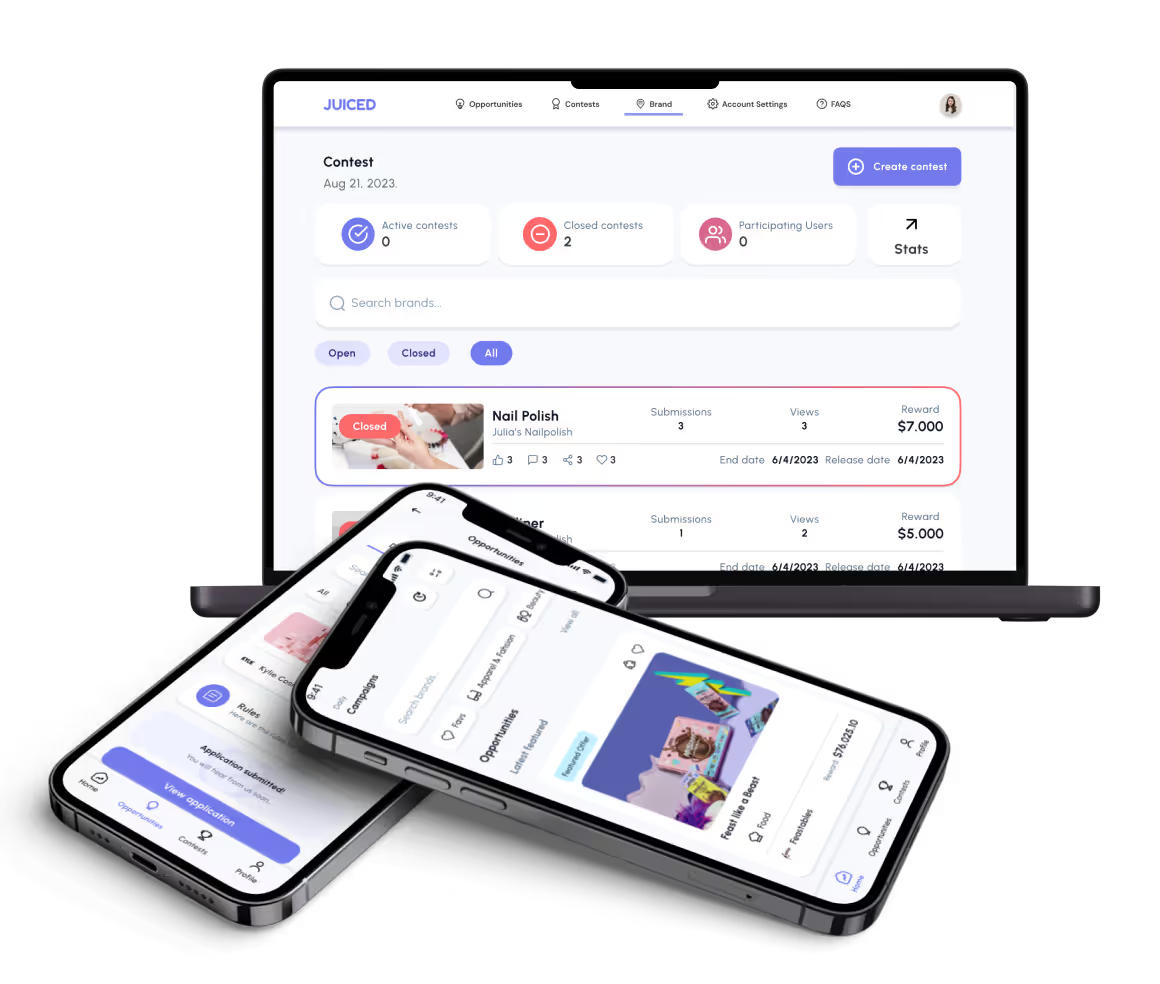

What Can FlutterFlow Build for a Product Catalog App?
FlutterFlow builds rich browsing experiences, real-time product data, search and filter interfaces, barcode scanning, and offline catalog access. It is a strong fit for B2B and B2C catalog apps without requiring a custom CMS or API layer.
Before reviewing these features, understanding what FlutterFlow does as a visual builder helps set expectations for what is native versus what requires a custom integration layer.
Category and Subcategory Navigation
Hierarchical category trees let users drill from broad product families into specific subcategories with tap-through navigation, supporting catalogs with multiple levels of product organisation.
Category structures are stored in Firestore and can be updated by a content administrator without requiring a developer to modify the app's navigation structure.
- Hierarchical browse: Users tap from top-level categories into subcategories and product lists, navigating deep product families without losing their position in the hierarchy.
- Dynamic category data: Category names, images, and product counts pull from Firestore, so catalogue administrators update the structure without requiring app changes or redeployment.
- Visual category cards: Each category displays with a thumbnail image and product count, giving users enough context to select the right branch quickly without opening multiple screens.
Product Detail Pages with Spec Sheets
Each product page displays images, technical specifications, dimensions, materials, and downloadable PDF data sheets, giving sales reps and buyers everything they need without leaving the app.
Product detail content is stored in Firestore with PDF assets in Firebase Storage, making content updates immediate without an app store release cycle.
- Full specification display: Technical specs, dimensions, materials, and certifications display on the product page, giving field sales teams the detail they need for client conversations.
- Image gallery: Multiple product images display in a swipeable gallery with zoom capability, reducing the need for printed catalogues or separate product image files.
- PDF spec sheet download: Data sheet PDFs stored in Firebase Storage are downloadable directly from the product page for sharing with clients or reference during site visits.
Advanced Search and Filter Engine
Users filter by price range, category, brand, availability, and custom attributes using Firestore query chains and filter panels, with results updating in real time as filter selections change.
For catalogs under approximately 5,000 SKUs, Firestore queries handle search and filter requirements effectively. Larger catalogs need Algolia or Typesense for reliable full-text search performance.
- Multi-attribute filtering: Users apply simultaneous filters across price range, category, brand, and custom attributes, with the result set narrowing in real time as each filter is selected.
- Firestore query performance: Firestore compound queries handle filter combinations reliably for catalogs up to approximately 5,000 SKUs without requiring a dedicated search service.
- Algolia integration path: For larger catalogs, Algolia integrates via FlutterFlow's API action builder to provide full-text search, typo tolerance, and faceted filtering at scale.
Product Comparison View
A side-by-side comparison screen lets users select up to three products and view their specifications in a parallel layout, making purchasing decisions faster for technically complex product categories.
This feature is particularly valuable for B2B catalogs where buyers need to compare specifications across similar products before making a procurement decision or client recommendation.
- Side-by-side layout: Up to three products display in a parallel column layout with specification rows aligned for direct attribute comparison across the selected products.
- Select-to-compare: Users add products to the comparison list from any product card or detail page, with a persistent comparison tray tracking their current selections.
- Attribute highlighting: Differences between compared products can be visually flagged, helping buyers identify the most relevant distinctions quickly during a sales conversation.
Barcode and QR Code Lookup
Sales reps scan a product barcode with their phone camera and land directly on the product detail page in the catalog app, eliminating manual product code entry during client visits or warehouse checks.
This feature works with the device's native camera through FlutterFlow's built-in barcode scanning widget and does not require external hardware for standard retail and commercial barcodes.
- Camera-based scanning: FlutterFlow's native barcode scanner uses the device camera to read standard product barcodes and QR codes without requiring dedicated scanning hardware.
- Direct product navigation: A successful barcode scan navigates directly to the matching product detail page, eliminating search steps for staff working in stockrooms or client sites.
- Industrial scanner limits: Dedicated industrial barcode scanners from Zebra or Honeywell with proprietary SDKs require custom Dart code integration beyond FlutterFlow's native scanning capability.
Favourites and Saved Lists
Users bookmark products or build custom lists for quoting purposes, stored against their user profile in Firestore and accessible across devices with the same account.
Saved lists give field sales reps a structured way to build client-specific product selections without the email attachments and PDF exports that most teams rely on currently.
- Product bookmarks: Users save individual products to a personal favourites list stored in Firestore against their user profile and accessible across all logged-in devices.
- Custom quote lists: Sales reps build named product lists for specific clients or projects, capturing the products most relevant to each opportunity without creating duplicate records.
- List sharing: Saved lists can be shared with colleagues or exported for client presentations, streamlining the quoting process for B2B sales teams managing multiple accounts.
Inquiry and Request-a-Quote Button
Each product page includes a request-for-quote form that submits directly to the sales team's CRM or email workflow, capturing buyer intent at the point of product interest.
RFQ submissions trigger automated notifications to the sales team, replacing the manual follow-up required when inquiries arrive through generic contact forms or email inboxes.
- In-app RFQ form: Buyers submit quantity, delivery requirements, and any custom notes directly from the product page without navigating to a separate contact channel.
- CRM integration: RFQ submissions route to the sales team's CRM via webhook or API action, creating a lead record automatically without manual data entry from the sales team.
- Sales team notification: A push notification or email alert fires on submission so the relevant sales rep can respond quickly while buyer interest is at its highest point.
Offline Catalog Mode
Cached Firestore data allows the app to display previously loaded catalog content without an active internet connection, supporting field sales reps working in locations with unreliable connectivity.
Offline mode requires deliberate data caching strategy during the build. Product images are the most significant storage consideration and require a CDN layer for reliable offline performance.
- Firestore offline cache: Previously loaded product data is cached locally on the device, allowing users to browse and search catalog content without an active internet connection.
- Image caching strategy: Product images require explicit caching configuration and CDN setup to load reliably offline, as Firestore caching covers data records but not image assets by default.
- Sync on reconnect: Any actions taken offline, such as adding to favourites or building a quote list, sync to Firestore automatically when connectivity is restored.
How Long Does It Take to Build a Product Catalog App with FlutterFlow?
A simple product catalog MVP with category navigation, product detail pages, and basic search takes 4 to 6 weeks. A full-featured catalog with comparison, offline mode, barcode scanning, and RFQ integration takes 10 to 14 weeks.
FlutterFlow eliminates the entire CMS and API layer that custom catalog builds require upfront, which is where the speed advantage over traditional development is most significant for this use case.
- Simple MVP timeline: Category navigation, product detail pages with images, and basic search ship in 4 to 6 weeks with a focused scope and clean product data to import.
- Full catalog timeline: Adding comparison view, offline mode, barcode scanning, and RFQ integration extends the build to 10 to 14 weeks with a structured phased approach.
- Attribute depth factor: Catalogs with many custom attributes per product require more data modelling and filter logic design, adding 1 to 2 weeks to any phase of the build.
- Content migration timeline: Moving existing product data from spreadsheets or legacy databases into Firestore is a separate workstream that runs in parallel with the app build.
- Phased approach advantage: Launching a browsable catalog first and adding comparison view and offline mode in phase two delivers sales team value 30 to 40 percent faster than building all features simultaneously.
What Does It Cost to Build a FlutterFlow Product Catalog App?
FlutterFlow product catalog apps cost $10,000 to $60,000 depending on scope. A simple single-category browse app sits at the lower end; a full B2B catalog with search, comparison, barcode scanning, and admin CMS sits at the top.
FlutterFlow subscription pricing is a modest line item compared to development costs, but it factors into the total cost of ownership alongside backend hosting and search service fees.
- Platform cost is minimal: FlutterFlow's monthly fee is a small fraction of total project cost; development time and search infrastructure drive the budget for catalog builds.
- Freelancer vs agency: Freelancers suit simple single-category catalogs; agencies suit multi-category catalogs with admin content management panels and Algolia integration.
- Custom comparison: Equivalent catalog apps with a custom CMS and API layer typically cost $60,000 to $150,000 and take 6 to 12 months to reach the same functional state.
- Hidden cost: content migration: Moving existing product data from spreadsheets or legacy databases into Firestore adds time and cost that depends entirely on source data quality.
- Hidden cost: Algolia setup: For catalogs exceeding 5,000 SKUs, Algolia index configuration adds 1 to 2 weeks of development time and a recurring monthly service fee.
- Hidden cost: media optimisation: High-resolution product images require CDN setup and compression workflows to load quickly on mobile, particularly for field sales use cases.
How Does FlutterFlow Compare to Custom Development for a Product Catalog App?
FlutterFlow is substantially cheaper and faster than custom-built catalog applications, deploying in 6 to 14 weeks versus 6 to 12 months for custom equivalents. The trade-off is enterprise PIM integration and complex multi-language taxonomy management.
- Speed advantage is significant: FlutterFlow delivers a working catalog in weeks; equivalent custom builds spend the first months on CMS and API infrastructure before the browsing interface exists.
- Content update advantage: Updating catalog content in Firestore reflects immediately across all devices without an app release cycle, giving product teams real-time control.
- When FlutterFlow wins: SME catalogs, field sales tools, trade show apps, B2B product reference apps, and any catalog that does not require enterprise PIM integration.
- When custom wins: Enterprise product information management with complex taxonomy, multi-region localisation, ERP inventory integration, and regulatory product data requirements.
A clear view of FlutterFlow pros and cons helps product managers make the platform decision confidently before committing to a build scope or development team.
What Are the Limitations of FlutterFlow for a Product Catalog App?
FlutterFlow's Firestore full-text search does not scale beyond approximately 5,000 SKUs, multi-language content requires manual data duplication or translation middleware, and deep filter logic with many attribute combinations becomes difficult to maintain in the visual editor.
FlutterFlow at scale is an essential consideration for catalogs with large SKU volumes before finalising your search architecture and data model design decisions.
- Large catalog search limit: Firestore full-text search is not native; catalogs over approximately 5,000 SKUs need Algolia or Typesense integration for reliable search performance.
- Multi-language content: Multi-language product descriptions require manual data duplication per language or a translation middleware layer that adds backend complexity to the content management workflow.
- Deep filter logic limits: Filter combinations exceeding 10 custom attribute dimensions become difficult to maintain in the visual editor and benefit from Cloud Function query handling.
- Image-heavy catalog performance: Catalogs with many high-resolution images need CDN planning and image optimisation to avoid slow load times on mobile connections in the field.
- Vendor dependency risk: Updating FlutterFlow versions during an active catalog build can disrupt in-development features, requiring version management discipline throughout the project.
- Code export option: Catalog apps are strong candidates for code export if PIM integration requirements demand direct database connections that FlutterFlow's API action builder cannot satisfy.
How Do You Find the Right Team for a FlutterFlow Product Catalog App?
You need a developer or agency with Firestore data modelling experience for product hierarchies, Algolia integration knowledge, and ideally prior B2B catalog build experience. Generic FlutterFlow skill without catalog-specific architecture experience creates search and performance problems that emerge at scale.
Choosing from top FlutterFlow agencies with catalog or B2B app experience reduces the risk of search and data architecture mistakes that are expensive to correct after launch.
- Required expertise: Firestore data modelling for product hierarchies, Algolia integration, PDF rendering in Flutter, and media optimisation are baseline requirements for catalog projects.
- Freelancer scope: Freelancers suit simple single-category catalogs with limited filter logic; they are not the right choice for multi-category catalogs with admin CMS and search integration.
- Agency scope: Multi-category catalogs with admin content management, Algolia integration, barcode scanning, and offline mode require a team with architecture, development, and QA capability.
- Red flag: no search architecture discussion: A developer who does not raise the SKU count and search strategy in the first conversation will create a performance problem that is expensive to fix.
- Key questions to ask: "How do you handle large SKU counts?" and "What search solution do you recommend for our catalog volume?" and "Can you build the admin content management panel?"
- Expected timeline from a good team: Scoping in week one, information architecture in weeks two to three, build starting week four, with catalog browsing live within six weeks of project start.
Interview at least two developers or agencies and ask to see verifiable examples of catalog or B2B product app builds before committing to a project scope.
Conclusion
FlutterFlow is an excellent fit for product catalog apps. Rich browsing experiences, real-time Firestore data, search, barcode scanning, and offline mode are all achievable within realistic timelines and budgets.
Large catalogs need a dedicated search layer beyond Firestore, and multi-language requirements need upfront planning before the data model is finalised. Audit your SKU count, attribute depth, and offline requirements before scoping. Then find a FlutterFlow team with demonstrated catalog builds to take the project from architecture through to production.
Building a Product Catalog App with FlutterFlow? Here Is How LOW/CODE Agency Approaches It.
Product catalog apps look straightforward until search architecture, content migration, and offline performance requirements surface mid-build. Getting those three elements right from the start is the difference between a catalog that sales teams actually use and one they abandon for their old spreadsheets.
At LOW/CODE Agency, we help SMBs compete with AI-powered software built for them — custom web and mobile apps, RAG systems, chatbots, and intelligent agents delivered by a senior development team. We build FlutterFlow product catalog applications with the full architecture behind them: Firestore data modelling for complex product hierarchies, Algolia search integration, CDN media setup, admin content management, and offline caching strategy from a team that has built catalog and B2B product apps at production scale.
- Information architecture design: We design the category hierarchy, product data model, and attribute structure before building, so search and filtering work correctly from the first sprint.
- Algolia search integration: We set up and configure Algolia indexes for catalogs exceeding Firestore's native search limits, with faceted filtering and typo tolerance built in from launch.
- Admin content management: We build the admin panel your product team needs to update catalog content, manage categories, and add new products without requiring developer involvement.
- Barcode scanning build: We implement camera-based barcode scanning with direct product page navigation, supporting field sales and warehouse use cases without external hardware requirements.
- Offline mode architecture: We design the Firestore caching and CDN strategy for offline catalog access, ensuring field sales teams have working product data in low-connectivity environments.
- Media optimisation: We configure image compression, CDN delivery, and progressive loading so high-resolution product images load quickly on mobile without degrading the browsing experience.
- Full product team: Strategy, UX, development, and QA from a single team so your product catalog is production-ready and performs well under real field sales conditions.
We have built 350+ products for clients including Coca-Cola, American Express, and Sotheby's. We know how to scope and deliver FlutterFlow catalog applications that sales teams rely on rather than work around.
Related Articles
- How to Build a Property Listing App with FlutterFlow
- How to Build a Project Management SaaS with FlutterFlow
- How to Build a Production Tracking System with FlutterFlow
- How to Build a Procurement Workflow System with FlutterFlow
- How to Build Procurement Apps with FlutterFlow
- How to Build a Prescription Management App with FlutterFlow
Looking to go low-code? Our low-code development services reduce build time without sacrificing quality.
Last updated on
September 24, 2026
.

Jesus is a visionary entrepreneur and tech expert. After nearly a decade working in web development, he founded LOW/CODE Agency to help businesses optimize their operations through custom software solutions.


FAQs
What are the first steps to create a product catalog app in FlutterFlow?
How do I add product images and descriptions in FlutterFlow?
Can I integrate search functionality in my FlutterFlow catalog app?
What backend options work best with FlutterFlow for product catalogs?
How do I handle product categories and filters in FlutterFlow?
Are there any common challenges when building a product catalog app with FlutterFlow?
Related Articles

FlutterFlow
How to Build a Tutoring App with FlutterFlow
Learn step-by-step how to create a tutoring app using FlutterFlow with no coding skills required. Start building your app today.
FlutterFlow
Hire FlutterFlow Developers (Cost, Vetting & Tips)
Hiring FlutterFlow developers? See real costs, vetting checklist, red flags, and what founders often get wrong before you decide.

Comparison
FlutterFlow
AppMaster vs FluterFlow
Compare FlutterFlow vs. AppMaster: Discover which no-code platform best fits your needs with this in-depth analysis of features, pricing, and real user feedback.
FlutterFlow
How to Build an Online Store App with FlutterFlow
Learn how to create an online store app using FlutterFlow with step-by-step guidance and best practices for a smooth development process.


Why customers trust us for no-code development


