

How to Build a Membership Subscription Platform with FlutterFlow
13 min
read
Learn how to create a membership subscription platform using FlutterFlow with step-by-step guidance and best practices.


Building a FlutterFlow membership subscription platform used to mean months of backend development and a significant upfront investment. FlutterFlow reduces both, but the billing architecture and access control logic still require careful planning before any screen is designed.
This guide covers what FlutterFlow delivers for membership subscription use cases, what the build costs, how it compares to custom development, and where the technical limits are before you commit.
Key Takeaways
- FlutterFlow handles the membership UX layer well: Sign-up flows, member portals, content gating, and renewal dashboards are all achievable without custom code.
- Stripe is the billing backbone: Recurring subscriptions, tier upgrades, payment failure handling, and cancellation flows all run through Stripe webhooks and Cloud Functions.
- Firebase Auth claims control content access: Membership tier access is enforced through Firebase custom claims updated by Cloud Functions on billing events.
- Apple and Google IAP compliance applies: App store distributions require in-app purchase routing for digital membership subscriptions, adding a 15–30% platform fee.
- Build cost is predictable: A FlutterFlow membership subscription platform typically costs $20,000–$65,000 to build through an agency.
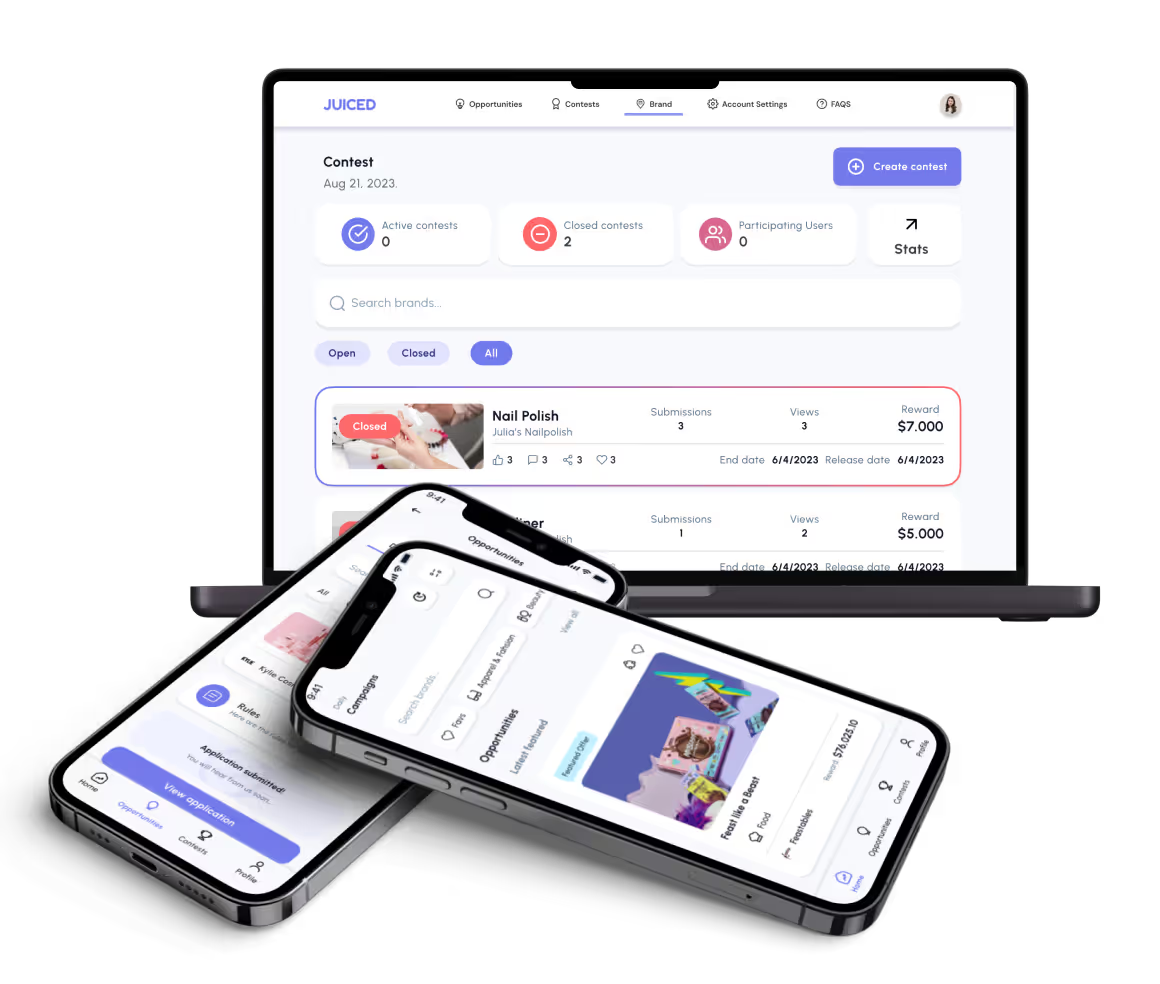

What Can FlutterFlow Build for a Membership Subscription Platform?
FlutterFlow delivers the full UX layer of a membership subscription platform: sign-up flows, recurring billing integration, tiered content gating, member portals, and admin management. Stripe handles the billing engine; Firebase handles access control.
Each feature below is achievable within FlutterFlow's toolset, with Stripe webhooks and Cloud Functions handling the server-side billing events that FlutterFlow cannot process natively.
Member Registration and Onboarding
A structured sign-up flow captures member details, plan selection, and payment, followed by a post-registration onboarding sequence that orients new members to the platform.
- Plan selection screen: Members choose their subscription tier during sign-up, with pricing, feature comparison, and recommended plan displayed clearly.
- Stripe Checkout integration: Payment is collected via Stripe Checkout at the end of the registration flow, with webhook confirmation triggering account activation.
- Onboarding sequence: Post-registration, a guided onboarding flow introduces members to key features and populates their profile before they reach the main dashboard.
Recurring Billing and Plan Management
Stripe handles monthly and annual subscription billing with automated renewal, failed payment retries, and dunning email sequences triggered via webhooks processed by Cloud Functions.
- Automated renewal: Stripe Billing handles subscription renewal automatically, with webhook events updating member status in Firestore on each billing cycle.
- Failed payment retries: Stripe's Smart Retries logic attempts failed payments on an optimised schedule, with Cloud Function-triggered notifications sent to members at each attempt.
- Dunning sequences: Custom email sequences via SendGrid or similar trigger on payment failure events, guiding members through payment method updates before access is suspended.
Tiered Access and Content Gating
Each membership tier's access is controlled using Firebase Auth custom claims, locking premium content, features, or app sections behind the appropriate plan level automatically.
- Custom claims update: A Cloud Function updates the authenticated user's Firebase Auth custom claims when Stripe confirms a billing event (new subscription, upgrade, cancellation).
- Content gate logic: App sections, pages, and media check the user's current claim value before rendering, showing a paywall or upgrade prompt for insufficient tier access.
- Async delay handling: A brief delay between the billing event and the claim update requires a loading state or pending access screen for a smooth member experience.
Member Dashboard and Account Portal
Members get a self-service portal to view their active plan, next billing date, payment history, and update payment methods without contacting support for routine account tasks.
- Billing summary: The member dashboard displays the active plan name, renewal date, and last payment amount pulled from Stripe via Cloud Function or API call.
- Payment method update: A link to Stripe's hosted payment update page or a custom FlutterFlow form allows members to update their card details without leaving the app.
- Invoice history: Past invoices pulled from Stripe via API display in a list view with download links for each receipt.
Upgrade, Downgrade, and Cancellation Flows
In-app flows let members switch plans or cancel, with Stripe proration handling the billing adjustment and configurable retention offers shown before cancellation is confirmed.
- Upgrade flow: Members select a new plan, view the prorated charge, confirm via Stripe API, and see their access update after the Cloud Function processes the billing event.
- Downgrade handling: Downgrades are scheduled to take effect at the next renewal date via Stripe subscription schedule, preserving current-period access.
- Cancellation retention: A configurable exit survey and discount offer screen appear before cancellation is confirmed, reducing churn through automated retention logic.
Renewal and Expiry Notifications
Automated renewal reminders, failed payment alerts, and subscription lapse notifications send via Firebase Cloud Messaging and email based on Stripe webhook events.
- Renewal reminders: A Cloud Function triggers a push notification and email 7 and 3 days before the next renewal date using the subscription period end timestamp from Stripe.
- Failed payment alerts: Immediate push notification and email send when Stripe fires the invoice payment failed webhook, prompting the member to update their payment method.
- Access lapse notification: When a subscription reaches the end of its grace period, a final notification informs the member their access has been suspended with a direct re-subscribe link.
Admin Member Management Portal
Administrators view all member accounts, manually adjust subscription status, issue refunds, and export member data from a dedicated admin portal within the same FlutterFlow app.
- Member table view: All active, cancelled, and expired subscriptions display in a filterable admin table with tier, billing status, and last payment date per member.
- Manual adjustments: Admins can manually extend access, apply discounts, or process refunds via Stripe API calls triggered from the admin portal UI.
- Data export: A Cloud Function generates a CSV export of member data for reporting, CRM import, or compliance audit purposes on admin request.
Founders building a membership SaaS on FlutterFlow will find the platform handles the subscription UI layer more capably than any other no-code tool at this price point.
How Long Does It Take to Build a Membership Subscription Platform with FlutterFlow?
A simple MVP with two tiers, Stripe billing, and gated content access takes 5–8 weeks. A full-featured membership platform with multiple tiers, upgrade and downgrade flows, admin portal, and retention logic takes 10–18 weeks. FlutterFlow is 45–60% faster than a custom membership platform build for equivalent scope.
The phased approach reduces time to first paying member while preserving the ability to add complexity after launch.
- Phase 1 (5–8 weeks): Core billing, access control, member dashboard, and renewal notifications deliver a fully functional subscription product.
- Phase 2 (5–10 more weeks): Add upgrade and downgrade flows, retention logic, admin portal, and analytics after the core revenue loop is live and tested.
- Apple and Google IAP timeline: If the app distributes through app stores, Apple IAP review and Google Play billing library integration add 2–4 weeks and require a dedicated compliance decision.
- Admin portal scope: A basic admin table adds 1–2 weeks; a full portal with manual adjustment, refund processing, and export capabilities adds 2–4 weeks more.
- Content gating complexity: Simple page-level gating adds 1 week; complex feature-level access control with multiple tier combinations adds 2–3 weeks to the build.
Understanding FlutterFlow subscription plan pricing helps founders budget the platform cost alongside the Stripe and IAP infrastructure that drives recurring revenue.
What Does It Cost to Build a FlutterFlow Membership Subscription Platform?
A FlutterFlow membership subscription platform costs $15,000–$70,000 to build, depending on tier count, IAP compliance requirements, and admin portal scope. Platform fees are $0–$70 per month. Stripe saves 40–60% on build cost compared to custom; Stripe and IAP fees are identical regardless of framework.
- Hidden cost: Apple Developer Programme: App Store distribution requires an annual Apple Developer Programme fee and compliance with App Store review guidelines for subscription apps.
- Hidden cost: dunning email service: Transactional email for dunning sequences and renewal reminders requires SendGrid or a similar provider, billed separately from FlutterFlow.
- Hidden cost: analytics integration: Subscription revenue analytics and cohort tracking require a third-party integration (Mixpanel, Amplitude) that adds scope and cost beyond the core build.
How Does FlutterFlow Compare to Custom Development for Membership Subscription Platforms?
FlutterFlow delivers a membership subscription platform in 5–8 weeks at 40–60% lower build cost than custom development. Custom development wins for enterprise SaaS with complex seat-based billing, multi-tenant architecture, or usage-based pricing models that require substantial Cloud Function logic.
The Bubble versus FlutterFlow memberships comparison is useful for founders choosing between no-code platforms for a membership-first product.
- When FlutterFlow wins: B2C membership communities, online education platforms, digital content subscriptions, and SaaS products with simple plan tiers.
- When custom wins: Enterprise SaaS with complex seat-based billing, multi-tenant architectures, or usage-based pricing models requiring substantial server-side logic.
- Maintenance advantage: FlutterFlow lets product teams update content, adjust pricing display, and modify onboarding flows without a developer involved in every change.
The 40–60% build cost savings are most compelling at the MVP and early-growth stage, where validating the subscription model matters more than handling complex billing edge cases.
What Are the Limitations of FlutterFlow for Membership Subscription Platforms?
Understanding FlutterFlow membership scale limits helps founders plan the Firestore and Auth architecture before the member base grows faster than the backend can handle. Beyond scale, Stripe webhooks, Apple IAP, and GDPR data portability are the key technical constraints.
These limitations are not blockers for most membership subscription use cases, but each requires deliberate engineering decisions before build begins.
- Stripe webhooks must be server-side: Subscription status changes from Stripe must be processed by Cloud Functions, FlutterFlow cannot listen to Stripe webhooks directly from the client.
- Firebase Auth claims are asynchronous: A short delay between a billing event and the content access update reaching the user requires a graceful pending state in the UX design.
- Apple and Google IAP compliance: Digital subscription purchases on iOS and Android must route through the app store, with 15–30% commission and platform review requirements.
- Complex billing models: Usage-based pricing, seat-based accounts, and quarterly billing cycles require substantial Cloud Function logic that goes well beyond FlutterFlow's visual builder.
- GDPR data portability: Data export requests under GDPR require a Cloud Function data pipeline to assemble member data, this is not a native FlutterFlow feature.
- Code export available: On paid plans, teams that need full codebase ownership can export the Flutter code and continue development outside the FlutterFlow platform.
How Do You Get a FlutterFlow Membership Subscription Platform Built?
Knowing how to hire a FlutterFlow developer with Stripe webhook and Firebase Auth experience is the most important qualification for a membership platform project. The wrong hire discovers billing architecture limits mid-build.
Freelancers suit a simple two-tier membership app. Multi-tier platforms with IAP compliance, retention flows, and admin portals need a structured team.
- Required expertise: Stripe subscription webhooks, Cloud Function integration, Firebase Auth custom claims for access control, and Apple and Google IAP implementation are non-negotiable.
- Portfolio requirement: Ask for examples of live subscription platforms with Stripe webhook integration and tiered content gating, not just membership-adjacent mockups.
- Red flag: A team that cannot explain how Stripe subscription status syncs to Firebase Auth claims has not built a subscription platform before.
- Key screening question: "How do you sync Stripe subscription status to Firebase Auth claims?" The answer reveals both technical experience and process clarity.
- Second screening question: "How do you handle Apple IAP alongside Stripe for web purchases?" This surfaces whether they understand the dual-payment path for mobile and web members.
- Expected timeline from a good team: 7–18 weeks from scoping to production, depending on tier count, IAP requirements, and admin portal complexity.
Define whether your app will distribute through the App Store and Google Play before scoping billing architecture. That single decision determines whether Stripe alone or Stripe-plus-IAP is required, and it changes the cost and timeline significantly.
Conclusion
FlutterFlow is a capable foundation for membership subscription platforms. The UX, access control, and billing flow all work within the platform's toolset when architected correctly.
The Stripe webhook architecture and Apple and Google IAP compliance are the two non-negotiable technical disciplines that determine whether the recurring revenue engine actually functions at launch.
Decide on app store distribution before scoping billing architecture. That decision determines your payment path and changes both cost and timeline.
Building a Membership Subscription Platform with FlutterFlow? Here Is How LOW/CODE Agency Approaches It.
Most membership subscription builds get the UI right and the billing architecture wrong. Stripe webhooks processed incorrectly or Firebase Auth claims updating inconsistently means members lose access they paid for, and that destroys retention faster than any competitor.
As AI development experts, we at LOW/CODE Agency help SMBs ship real software — web and mobile applications, intelligent chatbots, RAG pipelines, and autonomous AI agents built for businesses that need results, not platforms. We build membership subscription platforms on FlutterFlow with Stripe webhook architecture, Firebase Auth tiered access control, and Apple and Google IAP compliance designed for recurring revenue from day one.
- Billing architecture scoping: We define your Stripe subscription model, webhook handling, and Firebase Auth claims update logic before any screen is designed.
- Stripe integration: We implement recurring billing, upgrade and downgrade flows, dunning sequences, and cancellation handling using Stripe webhooks and Cloud Functions.
- Firebase Auth access control: We configure custom claims and Firestore security rules to enforce each membership tier's access boundaries with the async delay handled gracefully.
- Apple and Google IAP: We implement app store in-app purchase routing where required, alongside Stripe for web purchases, with a unified subscription status layer.
- Member portal and admin panel: We build the full member self-service portal and administrator management dashboard as part of the same delivery.
- Retention flow engineering: We build cancellation retention offers, win-back sequences, and failed payment recovery flows into the billing architecture from the start.
- Full product team: Strategy, UX design, FlutterFlow development, and QA from a single team accountable for the full subscription platform, not just individual screens.
We have built 350+ products for clients including Coca-Cola, American Express, and Sotheby's. We know exactly where membership subscription builds fail and we address those decisions before they cost you revenue.
Related Articles
- How to Build a Multi-Vendor Marketplace with FlutterFlow
- How to Build a Microfinance Platform with FlutterFlow
- How to Build a Menu Management System with FlutterFlow
- How to Build a Membership Management App with FlutterFlow
- How to Build a Medical Records App with FlutterFlow
- How to Build a Marketplace App with FlutterFlow
Last updated on
September 24, 2026
.

Jesus is a visionary entrepreneur and tech expert. After nearly a decade working in web development, he founded LOW/CODE Agency to help businesses optimize their operations through custom software solutions.


FAQs
What are the key steps to create a subscription platform in FlutterFlow?
Can FlutterFlow handle recurring payments for memberships?
How do I restrict content based on membership levels in FlutterFlow?
Is coding required to build a subscription platform with FlutterFlow?
What are common challenges when building membership platforms in FlutterFlow?
How can I test my membership subscription platform before launch?
Related Articles

FlutterFlow
How to Build a Volunteer Scheduling App with FlutterFlow
Learn how to create a volunteer scheduling app using FlutterFlow with step-by-step tips and best practices for easy management.

FlutterFlow
How to Build a Courier Tracking App with FlutterFlow
Learn how to create a courier tracking app using FlutterFlow with step-by-step guidance and essential features for real-time delivery tracking.

FlutterFlow
How to Build a Project Management SaaS with FlutterFlow
Learn how to create a project management SaaS using FlutterFlow with step-by-step tips and best practices for no-code app development.

FlutterFlow
How to Build a Healthcare App with FlutterFlow
Learn step-by-step how to create a healthcare app using FlutterFlow with no coding required. Start building your app today.


Why customers trust us for no-code development


