

How to Build a Self Storage Management App with Bubble
14 min
read
Create a self storage management app in Bubble without coding. Track units, manage rentals, and automate billing fast with this no-code step-by-step guide.


Building a self storage management app with Bubble gives independent operators a purpose-built platform for unit inventory, customer billing, access management, and reporting without expensive legacy software.
Storage operators managing units through paper forms and spreadsheets lose revenue through billing errors and vacancy blind spots. A Bubble-built platform eliminates both problems.
Key Takeaways
- Bubble handles the full storage management workflow: Unit inventory, customer onboarding, rental agreements, automated billing, and access management are all achievable in Bubble without custom code.
- Unit-level data is the foundation: Storage Unit, Rental Agreement, Customer, Payment, and Access Log data types cover the core operational needs for any storage facility.
- Automated recurring billing reduces revenue leakage: Monthly Stripe subscription billing workflows prevent the late payment and manual invoicing problems that cost small operators real money.
- Customer self-service reduces staff overhead: Online booking, payment, and access request features reduce front-desk dependency and operational staffing costs significantly.
- Multi-facility support is straightforward to add: Bubble's data model scales to multiple storage locations with facility-level filtering added to existing data types.
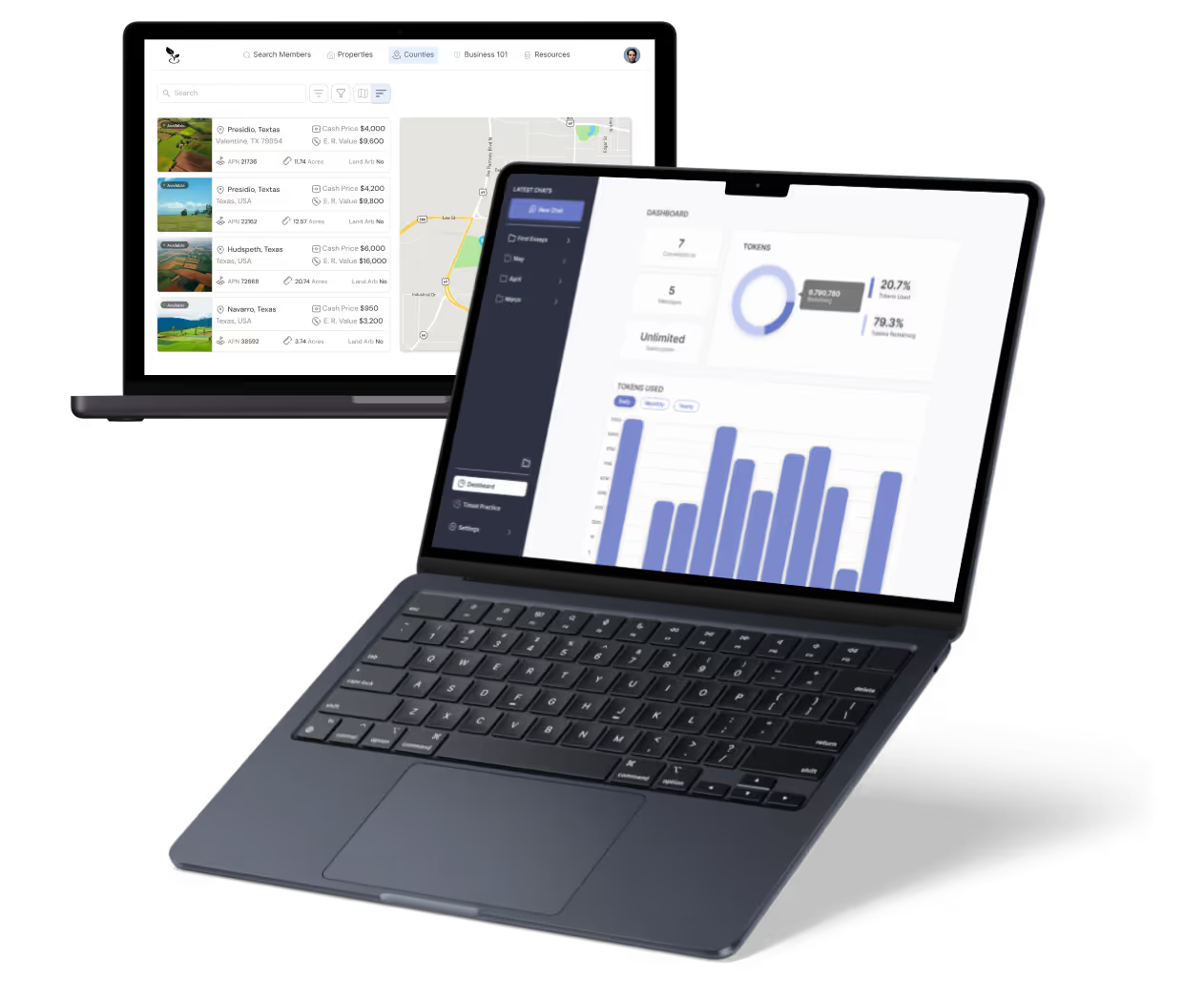

What Is a Self Storage Management App - and Why Build It with Bubble?
A self storage management app is a platform for managing storage unit inventory, customer rental agreements, access control, recurring billing, and occupancy reporting across one or more facilities.
Legacy storage management software like SiteLink or Storagecraft costs hundreds of dollars per month and is engineered for large chains. Independent operators need something built around their actual workflow.
- Purpose-built unit inventory: Bubble's Storage Unit data type tracks size, type, floor, climate control status, monthly rate, and real-time occupancy status per unit with no workarounds.
- Automated billing without manual invoicing: Stripe subscriptions linked to Rental Agreement records generate monthly charges automatically - no staff time required to produce and send individual invoices.
- Customer portal eliminates front-desk calls: Customers log in to view their agreement, check payment history, pay outstanding balances, and update contact details without calling the facility.
- Multi-facility in one platform: Unlike software priced per location, a Bubble-built platform handles as many facilities as you operate with one user interface and one data model.
Understanding Bubble's pros and cons helps storage operators assess whether the platform is the right fit for their billing complexity, access management requirements, and long-term facility growth plans.
What Features Should a Self Storage Management App Include?
An MVP self storage app needs unit inventory management, customer onboarding, rental agreement creation, automated billing, payment tracking, and a basic customer portal in one interface.
Start with unit management and Stripe billing - those two features replace the highest-volume manual tasks and deliver immediate operational return before adding access control or analytics.
- Unit inventory management: Displays all units by size, type, floor, and status (available/rented/reserved/maintenance) with quick filtering to find available units by size for new customer enquiries.
- Customer onboarding: An application form collects customer details, triggers ID verification, assigns a unit, creates the Rental Agreement, and sends a digital agreement for signing.
- Rental agreement management: Each agreement records start date, monthly rate, deposit amount, payment method, and current status - linked to both the customer and the specific unit.
- Automated monthly billing: A Stripe subscription created at agreement start charges the customer monthly without any manual action; payment confirmations update the Payment record automatically via webhook.
- Payment tracking and overdue alerts: A payment history view per customer shows all charges, dates, and statuses; overdue alerts trigger via SendGrid email and Twilio SMS when payment is 30+ days late.
- Access code management: The operator assigns or updates customer PIN codes and records changes in the Access Log; optionally, smart lock API integrations automate this via Bubble workflows.
- Customer self-service portal: Customers view their rental agreement, pay outstanding balances, update contact details, and view their access history from a dedicated portal page.
- Occupancy and revenue reporting: An operator dashboard shows occupancy rate per facility, monthly revenue, units by status, and upcoming move-out dates in a single management view.
An accurate unit status system - available, rented, reserved, and maintenance - prevents double-booking and ensures the availability display reflects reality at all times.
How Do You Structure the Database for a Self Storage Management App in Bubble?
The database needs seven types: Facility, Storage Unit, Customer, Rental Agreement, Payment, Access Log, and Maintenance Record - with Storage Unit as the central record linking the facility to the customer.
Every status field in this data model should be an option set with explicit values - free text status fields create inconsistency that breaks reporting queries and workflow conditions.
- Facility: Fields include facility name (text), address (text), total unit count (number), and manager (User) who has operator-level access to all records in that facility.
- Storage Unit: Fields include unit number (text), size category (option set: small/medium/large/extra-large), floor (number), unit type (option set: indoor/outdoor/climate-controlled/drive-up), monthly rate (number), occupancy status (option set: available/rented/reserved/maintenance), and linked Facility (Facility).
- Customer: Fields include full name (text), email (text), phone (text), ID verification status (option set), Stripe customer ID (text), and linked User (User) for portal access.
- Rental Agreement: Fields include start date (date), end date (date - nullable for rolling monthly agreements), monthly rate (number), deposit paid (number), Stripe subscription ID (text), agreement status (option set: active/expired/notice-period/terminated), linked Storage Unit (Storage Unit), and linked Customer (Customer).
- Payment: Fields include amount (number), payment date (date), billing period (text formatted as YYYY-MM), Stripe charge ID (text), payment status (option set: paid/failed/refunded), and linked Rental Agreement (Rental Agreement).
- Access Log: Fields include event timestamp (date), event type (option set: entry/exit/denied), access method (text), linked Customer (Customer), and linked Facility (Facility).
- Maintenance Record: Fields include description (text), priority (option set), status (option set: reported/in-progress/resolved), date reported (date), resolved date (date), and linked Storage Unit (Storage Unit).
Storing the Stripe subscription ID on the Rental Agreement record is essential - it's the reference you need for cancellation, pause, or upgrade workflows triggered by agreement status changes.
How Do You Build the Core Workflows for a Self Storage Management App in Bubble?
Core workflows handle unit booking with Stripe subscription creation, monthly billing via webhooks, overdue payment alerts, unit vacating, access management, maintenance flagging, and occupancy reporting.
The Stripe webhook handling workflow is the most critical to test thoroughly - payment confirmation, failed payment notification, and subscription cancellation all depend on webhook events being parsed correctly.
- Unit booking: The customer selects an available unit; a backend workflow creates the Rental Agreement, sets the Storage Unit status to "rented", creates a Stripe customer and subscription via the Stripe plugin, and stores the Stripe subscription ID on the Rental Agreement record.
- Monthly billing via webhook: When Stripe processes a monthly charge, it sends a webhook to Bubble's API endpoint; a backend workflow parses the webhook, creates a Payment record with billing period and Stripe charge ID, and sends a receipt email via SendGrid.
- Overdue payment alert: A nightly scheduled backend workflow searches for active Rental Agreements where the most recent Payment record's date is more than 30 days ago; it sends a SendGrid email and a Twilio SMS to the customer with payment link and outstanding balance.
- Unit vacating: On move-out date or customer request, a workflow sets the Rental Agreement status to "terminated", updates the Storage Unit status to "available", cancels the Stripe subscription via the API, and sends a final statement PDF to the customer.
- Access code management: The operator assigns or updates a customer's PIN from the Customer detail page; a workflow logs the change in the Access Log with timestamp and the operator User who made the change; smart lock integrations (PTI or Noke via API Connector) receive the update via webhook.
- Maintenance flagging: The operator marks a Storage Unit as "maintenance" status; a workflow creates a Maintenance Record and prevents any new Rental Agreement from being created for that unit until status returns to "available".
- Occupancy reporting: A scheduled daily workflow counts Storage Units by status per Facility and writes the totals to summary fields on the Facility record for instant dashboard display without triggering heavy search queries on each page load.
Failed Stripe payment webhooks need their own workflow branch. A failed charge should update the Payment record status to "failed" and immediately trigger the overdue notification flow rather than waiting for the next nightly check.
What Security and Data Requirements Apply to a Self Storage Management App?
Privacy rules must restrict each customer to their own records, scope all facility data to the assigned operator, and ensure Stripe payment credentials are never stored in Bubble's database.
The most common security mistake in storage management apps is leaving Payment records publicly queryable - a single misconfigured privacy rule exposes billing data across all customers.
- Customer privacy rule: Customers see only their own Customer record; operators see all Customers linked to their Facility. Rule: "This Customer is visible when: Current User is this Customer's linked User OR Current User is this Customer's linked Rental Agreement's linked Storage Unit's linked Facility's manager."
- Rental Agreement privacy: Customers see only Agreements where the linked Customer's linked User is the Current User. Operators see all Agreements for their Facility's units.
- Payment privacy: Payment records visible only to the Customer on the linked Rental Agreement and the Facility manager - no cross-customer payment visibility under any condition.
- Access Log scoping: Customers can view their own access history (useful for security awareness); only the Facility manager and admin roles can view the complete Access Log for audit or dispute purposes.
- Stripe security: The Stripe customer ID and subscription ID are stored as text fields in Bubble for reference - actual card data, card numbers, and CVVs are never stored in Bubble's database; Stripe handles all payment credential storage.
- Multi-operator isolation: Each Facility record links to a manager User; all Storage Unit, Rental Agreement, and Payment records inherit this scoping so operators cannot see other operators' facility data.
Applying Bubble's security configuration to every Storage Unit, Customer, and Payment record prevents customer data leaking between facilities, operators, or concurrent sessions.
What Plugins and Integrations Does a Self Storage Management App Need?
A self storage app needs recurring payment processing, digital agreement signing, ID verification, notifications, PDF generation, and optionally smart lock access control as core integrations.
Validate the Stripe subscription webhook handling in a test environment against failed payments, subscription pauses, and cancellations before connecting to live customer billing.
- Stripe plugin (official): Creates subscriptions for monthly billing, handles deposit charges as one-time payments, and sends webhooks to Bubble for payment confirmation and failure events.
- SendGrid plugin: Sends rental confirmation emails, monthly payment receipts, overdue balance reminders, move-out confirmations, and access code notifications with professional templates.
- Twilio plugin: SMS overdue payment reminders for customers who don't respond to email and access code updates for customers without smartphone access to the portal.
- DocuSign or HelloSign (via API Connector): Sends the rental agreement for e-signature during customer onboarding; signed document URL and completion status save back to the Rental Agreement record.
- Persona or Veriff (via API Connector): KYC identity verification at customer onboarding; webhook response updates the Customer record's ID verification status field.
- Air PDF Conjurer: Generates formatted rental agreements, monthly billing statements, deposit receipts, and move-out confirmation letters from Bubble data.
- Mapbox or Google Maps plugin: Displays facility location on a map within the customer portal and public-facing booking page.
- PTI, Noke, or Storlogix API (via API Connector): Smart lock and gate access control system integration; Bubble workflows trigger access code provisioning, PIN updates, and gate open commands via the access control API.
How Long Does It Take and What Does It Cost to Build a Self Storage Management App with Bubble?
A self storage management MVP takes 6 to 12 weeks; a full multi-facility platform with access control integration and customer portal takes 12 to 18 weeks.
Stripe subscription webhook handling and smart lock API integration are the two components that consistently take longer than estimated - both require testing against real provider sandbox environments.
- Solo MVP build: 8 to 12 weeks at 150 to 220 hours; covers unit inventory, customer profiles, manual rental agreements, basic payment tracking, and SendGrid notifications.
- Agency build: 6 to 10 weeks with a team; includes Stripe subscription billing, webhook-triggered payment logging, customer self-service portal, DocuSign agreement signing, and overdue alert workflows.
- Full multi-facility platform: 12 to 18 weeks; adds access control API integration, occupancy analytics dashboard, multi-operator support, Twilio SMS alerts, and mobile-responsive customer portal.
- Bubble plan recommendation: Growth plan at $119/month for a single-facility deployment; Team plan at $349/month for multi-facility operations with multiple staff accounts and higher scheduled workflow volume.
- Stripe fees: 2.9% plus 30 cents per transaction; a facility with 50 customers paying $150/month generates approximately $225 in Stripe fees monthly.
- DocuSign costs: Individual plans start at approximately $10 per user per month for standard e-signature; API integration for automated agreement sending requires a business plan.
- Persona verification costs: Approximately $1.50 per customer verification; a facility onboarding 10 new customers per month adds $15 to monthly operating costs.
Before adding smart lock API integration to the build scope, understanding Bubble's capabilities and limitations helps storage operators decide whether native Bubble API Connector calls or an external webhook handler is the right approach for real-time access management.
Conclusion
Bubble gives independent storage operators a path to a purpose-built management platform that outperforms expensive legacy software at a fraction of the cost. The Stripe recurring billing workflow and customer self-service portal deliver the fastest operational return after launch.
Map your unit types, sizes, and pricing tiers before designing the Storage Unit data type. That single exercise reveals the option sets and workflow conditions that every other feature in the app depends on.
Need Help Building Your Self Storage Management App on Bubble?
Self storage platforms combine recurring Stripe billing, smart lock API integration, and multi-unit inventory. A broken webhook handler or misconfigured subscription workflow creates revenue gaps and customer access failures that are costly to fix after launch.
LOW/CODE Agency is an AI product development company for SMBs. We build web apps, mobile apps, RAG systems, chatbots, and AI agents — custom software engineered for businesses that are not enterprise but demand enterprise-grade AI. We scope the architecture, engineer the workflows, and stay involved through launch and beyond.
- Data architecture: We design your data types, option sets, and privacy rules before writing a single element on the canvas.
- Workflow engineering: We build backend workflows, scheduled jobs, and API integrations with proper logic and error handling.
- Plugin configuration: We select and configure the right Bubble plugins for your feature set without unnecessary bloat.
- Role-based access: We implement privacy rules at the database level, not just conditional UI visibility.
- Integration setup: We connect your Bubble app to Stripe, SendGrid, Twilio, and other services correctly from day one.
- Pre-launch testing: We test against real data before deployment so every workflow performs correctly under live conditions.
- Post-launch support: We stay involved after go-live to optimize as real usage data shapes the app.
We have built 350+ products for clients including Coca-Cola, American Express, Sotheby's, and Medtronic. We know exactly where Bubble builds fail and we address those problems before they surface.
Related Articles
Last updated on
September 28, 2026
.

Jesus is a visionary entrepreneur and tech expert. After nearly a decade working in web development, he founded LOW/CODE Agency to help businesses optimize their operations through custom software solutions.


FAQs
Can you build a self storage management app without coding using Bubble?
How do you manage storage unit inventory in a Bubble app?
How do you handle online unit reservations in a Bubble self storage app?
How do you automate monthly billing in a Bubble self storage management app?
How do you manage tenant move-ins and move-outs in Bubble?
How do you track access logs for storage units in a Bubble app?
Related Articles

Bubble
How to Build a Corporate Event Management App with Bubble
Create a contractor management app with Bubble without coding. Onboard contractors, manage tasks, and track payments step-by-step fast.

Bubble
How to Build a Timesheet App With Bubble
Build a timesheet app with Bubble. Employee time logging, manager approvals, and payroll export in one system — no code, no timesheet software fees.

Bubble
How to Build a Price Management App With Bubble
Build a price management app with Bubble. Set rules, apply discounts, and control pricing across SKUs — a custom pricing engine, no dev team needed.

Bubble
How to Build a Supply Chain Analytics App with Bubble
Build a supply chain analytics app in Bubble without coding. Visualize data, track KPIs, and optimize operations with this no-code step-by-step guide.


Why customers trust us for no-code development


