

How to Build a Real Estate Marketplace App with Bubble
12 min
read
Create a real estate marketplace app with Bubble no code required. List properties, connect buyers, and scale fast with this no-code step-by-step guide.


Building a real estate marketplace app with Bubble gives founders a full-stack path to a working listing platform without a custom engineering team.
Zillow and Rightmove started as simple listing databases. A focused niche equivalent - commercial properties, rural estates, off-market deals - can be built in Bubble in weeks.
Key Takeaways
- Two-sided marketplace logic is native to Bubble: Buyers, sellers, and agents can each have distinct roles enforced at the data and workflow layer.
- Listing management anchors the data model: Property Listing, Enquiry, Saved Search, and User data types are the foundation every other feature builds on.
- Search and filter performance matters: Repeating group queries with multiple filters need careful data model design to stay fast at scale.
- Payment flows are fully supported: Listing fees, featured placements, and lead packages can all run through the native Stripe plugin in Bubble.
- Niche marketplaces outperform generalists: Building for a specific property type, geography, or buyer persona produces better conversion than broad listing platforms.
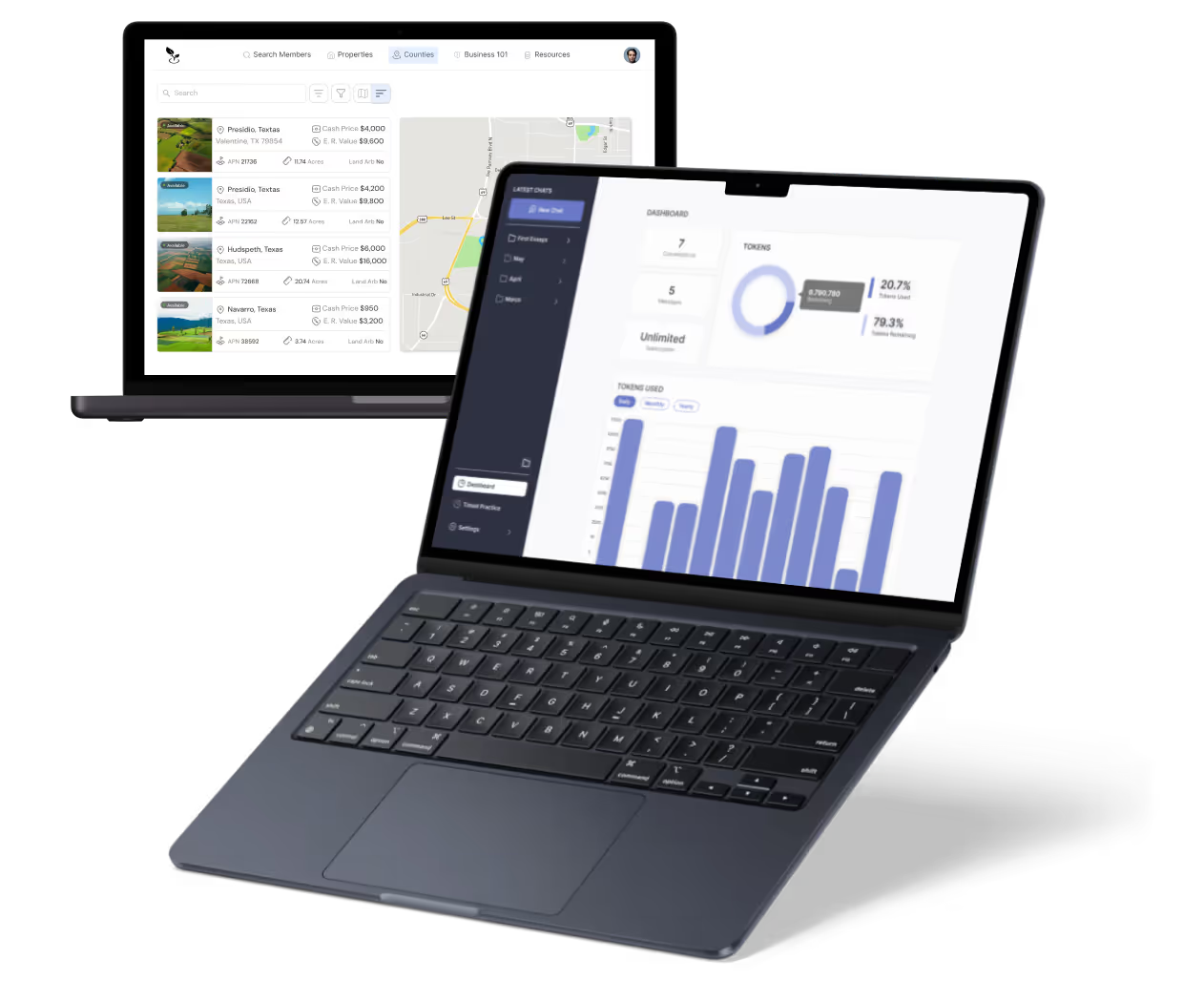

What Is a Real Estate Marketplace App — and Why Build It with Bubble?
A real estate marketplace app is a two-sided platform that connects property listers - agents or private owners - with buyers or renters searching for properties in a defined market.
Generic portal solutions built on WordPress plugins offer limited data control and no real workflow engine. Bubble gives you a proper relational database, custom workflows, and full UI control.
- Full-stack in one environment: Listing management, search, enquiries, payments, messaging, and admin tools all exist within Bubble. No separate CMS or backend required.
- Two-sided role architecture: Bubble's User data type and privacy rules support distinct buyer, seller, agent, and admin experiences within a single application.
- Niche marketplace opportunity: Commercial-only, rural properties, off-market residential, short-let, and co-living marketplaces are all underserved by incumbent platforms.
- Real database, real search: Unlike WordPress listing plugins, Bubble stores relational property data with filterable fields, geographic search, and conditional display logic.
Working with a Bubble SaaS development agency accelerates marketplace builds where two-sided architecture and complex search workflow logic are required from day one.
What Features Should a Real Estate Marketplace App Include?
An MVP real estate marketplace needs listing creation, advanced search with map integration, an enquiry system, and an admin moderation workflow in a single performant interface.
Build the listing creation and search features first. Without a working inventory and discovery experience, no other marketplace feature has context.
- Property listing creation: Listers upload multiple photos, add specs (bedrooms, bathrooms, sqft), set price, and select property type from an option set with the location geocoded automatically.
- Advanced search and filter: Buyers filter by property type, price range, bedroom count, location radius, and feature tags - results update dynamically in a repeating group without page reload.
- Map-based property browsing: Mapbox or Google Maps plugin shows property pins, clusters at zoom-out, and supports radius-from-point searches for buyers exploring a specific area.
- Enquiry and viewing request system: Buyers submit enquiries linked to a specific listing; the system notifies the agent, logs the enquiry, and tracks the response status.
- Saved searches with alerts: Users save their active filter combination and receive email notifications when new listings matching those filters are posted.
- Agent and seller profile pages: Each lister has a profile showing their active listings, contact details (gated behind enquiry), bio, and aggregate review rating.
- Featured listing and paid promotion: Listers pay via Stripe for featured placement that boosts their listing in search results and marks it as promoted on the map.
- Admin moderation dashboard: All new listings enter a pending status; admins review and approve or reject before the listing goes live to public search.
A moderation workflow protects platform quality early. Without it, a marketplace quickly fills with incomplete or duplicate listings that damage user trust.
How Do You Structure the Database for a Real Estate Marketplace App in Bubble?
The data model needs seven types: Property Listing, Enquiry, Saved Search, Agent Profile, Review, Transaction, and User. The Property Listing record sits at the centre of most relationships.
Every field you plan to filter or sort in search must be a top-level field on the Property Listing data type. Nested data structures make repeating group queries significantly slower.
- Property Listing: Fields include title (text), description (text), price (number), property type (option set), bedrooms (number), bathrooms (number), sqft (number), location (geographic address), photos (list of images), status (option set: pending/active/sold/withdrawn), and listed by (User).
- Enquiry: Fields include message text (text), sender (User), linked Listing (Property Listing), requested viewing date (date), status (option set: new/responded/closed).
- Saved Search: Fields include filter parameters stored as JSON text, email notification frequency (option set: daily/weekly), user (User), and last triggered date (date).
- Agent Profile: Fields include agency name (text), bio (text), active listings (list of Property Listing), phone number (text), linked User (User), and average rating (number).
- Review: Fields include rating (number 1-5), comment (text), linked Agent Profile (Agent Profile), and reviewer (User).
- Transaction: Fields include amount (number), Stripe charge ID (text), payment status (option set), linked Listing (Property Listing), and payment date (date).
- User: Fields include role (option set: buyer/seller/agent/admin), saved listings (list of Property Listing), and subscription tier (option set).
Storing saved search filters as a JSON text string, parsed when the search runs, is cleaner than creating individual filter fields on the Saved Search data type for every possible combination.
How Do You Build the Core Workflows for a Real Estate Marketplace App in Bubble?
Core workflows handle listing creation, search execution, enquiry routing, saved search alerts, payment processing for featured listings, and admin moderation.
Each workflow should be tested with at least 50 real listing records before launch. Search performance issues that only appear at scale are the most common post-launch problem.
- Listing creation: The multi-step listing form uploads photos to Bubble's file storage, creates a Property Listing record with status "pending", and triggers an admin notification via SendGrid.
- Search and filter: The repeating group's data source uses dynamic constraints from active filter inputs - property type, price range, bedroom count, and geographic radius from a selected address point.
- Enquiry submission: On form submit, a workflow creates an Enquiry record, sends a SendGrid email to the lister, increments the enquiry count field on the Property Listing, and shows a confirmation message.
- Saved search alert: A nightly scheduled backend workflow loops through all Saved Search records, re-runs each filter combination, compares results to the stored "last result count" field, and sends a SendGrid alert for searches with new matches.
- Featured listing payment: A Stripe checkout workflow collects the promotion fee; on payment success confirmation via webhook, a backend workflow sets the Property Listing's "featured" boolean to true and records the feature expiry date.
- Admin moderation: The admin reviews listings in the pending status queue; approval sets status to "active" and triggers a SendGrid notification to the lister with their live listing URL.
- Viewing request handling: When a buyer submits a viewing date request, the agent receives the request in their dashboard; acceptance or decline triggers a status update email to the buyer.
As your listing database grows to thousands of records, planning for Bubble's scalability ensures search queries, repeating group loads, and scheduled workflows stay performant under real traffic.
What Security and Data Requirements Apply to a Real Estate Marketplace App?
Privacy rules on a marketplace must protect enquiry data between buyer and lister, prevent unauthenticated scraping of contact details, and restrict financial transaction records to admin and payer.
A marketplace's reputation depends on trust. Contact details leaking between competing agents or enquiries being visible to third parties destroys credibility immediately.
- Property Listing visibility: Active listings are publicly searchable; pending, rejected, and sold listings are visible only to the original lister and admin roles - not to other platform users.
- Enquiry privacy rule: Each Enquiry record is visible only when "Current User is the sender OR Current User is the Listing's listed-by field" - prevents enquiry data crossing between competing agents.
- Agent contact gating: Phone and email fields on Agent Profile are restricted to authenticated users who have submitted at least one enquiry - anonymous browsing sees masked contact data.
- Transaction privacy: Transaction records are visible only to the User who made the payment and admin roles - never displayed in listing search results or agent profiles.
- Admin-only moderation access: The pending listing moderation queue is accessible only to users with the admin role - no agent or buyer can view unpublished competitor listings.
Verify privacy rules with a test buyer account before launch. The most common marketplace privacy mistake is setting listing contact fields to "visible to all" rather than authenticated enquirers.
What Plugins and Integrations Does a Real Estate Marketplace App Need?
A real estate marketplace needs mapping, image optimisation, fast search, payment processing, and email notifications as core integrations alongside Bubble's native capabilities.
Invest in image optimisation early. Slow-loading listing photos are the single biggest driver of bounce rate on property marketplace pages.
- Mapbox or Google Maps plugin: Powers property pin maps, polygon area drawing, cluster display at zoom-out levels, and radius-from-point search for geographic filtering.
- Cloudinary plugin: Resizes and optimises uploaded listing photos automatically, reducing page load times for listing cards and detail pages with multiple images.
- Algolia plugin: Provides instant full-text search across thousands of listing titles and descriptions - significantly faster than Bubble's native search for text-heavy queries.
- Stripe plugin (official): Handles listing fees, featured placement charges, and optional subscription tiers for agents with recurring billing.
- SendGrid plugin: Delivers enquiry notifications, saved search alerts, listing approval emails, and viewing request confirmations with custom templates per email type.
- Twilio plugin: Sends SMS notifications to agents when a new enquiry arrives on a high-value or featured listing.
- Bubble native Image Uploader: Handles multi-image upload per listing; set a maximum file count and size limit at the element level to control storage costs.
- Crisp or Intercom (via API Connector): Adds live chat support for listers and buyers needing help with listing creation or enquiry management on the platform.
How Long Does It Take and What Does It Cost to Build a Real Estate Marketplace App with Bubble?
A basic marketplace MVP takes 8 to 14 weeks; a full platform with agent profiles, featured listings, Algolia search, and subscription management takes 16 to 24 weeks.
Marketplace builds have more moving parts than single-sided apps. Two user types, moderation workflows, payment flows, and map integration all need individual testing cycles.
- Solo MVP build: 10 to 14 weeks at 180 to 260 hours; covers listing creation, basic search filters, enquiry form, and email notifications without map or payment features.
- Agency build: 8 to 12 weeks with a team; includes Mapbox integration, Stripe listing fees, admin moderation dashboard, saved search alerts, and agent profile pages.
- Full marketplace platform: 16 to 24 weeks; adds Algolia search, agent subscription tiers, review system, featured listing management, and Cloudinary image optimisation.
- Bubble plan: Growth plan at $119/month for early-stage; Team plan at $349/month once multiple team members need editor access and listing volume grows.
- Mapbox costs: Free tier handles 50,000 map loads per month; scales to $0.50 per 1,000 requests beyond that threshold.
- Algolia costs: Free tier covers 10,000 search records; paid plans start at approximately $1 per 1,000 additional records indexed.
- Cloudinary costs: Free tier handles 25 monthly credits (roughly 25,000 image transformations); paid plans start at $89/month for high-volume listing photo optimisation.
Listing-heavy marketplaces generate significant database activity from searches and scheduled alerts, so align your server capacity with Bubble's pricing plans before scaling user acquisition campaigns.
Conclusion
Bubble gives marketplace founders a full-stack path to a niche real estate platform that a custom engineering team would take months to deliver.
Design your niche and your Property Listing data type with search filter fields in mind before building anything else. Search performance and data model decisions determine success at scale.
Need Help Building Your Real Estate Marketplace on Bubble?
Two-sided marketplace search queries run slow when listing fields are nested incorrectly. Payment webhook failures leave bookings in a pending state with no automated recovery path.
At LOW/CODE Agency, we build AI-powered products for SMBs — custom web apps, mobile apps, chatbots, RAG systems, and AI agents, delivered with the depth and standards of a specialist software team. We scope the architecture, engineer the workflows, and stay involved through launch and beyond.
- Data architecture: We design your data types, option sets, and privacy rules before writing a single element on the canvas.
- Workflow engineering: We build backend workflows, scheduled jobs, and API integrations with proper logic and error handling.
- Plugin configuration: We select and configure the right Bubble plugins for your feature set without unnecessary bloat.
- Role-based access: We implement privacy rules at the database level, not just conditional UI visibility.
- Integration setup: We connect your Bubble app to Stripe, SendGrid, Twilio, and other services correctly from day one.
- Pre-launch testing: We test against real data before deployment so every workflow performs correctly under live conditions.
- Post-launch support: We stay involved after go-live to optimize as real usage data shapes the app.
We have built 350+ products for clients including Coca-Cola, American Express, Sotheby's, and Medtronic. We know exactly where Bubble builds fail and we address those problems before they surface.
Related Articles
- How to Build a Regulatory Compliance App with Bubble
- How to Build a Referral Management App with Bubble
- How to Build a Recipe Management App with Bubble
- How to Build a Real Estate Investment Tracker App with Bubble
- How to Build a Real Estate Deal Tracker App with Bubble
- How to Build a Real Estate Analytics App with Bubble
Partner with our no-code development experts to ship your app idea without the overhead.
Last updated on
September 24, 2026
.

Jesus is a visionary entrepreneur and tech expert. After nearly a decade working in web development, he founded LOW/CODE Agency to help businesses optimize their operations through custom software solutions.


FAQs
Can you build a real estate marketplace app without coding using Bubble?
How do you build advanced property search in a Bubble real estate marketplace app?
How do you support buyer and seller user roles in a Bubble real estate marketplace app?
How do you handle listing inquiries in a Bubble real estate marketplace app?
How do you implement saved searches and favorites in a Bubble real estate marketplace app?
How do you monetize a Bubble real estate marketplace app?
Related Articles

Bubble
How to Build a Class Management App with Bubble
Create a church management app with Bubble no coding required. Manage members, donations, and events step-by-step using no-code tools.

Bubble
How to Build a How to Building Management App with Bubble
Track hospital assets in real time with a Bubble app built without coding. Reduce losses, improve maintenance, and cut costs step-by-step.

Bubble
How to Build an HR Knowledge Base App with Bubble
Build an HR knowledge base with Bubble. Centralize policies, handbooks, and FAQs in a searchable portal — no dev team, fast to update.

Bubble
How to Build a Donation Platform App with Bubble
Build a doctor appointment booking app with Bubble no coding needed. Let patients self-schedule, send reminders, and manage slots fast.


Why customers trust us for no-code development


