

How to Build a Legal Analytics App with Bubble
11 min
read
Gain a legal edge with a Bubble analytics app no coding required. Visualize case data, spot trends, and make smarter decisions step-by-step.


Legal analytics tools turn raw matter, billing, and outcome data into actionable intelligence for law firms and in-house legal teams. Bubble makes them buildable without a business intelligence team or custom code.
This guide covers the analytics data model, dashboard design patterns, reporting workflows, data aggregation techniques, and role-based access controls needed for a production-ready legal analytics app in Bubble.
Key Takeaways
- - Bubble supports legal analytics dashboards using native aggregation, chart elements, and filtering on matter and billing data.
- Key metrics include matter cycle time, attorney utilization, billing realization rates, and win/loss ratios by practice area.
- A nightly aggregation workflow pre-calculates heavy metrics to avoid performance issues on dashboard page loads.
- Privacy rules control which attorneys can see individual performance data versus firm-level aggregates.
- A focused legal analytics dashboard builds in four to eight weeks and integrates with existing Bubble legal apps.
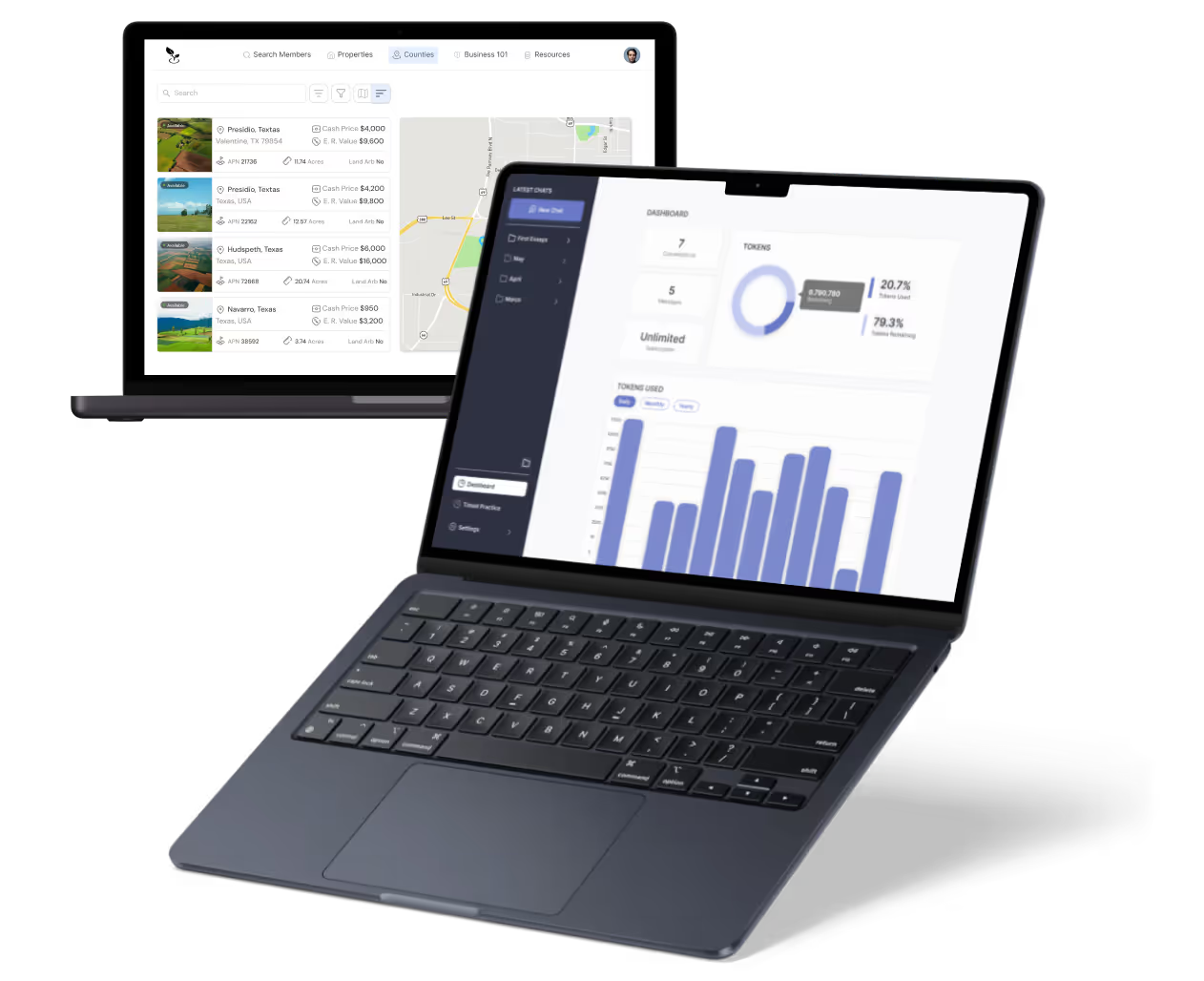

What Is a Legal Analytics App and Why Build It with Bubble?
A legal analytics app aggregates data from matters, time entries, billing records, and case outcomes to surface the performance metrics that law firm leadership and legal operations teams need to make informed decisions.
Most firms have the underlying data, in time-tracking tools, matter management systems, and billing platforms. What they lack is a layer that connects and visualizes it in a way that supports operational decisions.
Understanding Bubble's capabilities and limitations before designing a legal analytics app helps teams scope the right feature set for what Bubble handles well versus where external data tools add value.
- Matter velocity metrics: Average time from intake to close by matter type, practice area, and responsible attorney.
- Attorney utilization: Billable hours logged versus target, by individual and by team.
- Billing realization rates: Percentage of logged hours that are invoiced and collected.
- Practice area profitability: Revenue versus cost by matter type or practice group.
- Outcome tracking: Win/loss ratios by court, judge, attorney, and matter type for litigation practices.
Bubble handles legal analytics well when the underlying data lives in the same Bubble app. Pulling from external systems adds API Connector complexity but is achievable within the same architecture.
What Features Should a Legal Analytics App Include?
A legal analytics app is only as useful as the questions it can answer for its users. Design the feature set around the specific decisions the firm needs to make faster.
Map each analytics feature to a specific user question before building. This prevents building dashboards nobody uses.
- Matter performance dashboard: Displays open matter count, closed matter count, average cycle time, and status distribution across the active portfolio, filterable by practice area, attorney, and date range.
- Billing analytics panel: Shows total hours logged, hours invoiced, realization rate, unbilled balance, and invoice aging across all or filtered matters.
- Attorney performance metrics: Individual and team views of billable hours versus target, matter load, and average cycle time. Restricted to the attorney themselves and management roles.
- Practice area profitability view: Aggregates revenue, costs, and margin by matter type or practice group for firm leadership review.
- Outcome tracker: Win/loss record by case type, court, and attorney. Filterable by date range. Useful for litigation practice development decisions.
- Custom report generator: User selects date range, filters, and metric set; app generates a PDF summary report for sharing outside the system.
The most impactful feature for most firms is the billing analytics panel. Realization rate visibility alone, showing where hours are logged but not invoiced, typically surfaces immediate revenue recovery opportunities.
How Do You Structure the Database for a Legal Analytics App in Bubble?
Legal analytics apps aggregate data rather than create new records. The data types that matter most are the ones feeding the dashboards: Matter, Time Entry, Cost Entry, Invoice, and User.
Understanding the best backends for Bubble helps teams decide whether to keep all data in Bubble's native database or connect to an external data store for high-volume analytics.
For firms with up to a few thousand matters and tens of thousands of time entries, Bubble's native database handles analytics loads effectively when aggregation is pre-calculated.
- Metrics data type: Stores pre-calculated aggregations, total hours by attorney and month, realization rate by practice area, matter counts by status, updated nightly. This prevents heavy real-time computation on every dashboard load.
- Dashboard Filter data type: Saves each user's current filter preferences (date range, practice area, attorney) so dashboards reload with the user's last context.
- Report data type: Records every generated report with the user who generated it, the filter parameters applied, the timestamp, and the output file URL.
- Aggregation Job Log data type: Records each nightly aggregation run with start time, end time, record count processed, and any error flags.
The source data types (Matter, Time Entry, Cost Entry) should be modeled in a way that supports analytics filtering. Date fields, attorney references, matter type option sets, and status option sets must be consistent and complete.
| Data Type | Purpose | Update Frequency |
|---|---|---|
| Metrics | Pre-calculated KPI aggregations | Nightly scheduled workflow |
| Dashboard Filter | User filter preference persistence | On user filter action |
| Report | Generated report archive | On report generation |
| Aggregation Job Log | Nightly job monitoring | Nightly scheduled workflow |
| Data Type | Purpose | Update Frequency |
|---|---|---|
| Metrics | Pre-calculated KPI aggregations | Nightly scheduled workflow |
| Dashboard Filter | User filter preference persistence | On user filter action |
| Report | Generated report archive | On report generation |
| Aggregation Job Log | Nightly job monitoring | Nightly scheduled workflow |
Avoid computing aggregations in real time on dashboard page loads. Queries like "sum all time entries across all matters filtered by practice area and date range" can return slowly on large datasets. Pre-calculate nightly and display from the Metrics records instead.
How Do You Build the Core Workflows for a Legal Analytics App in Bubble?
Legal analytics workflows are primarily automated aggregation jobs and user-triggered report generation. Both require careful design to avoid performance bottlenecks.
Build the nightly aggregation workflow first. It is the foundation of every dashboard display.
- Nightly aggregation workflow (scheduled): Runs at 2 AM daily; calculates attorney utilization, billing realization, matter cycle times, and practice area counts; creates or updates Metrics records for each dimension; writes an Aggregation Job Log entry with completion status.
- Dashboard filter workflow: User changes filter dropdown; workflow updates Dashboard Filter record with new parameters; page refreshes Metrics data display based on saved filter; no full page reload required.
- Custom report generation: User selects date range and filter parameters; workflow queries relevant Metrics and source records; passes data to Documint or PDF Conjurer; generates formatted PDF; stores in Report data type; sends download link via email.
- KPI alert workflow (scheduled): Runs weekly; queries attorney Metrics records; identifies attorneys whose billable hours are below monthly target percentage; sends SendGrid alert email to the attorney and their supervisor.
- Data export workflow: User clicks export; workflow queries filtered Matter or Time Entry records; formats as CSV string; triggers file download. Useful for attorney-managed Excel analysis outside the app.
The data export workflow is often added late in a project but requested frequently post-launch. Build it into the scope upfront.
What Security and Data Requirements Apply to a Legal Analytics App?
Analytics data amplifies privacy concerns because it surfaces patterns that individual record access would not. An attorney can see their own matters, but an analytics view that shows all attorney performance data creates a different exposure.
Privacy rules for analytics apps require more nuance than standard CRUD apps. Think through each metric and who should see it.
- Individual performance data: Attorney utilization rates, realization rates, and billable hour data are restricted to the relevant attorney and users with firm management or billing administrator roles.
- Aggregate firm data: Firm-level metrics (total matters, total revenue, aggregate realization rate) are available to all attorney roles without individual breakdowns.
- Client matter data in analytics: Any analytics query that surfaces data about specific clients must respect the underlying Matter privacy rules. If an attorney cannot see a matter, they cannot see that matter's data in analytics.
- Billing and financial data: Invoice amounts, realization rates, and profitability metrics are restricted to billing administrator and managing partner roles. Standard associates see their own hours data only.
- Report access: Generated reports inherit the privacy rules of the data they contain. A report generated from restricted data is itself restricted.
The risk of oversharing in analytics is real. A dashboard that shows all attorney performance data to all attorneys creates internal political problems. Build role-based metric visibility from day one.
What Plugins and Integrations Does a Legal Analytics App Need?
Bubble's native chart element handles basic bar and line charts for most analytics use cases. More sophisticated visualization requirements benefit from plugin-based charting libraries.
Select visualization plugins based on the specific chart types your firm needs. Do not add charting complexity that your users will not actually use.
- Bubble native charts: Handles bar, line, and pie charts. Sufficient for most dashboard views. Uses Bubble data directly without plugin dependency.
- ApexCharts plugin: Adds heatmaps, area charts, multi-series comparisons, and drill-down capabilities for more sophisticated analytics views. Good for utilization heatmaps and billing trend analysis.
- Documint plugin: Generates formatted PDF analytics reports with charts, tables, and narrative sections from pre-calculated Metrics data.
- Google Sheets API (via API Connector): Exports raw time entry and matter data to Google Sheets for firms that have analysts who prefer working in spreadsheet tools.
- Clio or MyCase API: Pulls matter, time entry, and billing data from existing practice management platforms via API Connector. Enables analytics without migrating from the firm's current operational system.
The Clio/MyCase API integration path is worth evaluating early in scoping. If the firm already uses a practice management platform, analytics may be the right layer to build in Bubble while keeping operations in the existing tool.
How Long Does It Take and What Does It Cost to Build a Legal Analytics App with Bubble?
Legal analytics apps range from moderate to high complexity depending on the number of data sources, the sophistication of the visualizations, and whether external system integration is required.
A focused single-source dashboard (all data in Bubble) is four to six weeks. A multi-source analytics layer pulling from external practice management systems is eight to fourteen weeks.
- Bubble plan: Growth plan at $119/month provides the capacity for nightly aggregation workflows, data volume for analytics queries, and API workflow for report generation.
- Plugin costs: ApexCharts plugin adds $10 to $20 per month. Documint adds $15 to $30 per month for report generation.
- External API integration: Clio API integration adds two to four weeks of build time and requires a Clio partner API key. MyCase and other platforms vary.
- Build timeline: Four to six weeks for a single-source dashboard with nightly aggregation. Eight to twelve weeks for external data integration and custom report builder.
- Agency cost range: Expect $12,000 to $25,000 for a focused legal analytics dashboard. Multi-source integration builds run $20,000 to $40,000.
For teams considering building analytics as a SaaS product for multiple law firms, reviewing the approach of a Bubble SaaS development agency provides a useful framework for multi-tenant data isolation and user management at scale.
The nightly aggregation workflow is the most important technical decision in the build. Getting the aggregation logic right, computing accurate metrics efficiently across large datasets, is where most legal analytics builds either succeed or fail.
Conclusion
Bubble supports legal analytics dashboards that surface actionable operational metrics without a dedicated business intelligence team. Pre-calculated aggregation, native charting, and role-based privacy rules deliver practice management insight at a fraction of enterprise platform costs.
Design aggregation workflows and privacy rules before building any dashboard UI. Firms that can see billing realization rates and matter cycle times in real time make better decisions faster.
Ready to Build Your Legal Analytics App with Professional Support?
Legal analytics apps surface attorney performance data, billing financials, and client matter records through aggregation queries. A misconfigured privacy rule can expose individual performance metrics firm-wide. A poorly designed nightly job produces inaccurate dashboards that erode user trust.
At LOW/CODE Agency, we started as builders and that has not changed. Today we build AI-powered products — web apps, mobile apps, RAG systems, chatbots, and AI agents — specifically for SMBs that want real software, not a SaaS subscription. We scope the architecture, engineer the workflows, and stay involved through launch and beyond.
- Data architecture: We design your data types, option sets, and privacy rules before writing a single element on the canvas.
- Workflow engineering: We build backend workflows, scheduled jobs, and API integrations with proper logic and error handling.
- Plugin configuration: We select and configure the right Bubble plugins for your feature set without unnecessary bloat.
- Role-based access: We implement privacy rules at the database level, not just conditional UI visibility.
- Integration setup: We connect your Bubble app to Stripe, SendGrid, Twilio, and other services correctly from day one.
- Pre-launch testing: We test against real data before deployment so every workflow performs correctly under live conditions.
- Post-launch support: We stay involved after go-live to optimize as real usage data shapes the app.
We have built 350+ products for clients including Coca-Cola, American Express, Sotheby's, and Medtronic. We know exactly where Bubble builds fail and we address those problems before they surface.
Related Articles
- How to Build a Legal Document Automation App with Bubble
- How to Build a Legal Case Management App with Bubble
- How to Build a Legal Billing App with Bubble
- How to Build a Lease Management App with Bubble
- How to Build a Learning Management System App with Bubble
- How to Build a League Management App with Bubble
Last updated on
September 24, 2026
.

Jesus is a visionary entrepreneur and tech expert. After nearly a decade working in web development, he founded LOW/CODE Agency to help businesses optimize their operations through custom software solutions.


FAQs
Can you build a legal analytics app without coding using Bubble?
How do you visualize case outcome trends in a Bubble legal analytics app?
How do you track attorney performance metrics in a Bubble legal analytics app?
How do you analyze billing and revenue trends in a Bubble legal analytics platform?
How do you import external legal data into a Bubble legal analytics app?
How do you generate custom legal analytics reports in Bubble?
Related Articles

Bubble
Best Bubble Agency for MVP Development in 2026 (7 Top Picks)
Looking for the best Bubble agency for MVP development? Here are 7 vetted agencies that ship fast, scalable Bubble MVPs in 2026.

Bubble
How to Build a Mortgage Management App with Bubble
Simplify mortgage tracking with a no-code Bubble app. Manage applications, payments, and borrower data step-by-step no developer required.

Bubble
How to Build a Vendor Management App with Bubble
Streamline vendor relationships with Bubble. Build a no-code vendor management app step-by-step track contracts, payments & performance fast.

Bubble
How to Build a Bundle How to Builder App With Bubble
Build a bundle builder app with Bubble. Let customers create custom product bundles, see live pricing, and checkout — no dev team needed.


Why customers trust us for no-code development


