

How to Build an Entertainment Booking Platform App with Bubble
12 min
read
Launch an entertainment booking platform with Bubble no coding required. Book talent, manage contracts & process payments step-by-step with no-code.


Building an entertainment booking platform means solving a two-sided coordination problem: talent needs to list availability and get paid, while clients need to search, book, and sign contracts without back-and-forth email chains.
Bubble handles the full booking lifecycle, availability management, automated contracts, Stripe payments, and role-based dashboards, without requiring a custom backend or a team of developers.
Key Takeaways
- Two-sided marketplace logic: This app requires separate portals for talent and clients, with an admin layer for booking managers.
- Five core data types: Talent, Client, Booking, Availability, and Contract form the foundation of the data model.
- Calendar and payment are the hardest parts: Availability management and Stripe payment flows require careful workflow design to prevent double-bookings.
- Contracts can be automated: Documint or PDF Conjurer integration generates and sends contracts automatically on booking confirmation.
- MVP timeline: A functional first version takes 8–12 weeks; a full marketplace with ratings and automated contracts runs 14–20 weeks.
- Cost range: Expect $20,000–$55,000 depending on scope and integration complexity.
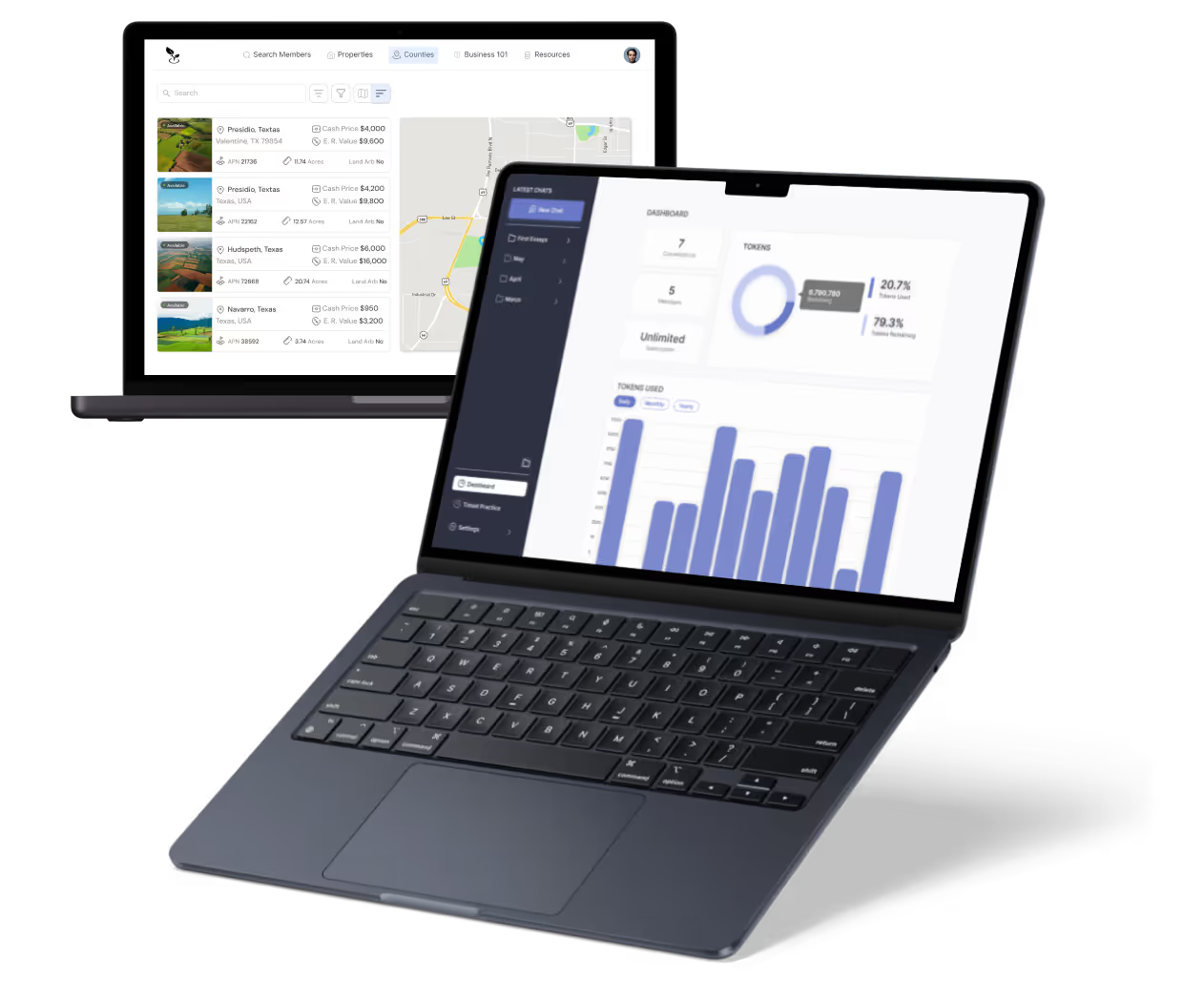

What Is an Entertainment Booking Platform — and Why Build It with Bubble?
An entertainment booking platform connects talent, musicians, DJs, speakers, performers, with clients like event organizers, venues, and corporate bookers. It manages the full booking lifecycle from availability search through contract signing and payment collection.
Generic tools cover pieces of this. Calendly handles scheduling. Stripe handles payments. But no off-the-shelf product handles availability management, contract generation, and role-based dashboards in a single platform.
- Two-sided user logic: Talent and clients need entirely different interfaces built on the same database, which Bubble handles through role-based conditionals and separate page sets.
- Availability management: Bubble's database can store per-slot availability records and update their status through backend workflows, preventing double-bookings without a custom server.
- API integration depth: Stripe, Documint, and SendGrid all connect to Bubble via the API Connector or native plugins, covering payments, contracts, and email in one app.
- Role-based dashboards: Organizers, talent, clients, and admins each see different data from the same underlying database through Bubble's privacy rule system.
Understanding Bubble's pros and cons is important before committing to this build. Bubble is a strong fit for early-stage marketplaces but has real-time performance limits at very high concurrency.
What Features Should an Entertainment Booking Platform Include?
A booking platform has two distinct sides: the talent-facing features and the client-facing features. Both depend on a shared booking workflow in the middle. Scope each side clearly before any development begins.
Features split into MVP scope and phase two. Launch with the booking workflow core. Add reviews, advanced search, and admin tools in the second phase.
- Talent profiles: Bio, media gallery, service categories, pricing tiers, and availability calendar that clients can browse before submitting a booking request.
- Client-facing search: Filter talent by category, location, price range, and availability to surface relevant options before a booking is initiated.
- Booking request workflow: Client submits request with event details, talent reviews and accepts or declines, admin can intervene or override.
- Contract generation: Booking confirmation automatically triggers PDF contract creation via Documint with both parties' details pre-filled.
- Payment processing: Stripe handles deposit collection at booking confirmation plus balance collection a set number of days before the event.
- Reviews and ratings: Post-event review submitted by client appears on talent profile after admin approval, keeping review data credible.
A focused approach to Bubble MVP development means shipping the booking workflow core first and validating it with real users before building advanced features.
How Do You Structure the Database for an Entertainment Booking Platform in Bubble?
The database for an entertainment booking platform requires six data types. The Availability data type design is the most critical architectural decision. It directly determines whether double-bookings are possible.
The Availability data type stores individual time slots as separate records. Each record links to a Talent and carries a status field. When a booking is confirmed, the matching Availability records change status from Available to Booked.
- Talent data type: Fields for linked User, bio, category list, location, hourly rate, profile image, and average rating (calculated field updated after each review).
- Client data type: Fields for linked User, company name, event history (list of linked Bookings), and verified status boolean.
- Availability data type: Fields for linked Talent, date, start time, end time, and status option set (Available, Blocked, Booked). Created in bulk when talent configures their calendar.
- Booking data type: Fields for linked Talent, linked Client, event date, event details text, status option set (Pending, Confirmed, Completed, Cancelled), linked Contract, deposit paid boolean, and balance paid boolean.
- Contract data type: Fields for linked Booking, PDF URL, signed status boolean, and signed timestamp.
- Review data type: Fields for linked Booking, linked Talent, integer rating, comment text, and published boolean for admin moderation.
Option sets to configure: Booking Status (Pending, Confirmed, Completed, Cancelled), Talent Category (Musician, DJ, Speaker, Performer, Comedian), Payment Status (Unpaid, Deposit Paid, Fully Paid).
The key relationship logic: a Booking links one Talent to one Client for one event. The Booking record is the central object that everything else: Availability, Contract, Review, and Payment references.
How Do You Build the Core Workflows for an Entertainment Booking Platform in Bubble?
Six backend workflows power the booking lifecycle. All six should be built as backend API workflows in Bubble, not client-side workflows triggered by button clicks. This prevents logic from firing twice and keeps sensitive payment operations server-side.
Build and test each workflow individually before chaining them together. Payment workflows especially need isolated testing against Stripe's test mode before any live key is used.
- Booking request: Client submits booking form, Booking record created with Pending status, matching Availability records status updated to Blocked, push notification or email sent to Talent via SendGrid.
- Talent accepts booking: Talent clicks Accept, Booking status updates to Confirmed, Availability records status updated to Booked, Stripe payment intent created for the deposit amount.
- Deposit collection: Stripe webhook fires on successful deposit charge, Bubble backend workflow receives the webhook, sets deposit_paid field to True, triggers contract generation workflow.
- Contract generation: Backend workflow calls Documint API with Booking data fields (talent name, client name, event date, price, terms), returns PDF URL, stores URL on Contract record, sends email to both parties with link.
- Balance collection: Scheduled backend workflow runs 7 days before the event date, charges remaining balance via stored Stripe payment method, updates balance_paid field to True.
- Post-event review: Automated email sent to Client 24 hours after event date with a unique review link. Client submits review, Review record created with published set to False pending admin review.
For the balance collection workflow, use Bubble's Schedule API Workflow on a date option and calculate the trigger date as event_date minus 7 days when the Booking is confirmed.
What Security and Data Requirements Apply to an Entertainment Booking Platform?
An entertainment booking platform processes financial transactions and stores personally identifiable information for both talent and clients. Privacy rules at the data type level are not optional. They are the minimum required to protect user data and meet platform liability standards.
Three user roles are required: Talent, Client, and Admin. Each role is stored as a boolean field on the User data type. Privacy rules reference these fields in every condition.
- Talent privacy rules: Talent users can only edit their own Talent record. Client users can read public profile fields (bio, category, pricing) but cannot access financial or contact fields directly.
- Booking visibility: Bookings are readable only by the Talent linked to that Booking, the Client linked to that Booking, and Admin users. No cross-user booking visibility.
- Contract access: Only the Talent, Client, and Admin on the linked Booking can access Contract records. Contract PDF URLs should not be guessable (use Bubble's random string generator for file paths).
- Payment data handling: Stripe manages all sensitive card data. Bubble stores only Stripe customer IDs and payment intent IDs, never raw card numbers or CVV data.
- Review moderation: Reviews are created with published set to False. Admin reviews and approves before setting published to True. This prevents manipulation of talent ratings.
- API key security: Stripe, Documint, and SendGrid API keys are stored in Bubble's server-side environment variables only, never exposed in frontend element logic.
What Plugins and Integrations Does an Entertainment Booking Platform Need?
Seven integrations cover the full feature scope. Install only what the current phase requires. Adding unused plugins slows the Bubble editor and creates unnecessary maintenance overhead.
Stripe Connect is the most complex integration on this list. If the platform model requires paying talent directly minus a commission, plan a full sprint just for Stripe Connect configuration and testing.
- Stripe plugin: Full payment flow including payment intents, deposit charges, balance charges, and refund handling. The Bubble Stripe plugin handles most of this natively.
- Stripe Connect: Enables talent to receive direct payouts minus the platform's commission percentage. Requires onboarding each talent as a Stripe Connect account, adds 2–3 weeks to the build.
- Documint or PDF Conjurer: Generates contract PDFs from Bubble data using a pre-designed template. Documint's visual template editor makes it easier for non-developers to update contract wording later.
- SendGrid API Connector: Transactional emails for booking confirmations, payment receipts, contract delivery, and review requests. Configure dynamic template variables in SendGrid to pull from Bubble data fields.
- Bubble's Calendar plugin or FullCalendar: Displays talent availability on a visual calendar. FullCalendar provides more customization for time-slot display than Bubble's native calendar element.
- Twilio API Connector: SMS notifications for booking confirmations and payment reminders. High-value for time-sensitive booking events where email open rates are uncertain.
- DocuSign API Connector: Optional electronic signature on generated contracts. Adds legal weight to the contract process but adds 1–2 weeks of integration complexity.
How Long Does It Take and What Does It Cost to Build an Entertainment Booking Platform with Bubble?
An MVP entertainment booking platform with talent profiles, booking request workflow, and basic Stripe payment processing takes 8–12 weeks. Adding automated contract generation, Stripe Connect payouts, reviews, and an admin panel extends the timeline to 14–20 weeks.
The complexity multiplier on this build is the payment flow. A basic deposit collection is 2–3 weeks of work. Adding Stripe Connect marketplace payouts with commission splits adds another 2–3 weeks on top.
- MVP build: Talent profiles, booking request workflow, Stripe deposit payment, basic availability calendar. Timeline: 8–12 weeks. Cost: $20,000–$32,000.
- Full-featured build: All MVP features plus automated contracts, Stripe Connect payouts, post-event reviews, and admin management panel. Timeline: 14–20 weeks. Cost: $38,000–$55,000.
- Bubble plan required: The Production plan ($349/month) is recommended for a marketplace with simultaneous users across multiple sessions. The Growth plan ($119/month) works for early testing.
- Ongoing infrastructure costs: Bubble subscription ($119–$349/month), Stripe fees (2.9% + 30 cents per transaction plus Stripe Connect fees), SendGrid ($15–$50/month), Documint (subscription-based).
Understanding Bubble's scalability is important before deciding on infrastructure. Bubble handles early-stage marketplace volumes well, but platforms expecting thousands of concurrent users need to plan their database structure and workflow architecture with growth in mind from the start.
Conclusion
Bubble is a strong fit for entertainment booking platforms when the Availability data type is correctly structured and the Stripe payment flows are engineered with proper error handling.
The two decisions that determine build quality are the Availability data type design and the Stripe payment flow architecture. Map the full booking lifecycle before writing a single workflow.
Building an Entertainment Booking Platform That Handles Real Transactions from Day One
Entertainment booking platforms fail most often at two points: the Stripe payment flow and the double-booking prevention logic. Both require careful data architecture and server-side workflow design before any UI is built.
At LOW/CODE Agency, we started as builders and that has not changed. Today we build AI-powered products — web apps, mobile apps, RAG systems, chatbots, and AI agents — specifically for SMBs that want real software, not a SaaS subscription. We scope the architecture, engineer the workflows, and stay involved through launch and beyond.
- Data architecture: We design your data types, option sets, and privacy rules before writing a single element on the canvas.
- Workflow engineering: We build backend workflows, scheduled jobs, and API integrations with proper logic and error handling.
- Plugin configuration: We select and configure the right Bubble plugins for your feature set without unnecessary bloat.
- Role-based access: We implement privacy rules at the database level, not just conditional UI visibility.
- Integration setup: We connect your Bubble app to Stripe, SendGrid, Twilio, and other services correctly from day one.
- Pre-launch testing: We test against real data before deployment so every workflow performs correctly under live conditions.
- Post-launch support: We stay involved after go-live to optimize as real usage data shapes the app.
We have built 350+ products for clients including Coca-Cola, American Express, Sotheby's, and Medtronic. We know exactly where Bubble builds fail and we address those problems before they surface.
Related Articles
- How to Build an Event Analytics App with Bubble
- How to Build an Equipment Tracking App with Bubble
- How to Build an Equipment Inspection App with Bubble
- How to Build an Enrollment Management App with Bubble
- How to Build an Electronic Health Records App with Bubble
- How to Build an Education CRM App with Bubble
Last updated on
September 24, 2026
.

Jesus is a visionary entrepreneur and tech expert. After nearly a decade working in web development, he founded LOW/CODE Agency to help businesses optimize their operations through custom software solutions.


FAQs
Can you build an entertainment booking platform without coding?
How do you manage talent or performer profiles in a Bubble entertainment booking app?
How do you handle booking requests and confirmations in Bubble?
How do you manage performer availability calendars in Bubble?
How do you process booking deposits and payments in Bubble?
How do you manage contracts and rider requirements in a Bubble entertainment booking platform?
Related Articles
Bubble
How to Build a Driver Log App with Bubble
Build a donor management app with Bubble without writing code. Track donors, manage gifts, and run campaigns step-by-step with no-code.
Bubble
Comparison
Bubble vs Backendless | 10 Factors to Decide the Best One
Compare Bubble vs Backendless across 9 factors like UI, logic, API, and scalability to find the best no-code platform for your app’s needs

Bubble
How to Build a Sales CRM App with Bubble
Build a sales CRM with Bubble. Track contacts, manage pipelines, and automate follow-ups — fully custom to your sales process, no code required.
Bubble
How to Build a Returns Management App with Bubble
Build a returns management app in Bubble without coding. Streamline refunds, track return status, and delight customers with this no-code guide.
Why customers trust us for no-code development


