

n8n vs Bubble: Automation or App Builder?
9 min
read
n8n vs Bubble — automation tool or no-code app builder? See what each does best and when to use one over the other.

n8n and Bubble are both popular no-code tools, but they operate in completely different categories. Picking the wrong one for your problem costs time and often requires rebuilding from scratch.
If you are comparing n8n and Bubble, you are likely building a product or automating backend processes and need to understand which platform handles what.
Key Takeaways
- Bubble is a full app builder: It lets you design and deploy web applications with a visual UI editor, database, and logic layer.
- n8n is a workflow automation platform: It automates backend processes and connects your existing tools and services together.
- Bubble does not replace automation tools: Its backend workflows handle app logic well, but cannot replicate n8n's cross-platform orchestration.
- n8n does not build user-facing apps: It has no frontend editor. It processes data and triggers actions but does not serve interfaces.
- They complement each other well: Bubble builds the product your users interact with. n8n automates the operational processes running behind it.

Comparison Table
What Is Bubble and Who Uses It?
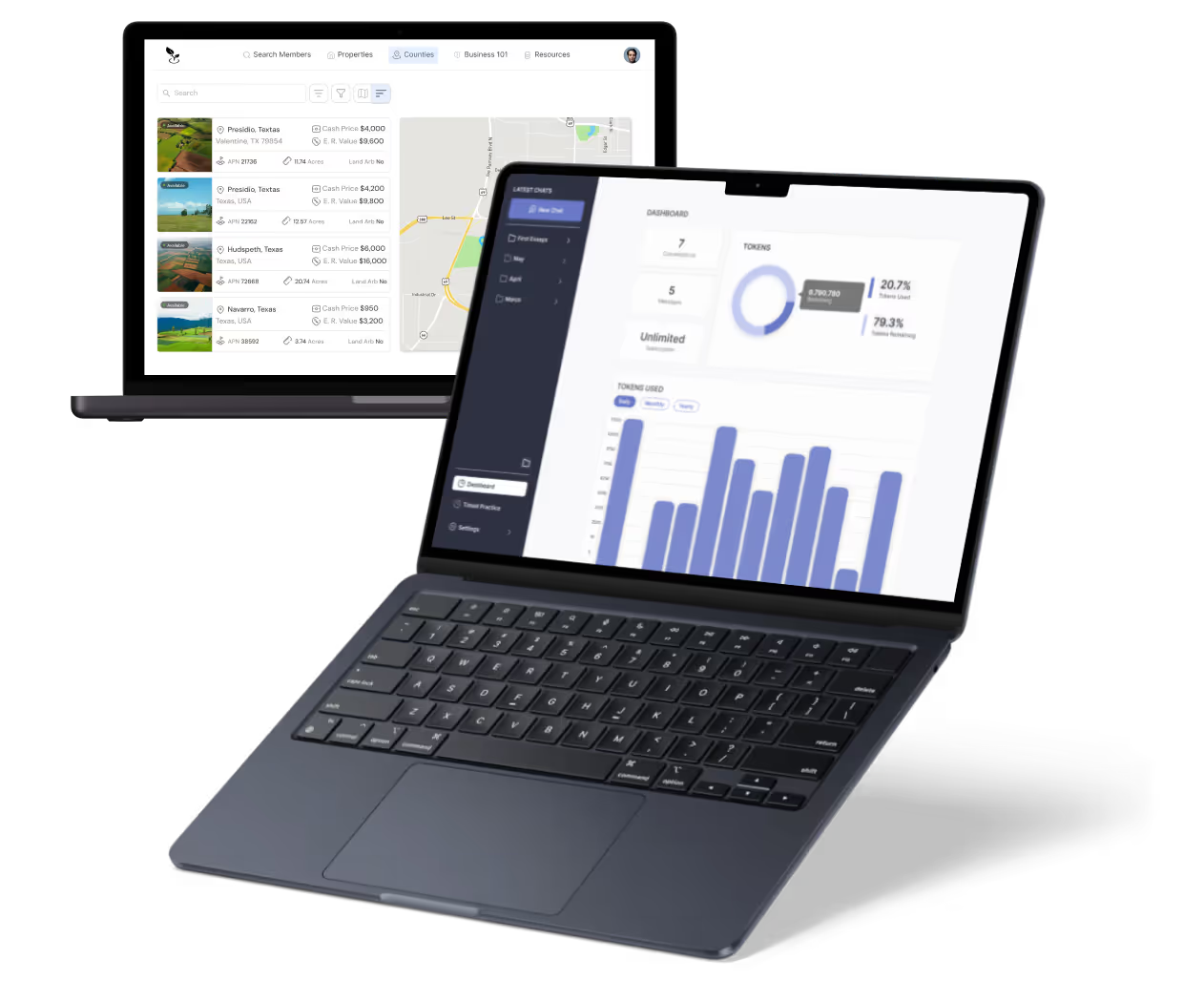
Bubble is a no-code platform for building fully functional web applications. It gives you a visual editor for designing interfaces, a database, and a workflow engine for app logic.
Founders, product teams, and agencies use Bubble to ship working products without hiring a development team or writing backend code from scratch.
- Visual UI editor: Design pixel-precise web application interfaces using a drag-and-drop canvas with responsive layout support.
- Built-in database: Store and manage app data directly inside Bubble without connecting to an external database service.
- Workflow editor: Define app logic like form submissions, user actions, and conditional page behavior using a visual rule builder.
- User authentication: Add login, registration, and role-based access to your Bubble app without writing custom auth code.
- Plugin marketplace: Extend Bubble with third-party plugins for payments, maps, AI, and hundreds of other functionality categories.
- API connector: Connect your Bubble app to external services and APIs for data that lives outside the Bubble database.
Bubble is a strong default for teams building SaaS products, marketplaces, internal tools, and MVPs that need a real, deployable web application.
What Is n8n and Who Uses It?
n8n is an open-source workflow automation platform with a visual node-based editor. It automates business processes and connects external tools without requiring code.
Understanding how n8n is built and what sets it apart from simpler automation tools covers the platform's model for automation and why it is a practical choice for operational and backend workflow needs.
- Node-based workflow canvas: Build automations by connecting trigger, action, and logic nodes on a visual canvas without writing code.
- 400+ integrations: Native nodes for CRMs, databases, communication tools, payment platforms, project management apps, and custom APIs.
- Webhook triggers: Receive HTTP requests from any external system and start complex multi-step workflows in real time.
- Custom code support: Add JavaScript or Python logic inside code nodes for requirements that go beyond built-in node capabilities.
- AI and agent workflows: Build LLM-powered automations for enrichment, classification, summarization, and autonomous agent tasks.
- Self-hosted or cloud: Deploy n8n on your infrastructure for full control, or use the managed cloud for zero maintenance overhead.
n8n is used by operations teams, RevOps professionals, developers, and agencies that automate the business logic running around their product and tool stack.
What Are Bubble's Automation Limits?
Bubble includes a workflow editor for app logic, but it is scoped to actions happening inside your Bubble application. It is not built for external orchestration.
You can send an API call from a Bubble workflow, but managing multi-step cross-platform logic with conditions, retries, and branching quickly becomes difficult.
- App-scoped workflows: Bubble workflows are tied to user interactions and app events. They are not designed for backend-only scheduled jobs.
- Limited scheduling: Running recurring server-side automations in Bubble requires workarounds. It is not a native first-class feature.
- API rate limits and complexity: Complex external API orchestration gets unwieldy inside Bubble's workflow editor compared to a dedicated automation tool.
- No visual multi-step orchestration: Bubble's workflows do not have n8n's canvas-based design for mapping complex multi-branch automation logic.
- Debugging is harder: When a Bubble workflow fails mid-process, diagnosing and retrying is more involved than in a purpose-built automation tool.
For any backend automation that spans multiple external services, n8n provides a purpose-built environment that is significantly easier to build and maintain.
What Are n8n's App Building Limits?
n8n has no frontend editor and no concept of a user interface. It is the wrong tool for building anything your end users need to click, fill out, or navigate.
Reviewing the full depth of n8n's feature set, including sub-workflows, branching logic, and integration options details what the platform is designed to do and helps clarify where it belongs in your technical architecture.
- No UI layer: n8n does not generate pages, forms, or interactive components. Everything it does is invisible to your end users.
- No user authentication: n8n does not manage users, sessions, or role-based access for a customer-facing product.
- No hosted app output: n8n produces workflow execution results, not deployable applications that live at a public URL.
- No database ownership: n8n reads from and writes to databases but does not own or manage a structured data layer itself.
- Developer-adjacent complexity: Advanced workflows with custom logic and conditional branching benefit from JavaScript knowledge, unlike Bubble's visual app builder.
If you need to build something users interact with directly, n8n is not the tool. Bubble, or a similar app builder, is the right choice for that layer.
How Do n8n and Bubble Work Together?
Bubble and n8n are a natural pair. Bubble handles the frontend and app database. n8n handles the operational automation running around the product.
Reviewing what real n8n deployments look like across different business functions shows how automation layers like n8n integrate with product platforms in practical deployments.
- Bubble triggers n8n via webhook: When a user completes a Bubble action, a webhook fires n8n to handle the downstream operational logic.
- n8n writes back to Bubble: After processing an external event, n8n can call Bubble's API to update records or trigger in-app states.
- Onboarding automation: A new Bubble user signup triggers an n8n workflow that sends emails, creates a CRM contact, and notifies your team in Slack.
- Payment event handling: A Stripe webhook triggers n8n to update the user's plan in the Bubble database and send a confirmation email.
- External data sync: n8n polls or listens to external services and pushes clean, structured data back into the Bubble database on a schedule.
This pairing lets Bubble focus entirely on the product experience while n8n handles all the operational connections to your broader business stack.
What Do Workflows Look Like in Each Tool?
The workflow design experience is fundamentally different between n8n and Bubble. Each reflects the tool's core purpose and intended audience.
Reviewing how n8n workflows are structured and what makes them reliable in production shows how real automations are built and what they look like across different use case categories.
- n8n workflows are process maps: Nodes flow left to right on a canvas. Each node performs one step. Branches handle conditions and parallel paths.
- Bubble workflows are event handlers: Rules are triggered by user actions on the frontend and execute a list of sequential steps in response.
- n8n supports long-running processes: Workflows can wait for external events, poll systems, and pause between steps across time.
- Bubble workflows are synchronous: They execute in the context of a user session or an immediate server-side action without long pauses.
- n8n is debuggable externally: Every execution is logged with inputs and outputs at each node, making troubleshooting straightforward.
- Bubble debugging is in-editor: You inspect workflow behavior through Bubble's own debugger tied to the app runtime environment.
Understanding these differences helps you design systems where both tools handle the work they are actually built for.
Which Tool Should You Choose?
Your choice depends on whether you are building an interface for users or automating processes that run without user interaction.
- Choose Bubble when: You are building a web application with pages, user logins, forms, and a database that customers or internal teams interact with.
- Choose n8n when: You are automating backend processes, connecting multiple services, or building operational workflows without a user-facing component.
- Use both when: You have a Bubble product and need to automate the operational layer around it, including notifications, CRM updates, and integrations.
If you are still exploring your automation options, how n8n compares to its main alternatives on pricing, flexibility, and use case fit covers the wider landscape of tools across the automation and no-code categories.
Conclusion
n8n and Bubble are not competing tools. Bubble builds the product. n8n automates what happens around and because of that product.
Teams that try to use Bubble for complex multi-platform automation, or n8n for building user interfaces, will quickly run into the limits of each platform.
Choosing both and letting each do what it is built for is the most reliable architecture for teams shipping no-code products with operational automation.
Work With a Certified n8n Partner
LOW/CODE Agency builds and deploys n8n workflows for businesses that need reliable automation without the internal overhead. From simple integrations to complex multi-step workflows, we handle the build so your team can focus on outcomes.
Related Articles
Last updated on
September 3, 2026
.

Jesus is a visionary entrepreneur and tech expert. After nearly a decade working in web development, he founded LOW/CODE Agency to help businesses optimize their operations through custom software solutions.


FAQs
What is the difference between n8n and Bubble?
Can n8n replace Bubble for building web applications?
Can you use n8n and Bubble together?
Which is better for a non-developer building a business tool: n8n or Bubble?
What does Bubble do that n8n cannot?
What does n8n do that Bubble cannot?
Why customers trust us for no-code development


