

Mobile App Scaling & Performance Monitoring
13 min
read
Is your mobile app ready to handle growth? Learn how to monitor performance, catch bottlenecks early, and scale without breaking things.


Your app works great with 500 users. At 50,000, it collapses. Mobile app scaling is not something you plan for later. It is something you architect from the start.
Mobile app scaling and performance monitoring determine whether your product survives growth or crumbles under it. Scaling handles increased load without degrading user experience. Performance monitoring detects problems before users notice them. This guide covers both so you can grow confidently.
Key Takeaways
- Backend scaling failures are most common, where database queries, API endpoints, and server resources buckle under concurrent user load.
- Monitor from day one because baseline data collected early makes it possible to detect degradation before it impacts users.
- Vertical scaling limits mean adding more power to a single server only works until you hit the hardware ceiling, then you need horizontal architecture.
- 95th percentile matters more than averages because averages hide the 5% of users experiencing unacceptable delays.
- Proactive scaling costs less than reactive scaling since emergency infrastructure changes under load carry premium pricing and higher failure risk.

What Is Mobile App Scaling?
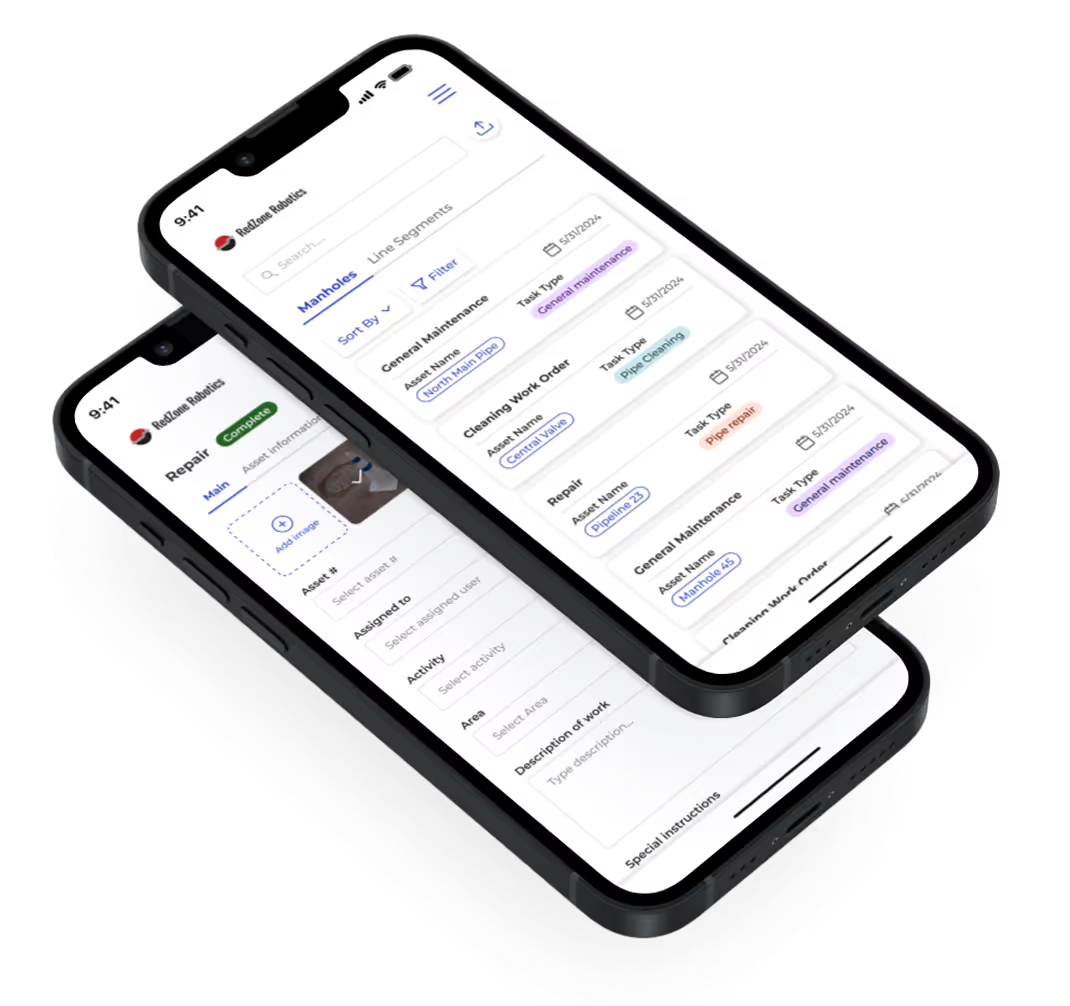
Mobile app scaling is the process of increasing your app's capacity to handle more users, more data, and more transactions without degrading performance, reliability, or user experience.
Mobile app scaling touches every layer of your technology stack. Frontend performance, backend capacity, database throughput, CDN distribution, and third-party API limits all need to scale together or the weakest link breaks first.
- Horizontal scaling adds more servers distributing load across multiple machines so no single server becomes a bottleneck.
- Vertical scaling adds more resources to existing servers through additional CPU, RAM, or storage on your current infrastructure.
- Database scaling handles growing data volumes through read replicas, sharding, connection pooling, and query optimization.
- CDN scaling distributes static content globally reducing latency by serving images, videos, and files from servers nearest to each user.
- API rate limiting protects against traffic spikes by throttling requests to prevent cascading failures across your backend services.
Mobile app scaling is not a one-time project. It is a continuous process that evolves as your user base grows and usage patterns change. Planning for it early costs a fraction of retrofitting it under pressure.
How Do You Know When Your Mobile App Needs to Scale?
Your app needs to scale when response times increase during peak hours, error rates climb above 1%, database queries slow down noticeably, or users report intermittent failures that your team cannot reproduce consistently.
Mobile app scaling problems often disguise themselves as random bugs. Intermittent crashes, occasional timeouts, and inconsistent API responses frequently point to infrastructure hitting its capacity limits.
- Response time degradation during peak usage indicates your servers are running out of processing capacity during high-traffic windows.
- Database connection pool exhaustion causes timeouts when more users query the database simultaneously than your connection limit allows.
- Memory consumption climbing steadily over days suggests memory leaks or inefficient caching that will eventually crash your servers.
- Third-party API rate limits being hit means your user growth has outpaced the capacity your vendor agreements support.
- Deployment times increasing significantly signals that your codebase and infrastructure have grown beyond what your current CI/CD pipeline handles efficiently.
Monitor these mobile app scaling indicators continuously rather than waiting for users to complain. By the time users notice, you have already lost some of them permanently.
What Should You Monitor in a Mobile App?
Monitor crash rates, API response times, server CPU and memory usage, database query performance, error rates by endpoint, user session metrics, and third-party service availability to maintain a complete picture of app health.
Mobile app scaling and performance monitoring require visibility into every layer. Client-side monitoring tells you what users experience. Server-side monitoring tells you why.
The goal of performance monitoring in mobile app scaling is not just collecting data. It is setting thresholds that trigger alerts before metrics reach dangerous levels. Data without action is just noise.
How Do You Set Up Performance Monitoring?
Set up performance monitoring by implementing crash reporting, APM tools, server infrastructure dashboards, synthetic monitoring for critical flows, and alerting rules that notify your team when metrics cross defined thresholds.
Performance monitoring for mobile app scaling requires both client-side and server-side instrumentation. Missing either side leaves blind spots that will eventually surprise you during a growth spike.
- Client-side crash reporting captures device-specific failures logging the exact stack trace, device model, OS version, and user actions before each crash.
- Application performance monitoring tracks every API call measuring response time, throughput, and error rates for every endpoint in your backend.
- Infrastructure dashboards visualize server health showing real-time CPU, memory, disk, and network utilization across your entire deployment.
- Synthetic monitoring tests critical user flows by running automated checks every few minutes to detect outages before real users encounter them.
- Custom business metric tracking measures what matters to you like checkout completion rates, search response times, or content load speeds.
Set up performance monitoring before your app launches, not after your first outage. Baseline data from low-traffic periods makes it possible to detect performance degradation as your app scales.
What Are the Most Common Mobile App Scaling Mistakes?
The most common mobile app scaling mistakes are premature optimization, ignoring database indexing, coupling services too tightly, skipping load testing, and scaling infrastructure without fixing the underlying code performance issues.
Mobile app scaling fails when teams throw hardware at software problems. Adding servers does not fix an inefficient database query that scans millions of rows for every request.
- Premature optimization wastes resources by solving scaling problems you do not have yet instead of addressing the bottlenecks that actually exist.
- Missing database indexes force full table scans turning millisecond queries into multi-second operations as your data grows.
- Tightly coupled services create cascading failures where one slow endpoint backs up the entire API and crashes everything downstream.
- Skipping load testing hides breaking points until real traffic exposes them during a product launch or marketing campaign.
- Scaling compute without fixing code inefficiency means paying for 10 servers to do what one server could handle with optimized queries and caching.
Before spending money on mobile app scaling infrastructure, profile your application. Find where the time goes. Often a few query optimizations and caching layers eliminate the need for expensive infrastructure changes.
The most cost-effective scaling improvements come from fixing inefficient code, not from throwing more hardware at the problem. A single optimized database query can eliminate the need for an entire additional server.
How Do You Scale a Mobile App Backend?
Scale your backend through horizontal scaling with load balancers, database read replicas, caching layers like Redis, CDN distribution for static assets, queue-based processing for heavy tasks, and microservice decomposition for independent scaling.
Mobile app scaling on the backend follows a predictable progression. Most apps start on a single server, move to a load-balanced cluster, add caching and database replicas, and eventually decompose into independently scalable services.
- Load balancers distribute traffic across servers ensuring no single instance bears disproportionate load during traffic spikes.
- Read replicas offload database read operations from your primary database, which is critical since most apps are 90% reads and 10% writes.
- Caching layers serve frequently requested data from memory reducing database load by 60-80% for data that does not change every request.
- Message queues defer heavy processing by moving time-consuming tasks like email sending, image processing, and report generation to background workers.
- Microservice architecture enables independent scaling so your payment service can scale separately from your notification service based on actual demand.
The path you take for mobile app scaling depends on where your bottlenecks are. Risk management planning should identify the most likely scaling scenarios before you need to act on them.
How Do You Scale the Mobile App Frontend?
Scale the frontend by optimizing image delivery, implementing lazy loading, caching API responses locally, reducing bundle sizes, and using code splitting to load only the features each screen requires.
Backend scaling gets most of the attention, but frontend performance directly impacts what users experience. A fast backend means nothing if the app takes five seconds to render the results on screen.
- Image optimization reduces payload sizes by compressing, resizing, and serving images in modern formats like WebP based on device capabilities.
- Lazy loading defers off-screen content so the app renders visible elements immediately and loads additional content as users scroll down.
- Local API response caching reduces network calls by storing frequently accessed data on the device and refreshing it in the background.
- Code splitting loads features on demand by downloading only the code needed for the current screen rather than the entire application upfront.
- Animation performance optimization prevents jank by offloading complex animations to the GPU and reducing main thread work during transitions.
- Network request batching reduces round trips by combining multiple small API calls into fewer, larger requests that complete faster overall.
Frontend scaling requires different expertise than backend scaling, but both affect the same user experience. Monitor client-side performance metrics alongside server metrics to get a complete picture of where users experience slowness.
A fast backend paired with a slow frontend still delivers a poor experience, and users cannot tell the difference between server lag and client-side rendering delays.
How Does Mobile App Scaling Affect User Experience?
Scaling directly affects user experience through load times, reliability, and responsiveness. Users do not know or care about your infrastructure. They know the app is fast or slow, reliable or crashy.
Mobile app scaling exists to protect user experience. Every millisecond of added latency, every timeout error, and every crash caused by overwhelmed infrastructure degrades the metrics that drive your business.
- Response time increases drive user abandonment with each additional second of load time reducing conversion rates by approximately 7%.
- Intermittent errors destroy user trust because users blame the app, not the infrastructure, when something fails unpredictably.
- Geographic latency affects users far from your servers making CDN distribution essential for apps with national or global user bases.
- Inconsistent performance frustrates more than consistent slowness because users cannot develop expectations when speed varies randomly.
- Scaling failures during high-visibility moments like product launches, marketing pushes, or media coverage permanently damage brand perception.
The entire purpose of mobile app scaling and post launch maintenance is ensuring that user growth improves your business instead of destroying it.
What Does a Mobile App Scaling Strategy Look Like?
A scaling strategy defines your current capacity limits, projected growth, trigger points for infrastructure changes, estimated costs at each scale tier, and the technical changes required to support each growth milestone.
Mobile app scaling without a strategy means reacting to fires instead of executing a plan. Document your scaling roadmap alongside your product roadmap so infrastructure investment aligns with growth targets.
- Baseline your current capacity through load testing to know exactly how many concurrent users your infrastructure supports before degradation.
- Define scaling triggers tied to specific metrics such as "add read replica when database CPU exceeds 60% sustained for 30 minutes."
- Estimate costs at 2x, 5x, and 10x current traffic so you can budget for infrastructure as your user base grows to each milestone.
- Identify architectural changes required at each tier because some scaling levels require code changes, not just infrastructure additions.
- Schedule quarterly scaling reviews aligned with your mobile app maintenance cadence to adjust the plan based on real growth data.
The best mobile app scaling strategies are boring. They are documented plans executed methodically, not heroic engineering efforts during production emergencies at 3 AM.
How Do You Choose the Right Monitoring Tools for Your Stack?
Choose monitoring tools based on your technology stack, team size, budget, and the specific metrics that matter most for your app's performance and scaling requirements.
The monitoring tool landscape is crowded, and choosing the wrong tools creates gaps in visibility or unnecessary costs. Match your tools to your actual needs rather than adopting the most popular option.
- Start with crash reporting and basic APM because these two tools cover the highest-priority visibility gaps for most apps.
- Add infrastructure monitoring as you scale because server-level metrics become critical once you manage multiple instances.
- Consolidate tools when possible since running six different monitoring platforms creates alert fatigue and increases monthly costs.
- Set actionable alerts, not noisy ones because a team that receives hundreds of non-critical alerts daily starts ignoring all of them.
- Review your monitoring stack quarterly to ensure tools still match your architecture as it evolves through scaling changes.
The best monitoring setup is one your team actually uses daily. Expensive tools that nobody checks provide zero value compared to simple dashboards reviewed every morning.
Assign monitoring ownership to specific team members and include monitoring review as a standing item in your weekly engineering meetings to ensure performance data drives real decisions.
Conclusion
Mobile app scaling and performance monitoring separate apps that handle growth from apps that collapse under it. Start monitoring from day one, load test before launch, fix code before adding servers, and document a scaling strategy that maps infrastructure to growth milestones.
The apps that scale successfully are the ones that planned for it before they needed it.
Want to Build a Mobile App That Scales?
Scaling failures cost more than the infrastructure they require. At LOW/CODE Agency, we help SMBs compete with AI-powered software built for them — custom web and mobile apps, RAG systems, chatbots, and intelligent agents delivered by a senior development team. We architect mobile apps for growth from the first sprint so scaling becomes execution, not emergency.
- Architecture designed: for horizontal scaling from the foundation
- Performance monitoring: and alerting configured before launch day
- Load testing: that identifies breaking points before real users find them
- Database optimization: and caching strategies for high-throughput applications
- Quarterly scaling reviews: as part of ongoing maintenance engagements
- Infrastructure cost modeling: aligned with your growth projections
Over 350 projects delivered for clients including Medtronic, American Express, Coca-Cola, Zapier, and Sotheby's.
Talk to our team about your scaling needs. LOW/CODE Agency builds mobile apps that handle growth because we plan for it from day one.
Related Articles
- Mobile App Team Change Risk: How to Prepare
- Mobile App Security, Liability & IP Risk
- Mobile App Scope Changes & Change Orders Guide
- Mobile App ROI: Bootstrap vs Raise Capital
- How to Define Your Mobile App Requirements
- Mobile App Project Communication: Full Guide
Work with our custom app development specialists to build exactly what your users need.
Want to learn more? Explore our services.
Last updated on
September 28, 2026
.

Jesus is a visionary entrepreneur and tech expert. After nearly a decade working in web development, he founded LOW/CODE Agency to help businesses optimize their operations through custom software solutions.


FAQs
How do I scale my mobile app to handle more users?
What performance benchmarks should a mobile app meet?
What tools should I use to monitor mobile app performance?
How do I identify performance bottlenecks in my mobile app?
What is load testing and should I do it before scaling my mobile app?
When should I consider rewriting my mobile app for better performance?
Related Articles

Mobile App Development
How to Define Your Mobile App Requirements
Unclear requirements lead to costly mobile app mistakes. Learn how to define, document, and communicate exactly what you need to build.

Mobile App Development
How to Design a Mobile App Users Will Love
Good mobile app design is more than looks. Learn the key principles, process, and decisions that make users keep coming back.

Mobile App Development
How to Build a Social Media App with No-code
Learn how to build a social media app without coding using top no-code tools. Fast, affordable, and perfect for startups in 2025
Mobile App Development
Mobile App Development Challenges (Avoid these mistakes)
Discover mobile app development challenges and learn how working with LowCode Agency helps you avoid mistakes and launch smarter with no-code/low-code

Why customers trust us for no-code development


