

Claude vs Bubble: AI Code Agent vs No-Code Builder
10 min
read
Compare Claude AI code agent and Bubble no-code builder to choose the best tool for app development and automation needs.


Claude vs Bubble looks like a straight capability comparison. It is not. Bubble removes the need to write code by giving you a visual builder. Claude removes the friction of writing code by writing it for you.
Which one is right depends entirely on who is building, what they are building, and how much control they need over the final product.
Key Takeaways
- Bubble is a self-contained no-code platform: Visual drag-and-drop frontend, backend workflows, and database all live inside Bubble's hosted environment.
- Claude is an AI coding agent, not a builder: It writes, edits, and debugs code in real codebases but requires a developer or technical co-founder to implement and deploy.
- Bubble wins on speed for non-technical founders: A solo founder with no coding background can ship a working web app in days without any developer involvement.
- Claude wins on full architectural control: Custom logic, any database, any tech stack, no vendor dependency, and no performance ceiling.
- Bubble pricing is predictable; Claude scales with usage: Bubble ranges from $29 to $529/month; Claude Code runs on pay-per-token Anthropic API pricing.
- The decision turns on technical background and scale: Bubble is the right starting point for non-technical founders; Claude-assisted code is right when the product outgrows a visual builder.

What Is Bubble and Who Uses It?
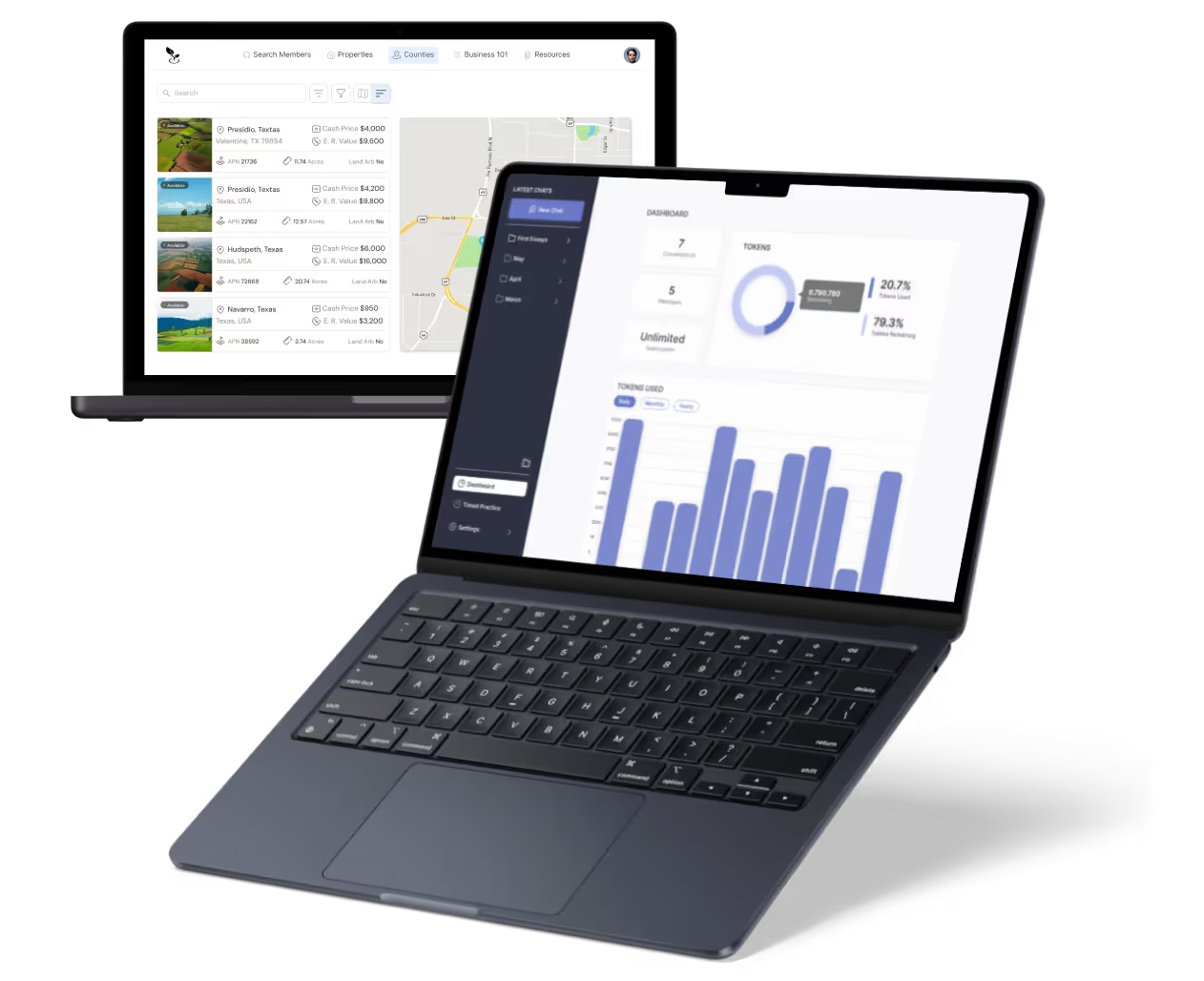
Bubble is a visual no-code platform for building full-stack web applications without writing code. It includes a drag-and-drop design editor, visual workflow builder for logic, a built-in database, and managed hosting.
Bubble handles frontend UI, backend logic, data storage, user authentication, and payment integrations from a single platform with no server configuration required.
Real companies have been built and scaled on Bubble. It is not a toy.
- Who uses Bubble: Non-technical founders building SaaS MVPs, agencies building client portals, and early-stage startups validating concepts before raising money.
- Real use cases: SaaS dashboards, marketplaces, membership platforms, booking apps, and internal tools that require user accounts and data management.
- Plugin ecosystem: 500+ community-built plugins for Stripe, Google Maps, Twilio, SendGrid, and more, plus a native API connector for custom integrations.
- Pricing tiers: Free with a Bubble subdomain; Starter at $29/month; Growth at $119/month; Team at $349/month; Production at $529/month with dedicated infrastructure.
- Proven at scale: Companies like Dividend Finance and Qoins have built meaningful products on Bubble, demonstrating the platform's ceiling is higher than skeptics assume.
Before comparing the two further, it helps to understand what Claude Code actually does, because unlike Bubble, it is not a platform you log into; it is an agent you direct from your terminal.
What Can Bubble Do That Claude Cannot?
Bubble gives non-technical founders a path from idea to live web application without writing a single line of code. Claude produces code that still requires a developer to run, host, and deploy.
The core advantage is that Bubble collapses every step between design and deployment into one visual interface.
- Zero-code deployment: Bubble apps are live from day one with no server setup, no deployment pipeline, and no DevOps knowledge required.
- Visual workflow builder: Logic is built by connecting trigger-action blocks in a canvas, not by writing functions, so non-technical founders can build complex conditional workflows.
- Built-in relational database: Bubble's database supports one-to-many and many-to-many relationships through its Thing/List model, with no SQL required.
- Live preview and instant iteration: Changes in Bubble's editor appear in real-time preview immediately, with no build process, compile step, or redeployment cycle.
- Responsive design without CSS: Bubble's layout engine handles responsive breakpoints visually, so designers with no CSS background can build mobile-friendly layouts.
- One-click plugin integrations: Payment processors, maps, email services, analytics, and social logins are available as plugins rather than code integrations.
Founders deciding between different no-code builders should also read the Bubble compared to Webflow breakdown, since the two tools serve overlapping but distinct use cases.
Where Does Bubble Hit Its Ceiling?
Bubble's interpreted no-code execution layer adds overhead that pure code does not have. Apps with high concurrent users or compute-heavy operations face real latency constraints.
These constraints are not easily resolved without upgrading to the most expensive plans.
The ceiling is specific and predictable. The founders who hit it know exactly when it happens.
- Database query limitations: Bubble's database is not a relational SQL database; complex multi-table queries, aggregations, and joins that are standard in PostgreSQL are awkward or impossible inside Bubble's data model.
- Custom algorithm limits: Deeply nested conditional logic, recursive operations, and non-standard data transformations are difficult to express cleanly in visual workflows.
- External API friction: Bespoke integrations with APIs requiring OAuth flows, webhook handling, or complex authentication often require workarounds that are harder to maintain than code.
- Vendor lock-in: Bubble apps cannot be exported as code; migrating off Bubble means rebuilding from scratch, which is a genuine long-term risk for any growing startup.
- No native mobile apps: Bubble does not natively produce iOS or Android apps; responsive web apps are the output, and cross-platform mobile builds require third-party wrappers.
- Limited debugging transparency: When something breaks in Bubble's execution layer, the error messages and debugging tools are less precise than a stack trace in real code.
Teams choosing between no-code platforms for internal tooling should also review Softr vs Claude for internal tools, since Softr's data model is better suited to simpler use cases.
What Can Claude Do That Bubble Cannot?
The assumption that code-based development requires an experienced engineer is changing. Non-technical founders using Claude Code are building real applications with guidance from the AI at each step.
Claude-assisted code removes the constraints that come with building inside any platform's visual interface.
- No capability ceiling: Claude-assisted code can implement any algorithm, any data structure, any integration, and any architecture that software engineering allows.
- Full stack ownership: Code runs on infrastructure the builder controls -- AWS, Vercel, Railway, or any other provider -- with no dependency on a third-party platform's pricing or roadmap.
- Custom database design: Claude helps design and implement PostgreSQL, MySQL, MongoDB, or any other database with a schema precisely fitted to the product's requirements.
- Performance and scalability: Code-based applications can be optimized at every layer, from database queries to caching to CDN configuration, without a no-code performance floor.
- Native mobile applications: With React Native, Flutter, or Swift, Claude-assisted development produces real iOS and Android apps, not browser wrappers.
- Real debugging and testability: Code has stack traces, unit tests, integration tests, and CI/CD pipelines, giving meaningful feedback when things break.
Code built with Claude's help is portable, owned by you, and can be reviewed or extended by any developer you bring in.
How Do They Compare on Cost and Scalability?
Bubble's pricing is structured and predictable. Claude Code's cost depends on how intensively you use the API during the build, with hosting costs as a separate ongoing expense.
The more important cost question is not monthly spend. It is what you pay when the platform no longer fits.
- Bubble scalability cost curve: Pricing scales with capacity tiers, and production-level plans are expensive for startups.
- The hidden migration cost: If a Bubble app hits its ceiling and must be rebuilt in code, the founder pays twice: once for the original Bubble build and once for the full rebuild.
Founders evaluating the actual time and cost involved in building a SaaS MVP with Claude Code can find a detailed breakdown that covers the build process end to end.
Which Should You Choose?
Choose Bubble if you have no technical background and no developer on the team, you need to validate a SaaS idea quickly without a large upfront investment, and your product's core logic maps well to standard CRUD workflows.
Choose Claude-assisted code if you have technical skills or a developer co-founder, your product requires custom algorithms or integrations unavailable in Bubble's plugin store, or you anticipate needing native mobile apps or high-volume data processing.
- Hybrid path: Use Bubble to validate the concept with early users, then rebuild in code once product-market fit is established.
- Warning for non-technical founders using Claude: Claude Code still requires enough technical understanding to evaluate code, set up deployment environments, and debug when things break.
- Team size context: Bubble suits solo founders well; Claude-assisted development benefits from at least one team member who can read and review the output.
- Red flags for choosing wrong: If you are a developer who wants full control, Bubble will feel restrictive within weeks.
Founders evaluating spreadsheet-based no-code tools alongside Bubble should also read the Glide vs Claude for app builders comparison before deciding on a platform.
Conclusion
Bubble and Claude are not competing for the same builder. Bubble replaces code entirely with a visual interface. It is the right choice for non-technical founders who need to move fast without a developer.
Claude is an AI agent that writes code. It is the right choice when full control, custom architecture, or long-term scalability is the priority.
If you are non-technical and need to validate an idea this month, start with Bubble's free plan. If you have technical resources and are building for scale from the outset, begin with a Claude-assisted code scaffold and skip the migration risk entirely.
Building With AI? You Need More Than a Tool.
Building a no-code app or getting Claude to write code is easy to start. The hard part is architecture, scalability, and making it work in a real product.
SMBs do not need a no-code tool. They need an AI product team. At LOW/CODE Agency, we build custom web apps, mobile apps, chatbots, and AI agents — software that actually scales with your business. We build custom apps, AI workflows, and scalable platforms using low-code tools, AI-assisted development, and full custom code. We choose the right approach for each project, not the easiest one.
- AI product strategy: We map your use case to the right stack and architecture before writing a single line of code.
- Custom AI workflows: We build AI-powered automation and agent systems tailored to your business logic via our AI agent development practice.
- Full-stack delivery: Front-end, back-end, integrations, and AI layers built as one coherent production system.
- Low-code acceleration: We use Bubble, FlutterFlow, Webflow, and n8n to ship production-ready products faster without cutting corners.
- Scalable architecture: We design systems that grow beyond the prototype and handle real users, real data, and real load.
- Post-launch iteration: We stay involved after launch, refining and scaling your product as complexity grows.
- Full product team: Strategy, design, development, and QA from a single team invested in your outcome.
We have built 350+ products for clients including Coca-Cola, American Express, Sotheby's, Medtronic, Zapier, and Dataiku.
If you are ready to build something that works beyond the demo, or start with AI consulting to scope the right approach, let's scope it together.
Related Articles
- Claude vs Base44: Conversational AI vs No-Code App Builder
- Claude vs Cohere Command R+: Enterprise LLM Showdown
- Claude vs ChatGPT (GPT-5): Which AI Is Better in 2026?
- Claude vs Bolt.new: Instant App Builder vs Conversational AI
- Claude vs AutoGen: Microsoft's Agent Framework vs Claude
- Claude vs Amazon Q: AWS AI vs Anthropic for Developers
Last updated on
September 24, 2026
.

Jesus is a visionary entrepreneur and tech expert. After nearly a decade working in web development, he founded LOW/CODE Agency to help businesses optimize their operations through custom software solutions.


FAQs
What is the main difference between Claude and Bubble?
Can Claude replace Bubble for no-code app development?
Which tool is better for beginners, Claude or Bubble?
Are there risks in relying solely on Claude for app creation?
How do Claude and Bubble differ in customization options?
Is it possible to use Claude and Bubble together effectively?
Related Articles
Claude
Claude vs DeepSeek V3: Open Source vs Proprietary AI
Compare Claude and DeepSeek V3 AI platforms. Discover key differences, benefits, and risks of open source versus proprietary AI solutions.

Claude
How to Build a Slack Bot with Claude Code
Learn step-by-step how to create a Slack bot using Claude Code for seamless team communication and automation.

Claude
Claude vs AutoGen: Microsoft's Agent Framework vs Claude
Explore key differences between Claude and AutoGen, Microsoft's agent framework, to choose the best AI solution for your needs.

Claude
Claude vs Framer: AI-Generated Sites vs Design-First Builder
Compare Claude's AI-generated sites with Framer's design-first approach. Discover which tool fits your web design needs best.

Why customers trust us for no-code development


