

How to Build an Investment Tracker App with Bubble
9 min
read
Track investments with Bubble no coding needed. Build an investment tracker app step-by-step to monitor portfolios, returns & goals using no-code.


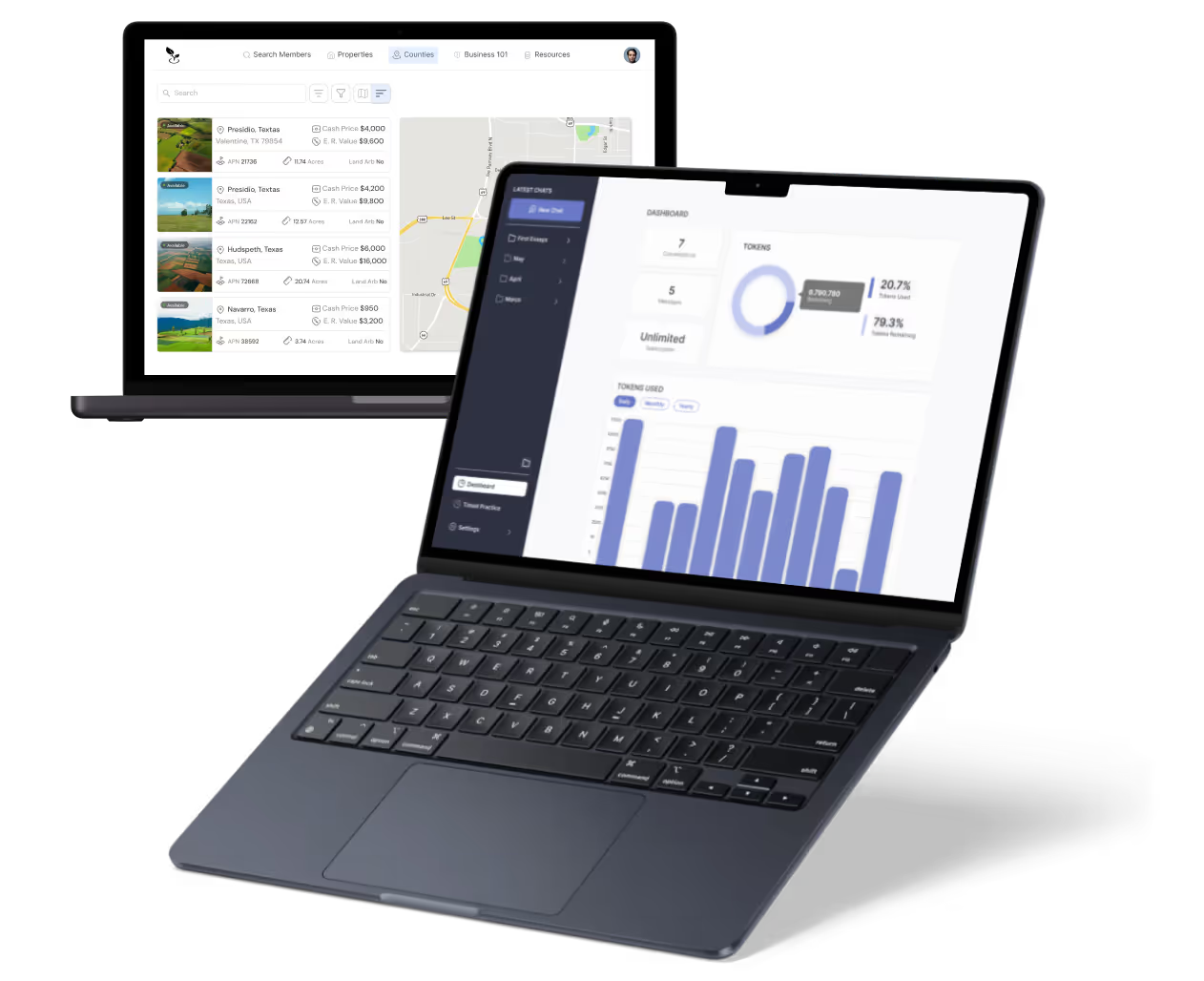
Individual investors and advisors are ditching generic spreadsheet templates for custom dashboards that show real-time prices, live gains, and portfolio allocation in one place. Building an investment tracker app with Bubble is the fastest way to deliver that experience without a dedicated engineering team.
Bubble's API Connector pulls live prices, calculated fields display real-time gains, and repeating groups list holdings cleanly. Investment trackers are also natural SaaS products. Charge per user or per portfolio, and Bubble handles the subscription logic too.
Key Takeaways
- Asset data types power everything: A well-structured
AssetandTransactiondata model makes all gain/loss calculations possible. - Live prices come from APIs: Alpha Vantage and Finnhub provide free-tier market data, connect via Bubble's API Connector.
- Gain/loss is a formula: Bubble's math expressions calculate unrealised gains dynamically without storing the result.
- Charts require a plugin: Bubble Chart Element or the Highcharts plugin renders portfolio performance visually.
- SaaS potential is high: An investment tracker is a natural SaaS product. Charge per user or per portfolio size.

What Is an Investment Tracker, and Why Build It with Bubble?
An investment tracker is an app where users log their holdings, stocks, ETFs, bonds, real estate, or crypto, and track performance over time against their purchase price. It is a reporting and tracking tool, not a trading or execution platform.
Investment trackers sit firmly in the range of apps you can build with Bubble. Relational data, API connections, and calculated displays are all native capabilities.
- API Connector integration: Bubble connects to Alpha Vantage and Finnhub price APIs without custom backend code. Live prices flow directly into your data types.
- Calculated field displays: Unrealised gain and portfolio value are computed dynamically from stored transaction data, no manual updates needed.
- SaaS monetisation: Investment trackers work well as subscription products. Bubble's Stripe plugin handles plan gating, trials, and recurring billing.
- Audience flexibility: The same Bubble architecture supports a personal tool, a B2B product for advisors, or a consumer SaaS app.
Teams commissioning Bubble development for finance apps regularly use the API Connector to pull live market data into custom dashboards.
What Features Should an Investment Tracker App Include?
A production investment tracker covers seven core feature areas. Define all of them before starting the Bubble data model.
- Portfolio overview dashboard: Total portfolio value, total gain/loss in both dollar and percentage terms, and allocation by asset class rendered as a pie chart.
- Asset list: Each holding shows ticker symbol, name, quantity, purchase price, current price sourced live from the API, current value, and unrealised gain/loss.
- Transaction log: Buy and sell entries with date, quantity, price per unit, and fees. The source of truth for all gain and cost basis calculations.
- Performance charts: Line chart of portfolio value over time; individual asset price history chart for 30-day or 365-day views.
- Asset search: Look up a ticker symbol, pull the current price from the API, and pre-fill the add-asset form to reduce manual entry errors.
- Watchlist: Track assets not yet owned, display current price and 24-hour percentage change without requiring a transaction entry.
- Multi-currency support (optional): Store a base currency field on the
Userrecord; convert displayed values using a stored exchange rate pulled from a forex API.
The transaction log is the architectural centrepiece of the app. Every calculation, current value, unrealised gain, cost basis, derives from the transaction history.
How Do You Structure the Database for an Investment Tracker in Bubble?
Four data types form the core of the investment tracker. Each has a specific role in the calculation chain.
If daily price snapshots grow large, consider the backend options for Bubble apps that handle time-series data more efficiently than Bubble's native database.
- Portfolio data type: Fields include
owner(User),name(text),currency(option set), andcreated_date(date), supports users with multiple portfolios. - Asset data type: Fields include
portfolio(Portfolio),ticker(text),asset_name(text),asset_class(option set: Stock / ETF / Bond / Real Estate / Crypto / Other),quantity(number),average_cost_basis(number, recalculated after each transaction),current_price(number, updated via API), andlast_price_update(date). - Transaction data type: Fields include
asset(Asset),transaction_type(option set: Buy / Sell),quantity(number),price_per_unit(number),fees(number),transaction_date(date), andnotes(text). - PriceSnapshot data type (optional): Fields include
asset(Asset),price(number), andsnapshot_date(date), stores daily prices specifically for historical chart rendering.
The gain/loss calculation is displayed dynamically as (current_price - average_cost_basis) * quantity. No stored field is needed because the result is always computed fresh from current data.
How Do You Build the Core Workflows for an Investment Tracker in Bubble?
Six workflows drive the investment tracker. The price fetching and transaction recording workflows are the most technically important to get right.
- Add transaction workflow: Form submit creates a
Transactionrecord; triggers a backend workflow to recalculateaverage_cost_basison the linkedAssetrecord using a weighted average of all buy transactions for that asset. - Live price fetch: API Connector call to Alpha Vantage
GLOBAL_QUOTEendpoint or Finnhubquoteendpoint, triggered on page load or by a "Refresh Prices" button; result stored in theAssetcurrent_pricefield. - Scheduled price update: Backend workflow on a timer, hourly or daily depending on Bubble plan capacity, calls the price API for each tracked asset and updates
current_priceautomatically. - Portfolio value calculation: Displayed dynamically as a sum on the dashboard using Bubble's list aggregation: sum of
Asset's current_pricemultiplied byAsset's quantityacross all assets in the portfolio. - PriceSnapshot creation: Daily scheduled workflow creates one
PriceSnapshotper asset. This record set powers the historical performance line chart over time. - Sell workflow: Creates a sell
Transactionrecord; reduces theAssetquantityfield; if quantity reaches zero, marks the asset as inactive to remove it from the active holdings list.
The weighted average cost basis recalculation in the add transaction workflow is critical for accuracy. Each new buy transaction must trigger a recalculation that accounts for all previous buys for that asset.
What Plugins and Integrations Does an Investment Tracker App Need?
Six integrations complete a production-quality investment tracker. The API Connector is the most important. It is the bridge between Bubble and live market data.
- API Connector (Bubble built-in): primary integration for Alpha Vantage (stocks, ETFs, forex) and Finnhub (stocks, crypto), both offer generous free tiers suitable for an MVP.
- Bubble Chart Element (built-in): renders line charts and bar charts natively; sufficient for basic portfolio performance visualisation without additional cost.
- Highcharts plugin (third-party): more powerful charting, candlestick charts, area charts, and multi-series comparison views, recommended for a production SaaS product where visual quality matters.
- Stripe plugin: SaaS monetisation, subscription billing, plan gating to limit holdings on free tiers, and trial period logic configured directly in Bubble workflows.
- SendGrid plugin: Weekly portfolio summary emails, price alert notifications when a holding crosses a defined threshold, and scheduled performance reports.
- CoinGecko API via API Connector: If the tracker includes crypto assets, CoinGecko provides token prices, market cap, and 365-day historical data for free at a generous rate limit.
How Long Does It Take and What Does It Cost to Build an Investment Tracker with Bubble?
Timeline splits across two build stages: a focused MVP and a full SaaS product.
If you plan to monetise the tracker as a product, working with a Bubble SaaS development agency ensures the subscription logic and plan gating are architected correctly from day one.
- MVP scope: Portfolio dashboard, asset list, transaction log, one API price feed, and a basic chart takes 8–12 weeks with an experienced Bubble developer.
- Full SaaS product: Adding multi-portfolio, historical charts, price alerts, Stripe subscriptions, and email reports extends the build to 14–20 weeks.
- Bubble plan: Growth ($29/mo) covers basic API calls; Team ($99/mo) is recommended for scheduled price updates and higher user capacity.
- Development cost: $12,000–$35,000 for an agency-built MVP; lower with experienced freelancers for a simpler scope.
- API costs: Alpha Vantage free tier allows 5 calls per minute and 500 per day, sufficient for early stage; paid plans start at $50/mo for higher volume. Finnhub's free tier is comparable.
Conclusion
Bubble enables investment tracker apps that combine live API pricing, transaction-based cost basis calculations, and dynamic gain displays in a single platform.
Set up your API Connector connection to Alpha Vantage first, then build the Transaction data type. Getting live prices working early validates the most critical dependency before investing time in the full data model and UI.
Build Your Investment Tracker App with Bubble Specialists
Investment trackers break when the cost basis recalculation workflow doesn't fire on every new buy transaction and when live price API calls aren't rate-limited, causing the Bubble plan to exhaust its workflow capacity mid-session.
At LOW/CODE Agency, we build AI-powered products for SMBs — custom web apps, mobile apps, chatbots, RAG systems, and AI agents, delivered with the depth and standards of a specialist software team. We build Bubble investment and portfolio tracking products with correct data modelling, live price API integration, charting setup, and SaaS monetisation architecture.
- Scoping: We define portfolio structure, transaction types, and calculation logic before touching the editor.
- Database architecture: We model
Portfolio,Asset,Transaction, andPriceSnapshotdata types with the correct field types and relationships. - Workflow build: We configure price fetching, transaction recording, cost basis recalculation, and scheduled price update workflows.
- Integrations: We connect Alpha Vantage, Finnhub, CoinGecko, Stripe, and SendGrid with correct API Connector setup.
- Testing: We validate gain/loss calculations, price update timing, and Stripe subscription logic across plan tiers.
- Deployment: We configure Bubble plan, set up scheduled workflows, and manage go-live.
- Post-launch: We support the product as user count and portfolio data volume grow.
We have built 450+ products for clients including Coca-Cola, American Express, and Medtronic.
Related Articles
- How to Build a Job Scheduling App with Bubble
- How to Build an ISO Compliance App with Bubble
- How to Build an IoT Asset Monitoring App with Bubble
- How to Build an Inventory Management App with Bubble
- How to Build an Intellectual Property Management App with Bubble
- How to Build an Insurance Management App with Bubble
Last updated on
September 28, 2026
.

Jesus is a visionary entrepreneur and tech expert. After nearly a decade working in web development, he founded LOW/CODE Agency to help businesses optimize their operations through custom software solutions.


FAQs
Can you build an investment tracker app without coding using Bubble?
How do you pull real-time stock and asset prices into a Bubble investment tracker?
How do you calculate portfolio performance and returns in a Bubble investment tracker app?
How do you visualize asset allocation and portfolio diversification in Bubble?
How do you track dividend income and investment transactions in a Bubble investment tracker?
How do you set investment goals and track progress in a Bubble investment tracker app?
Related Articles

Bubble
How to Build a Wishlist App With Bubble
Build a wishlist app with Bubble. Let users save, share, and revisit products — a custom feature for e-commerce or marketplaces, no code needed.

Bubble
How to Build a Wholesale Store App with Bubble
Build a wholesale store with Bubble. Tiered pricing, bulk ordering, and buyer account management — a custom B2B store without enterprise ecommerce costs.
Bubble
Comparison
Bubble vs Thunkable | 9 Factors to Decide the Best One
Compare Zapier vs Workato across ease of use, automation power, integrations, and security to find the best no-code platform for your automation needs
Comparison
Webflow
Bubble
Bubble vs Webflow | 11 Factors to Decide the Best One
Compare Bubble vs Webflow across 11 key factors, including use cases, flexibility, backend needs, scalability, pricing, and which platform suits your project.


Why customers trust us for no-code development


