

How to Build a Healthcare CRM App with Bubble
11 min
read
Build a healthcare compliance app with Bubble and reduce risk fast. No-code setup, automated alerts, and audit trails step-by-step guide.


Healthcare providers lose patients between appointments because follow-up depends on individual staff remembering to act. A healthcare CRM built in Bubble centralizes every patient relationship, automates follow-up, and gives care coordinators a single management interface without expensive enterprise software or a long development timeline.
For teams that need a production-ready CRM without a long dev cycle, Bubble app development services provide the fastest path from specification to deployed application.
Key Takeaways
- Bubble covers the full CRM stack: Patient profiles, interaction logs, appointment pipelines, task management, and automated follow-up sequences all build natively in Bubble.
- Role-based access is essential from day one: Admins, care coordinators, providers, and patients each need distinct data permissions configured before the first patient record is created.
- HIPAA rules apply to healthcare CRMs: Any CRM storing patient communication or health data requires Bubble's Dedicated plan for a BAA with the hosting provider.
- Automation replaces manual follow-up: Bubble workflows trigger SMS and email reminders at defined intervals via Twilio and SendGrid without staff intervention.
- Segmentation drives targeted outreach: Bubble's filtering allows coordinators to segment patients by condition, last contact date, or care status for targeted communication.
- Build the MVP around one coordinator workflow first: Start with the highest-volume manual task before expanding to the full CRM feature set.
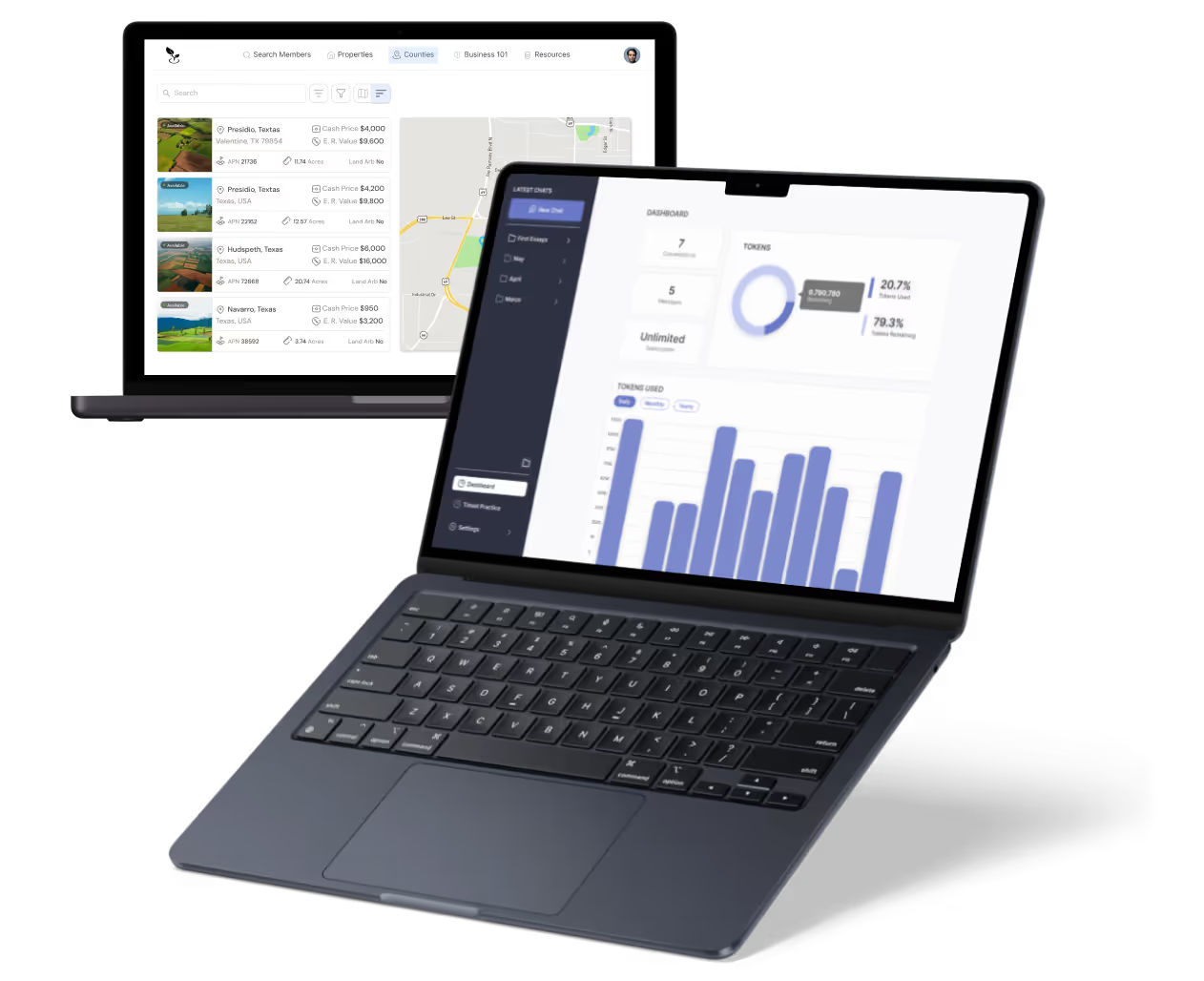

What Is a Healthcare CRM — and Why Build It with Bubble?
A healthcare CRM manages patient relationships across the care journey. From referral through intake, treatment, follow-up, and retention. It centralizes communication, tasks, and appointment history in one place.
Standard CRMs fall short for healthcare teams. Salesforce and HubSpot lack healthcare-specific data models, clinical workflow logic, and the flexibility to match each practice's unique process without six-figure enterprise licensing.
Bubble fits this use case well: the visual database builder supports custom patient data types, the workflow editor handles automated follow-up triggers, and role-based access supports multi-user care teams. The pricing is a fraction of enterprise CRM costs.
- Who builds this: Group practices, telehealth providers, mental health clinics, home care agencies, and healthcare staffing firms managing ongoing patient or client relationships.
- No-code advantage: Care coordinators can request new workflow automation and segmentation rules without waiting for a development sprint.
- Data ownership: Unlike locked SaaS CRMs, a Bubble-built CRM gives the practice full ownership of the data model and the ability to extend it as workflows evolve.
What Features Should a Healthcare CRM Built in Bubble Include?
The feature set must cover the full care coordinator workflow: patient management, interaction logging, task tracking, automated outreach, and reporting. A CRM without automation is just a database.
Define all coordinator workflows and reporting needs before building any data types.
- Patient profile: Demographics, contact details, insurance info, assigned provider, care status, tags, and custom fields per practice type. All in one structured record.
- Interaction log: Every call, email, message, and appointment linked to the patient record with date, staff member, channel, and outcome fields.
- Appointment pipeline: A list view or Kanban showing patient stage (referred, scheduled, active, discharged, follow-up due) with status updates driven by workflow triggers.
- Task management: Assignable tasks per patient with due dates, priority levels, and completion tracking. Gives care coordinators a structured daily workflow.
- Automated follow-up sequences: Time-based trigger workflows send SMS or email at defined intervals post-appointment or post-discharge via Twilio and SendGrid.
- Segmentation and search: Filter patients by condition, last contact date, care status, or assigned provider for targeted outreach campaigns.
- Reporting dashboard: Patient volume, task completion rate, follow-up response rate, and no-show tracking with date range filters for management oversight.
How Do You Structure the Database for a Healthcare CRM in Bubble?
The database is the structural centerpiece of the CRM. Every automation, report, and coordinator workflow depends on clean, consistently structured patient data.
Define each data type with specific field types and privacy rule intentions before writing a single workflow.
- Patient data type: Fields include first_name, last_name (text), date_of_birth (date), phone (text), email (text), insurance (linked data type), assigned_provider (linked to User), care_status (option set), and tags (list of text).
- Interaction Log data type: Fields include patient (linked), date_time (date), channel (option set: Call/Email/SMS/In-Person), staff_member (linked to User), notes (long text), and outcome (option set).
- Appointment data type: Fields include patient (linked), provider (linked), scheduled_date (date), status (option set: Scheduled/Confirmed/Attended/No-Show/Cancelled), and follow_up_trigger_date (date).
- Task data type: Fields include patient (linked), assigned_to (User), due_date (date), priority (option set), description (text), completed (yes/no), and completed_at (date).
- Option sets: Define care_status, interaction outcome, and appointment status as option sets rather than free text. This enables consistent filtering and reporting across all data types.
- Privacy rules: Care coordinators access communication and task data; providers access clinical notes; admin accesses all records. Set at the data type level before building any UI.
How Do You Build the Core Workflows for a Healthcare CRM in Bubble?
CRM workflows fall into three categories: patient lifecycle automation, follow-up sequences, and task escalation. Each category must be automated to deliver the CRM's core value of removing manual follow-up from coordinator workloads.
Build the new patient creation workflow and follow-up sequence first. They define the core value proposition of the CRM.
- New patient creation: Triggered by referral or intake form submission → creates Patient record, assigns care coordinator, creates an initial follow-up Task, and sends a welcome SMS via Twilio.
- Follow-up sequence: A scheduled backend workflow checks daily for patients where follow_up_date = today → sends SMS or email via SendGrid and logs an Interaction record automatically.
- Appointment reminder: Triggered 24 and 48 hours before each scheduled appointment → sends SMS reminder via Twilio → logs the reminder as an Interaction record on the patient profile.
- Task escalation: When a care coordinator has overdue tasks → an escalation notification goes to admin; when a task is completed → the workflow auto-creates the next-step task based on the patient's care status.
- No-show handling: When appointment status is set to "No-Show" → a follow-up Task is created with a due date within 48 hours and the no-show is logged as an Interaction record.
- Status transition: When care status changes from Active to Discharged → a discharge follow-up sequence triggers and the patient's pipeline stage updates automatically.
What Security and Compliance Requirements Apply to a Healthcare CRM?
Before configuring any patient data types, review data security in Bubble to understand the privacy rule architecture and hosting requirements for HIPAA-adjacent applications.
HIPAA applies to a healthcare CRM if it stores Protected Health Information. Most healthcare CRMs do. A patient name combined with appointment history, contact details, or health status qualifies as PHI regardless of whether clinical notes are stored.
- HIPAA applicability: If the CRM stores patient names, contact details, appointment history, or health status, HIPAA rules apply. Regardless of whether the app is clinical or purely administrative.
- Bubble Dedicated plan and BAA: Bubble's Dedicated plan supports a Business Associate Agreement. Standard Growth and Team plans do not. Any healthcare CRM storing PHI must run on the Dedicated plan.
- Privacy rules in Bubble: Field-level and record-level privacy rules must restrict access so each role sees only the data their function requires. Never use open visibility settings on patient data types.
- Audit logging: Implement an Interaction Log or Audit Log data type recording every data access, edit, and deletion with user and timestamp. Required for HIPAA compliance and useful for practice management oversight.
- Data minimization: Only collect fields the application actually uses. Every additional PHI field stored increases compliance scope and breach risk.
What Plugins and Integrations Does a Healthcare CRM Need?
The plugin stack powers the CRM's automation, communication, and document features. Select plugins before building workflows that depend on them. Plugin configuration affects how workflow actions are structured.
Each plugin below addresses a specific gap in Bubble's native feature set for a healthcare CRM.
- Twilio plugin: SMS and voice notifications for appointment reminders, follow-up messages, and no-show outreach. Requires a Twilio account and phone number.
- SendGrid plugin: Transactional email for follow-up sequences, appointment confirmations, and staff task notifications. Use dynamic templates with patient name merged from Bubble data.
- Calendly API or Bubble calendar: For appointment booking integration. Sync scheduled appointments into Bubble's Appointment data type via API Connector if providers use Calendly externally.
- DocuSign or Signable plugin: Consent forms and intake documents requiring e-signature, linked to the patient profile on completion.
- PDF generation (Documint or PDF Conjurer): Patient summaries, referral letters, or care plans as downloadable PDFs linked to the patient record.
- Bubble's built-in notifications: In-app task alerts and care coordinator notifications handle basic internal communication without requiring third-party plugins.
How Long Does It Take and What Does It Cost to Build a Healthcare CRM with Bubble?
Healthcare CRMs built for multiple practices or sold as standalone products follow the same architecture principles as Bubble SaaS development. Multi-tenancy, role separation, and scalable data models from version one.
Timeline depends on the number of automated workflows, the reporting depth, and whether multi-location or multi-practice support is in scope for the first version.
- MVP timeline: Core CRM covering patient profiles, interaction logging, appointment pipeline, task management, and automated SMS/email reminders takes 4–8 weeks.
- Full-featured CRM timeline: Multi-provider, multi-location CRM with custom reporting, full automation, document management, and role-based dashboards takes 10–16 weeks.
- Developer cost: $8,000–$25,000 for MVP; $25,000–$60,000 for a full-featured production system depending on developer rates and integration complexity.
- Bubble plan cost: Growth or Team plan for standard CRM builds; Dedicated plan (approximately $350 per month) if storing PHI requiring a BAA.
- Third-party costs: Twilio, SendGrid, and DocuSign combined under $50 per month at low volume. Scaling with patient volume as the practice grows.
- Discovery recommendation: Run a two-week discovery sprint to map every data type, workflow, and permission rule before building. Undiscovered requirements during build add 30–50% to the timeline.
Conclusion
A healthcare CRM in Bubble is entirely achievable without enterprise software costs. The build requires disciplined data modeling, HIPAA-appropriate privacy rules, and automation that replaces manual follow-up.
Map every interaction type your care team currently handles manually: calls, emails, reminders, and follow-ups. That list is your workflow backlog for the first build sprint.
Building a Healthcare CRM with Bubble? Start with the Right Architecture.
Most healthcare CRM builds go wrong in the first week. Poor data modeling exposes PHI across roles, and missing HIPAA-aligned privacy rules create regulatory liability that compounds through every later feature.
At LowCode Agency, we are a strategic product team, not a dev shop. We build healthcare CRM apps in Bubble for group practices, telehealth providers, and mental health clinics. We handle data type design, privacy rule configuration, workflow automation, and HIPAA-appropriate deployment so the CRM is compliant and functional from the first version.
- Requirements scoping: We map every patient interaction type, care status transition, and coordinator workflow before designing a single data type.
- Database design: We define Patient, Interaction Log, Appointment, Task, and Provider data types with all required field types and privacy rule specifications.
- Workflow build: We configure new patient creation, follow-up sequences, appointment reminders, task escalation, and no-show handling as scheduled backend workflows.
- Plugin and API integration: We integrate Twilio for SMS, SendGrid for email, DocuSign for consent forms, and PDF generation for patient summaries.
- HIPAA and compliance config: We configure Bubble's Dedicated plan BAA, field-level privacy rules for every patient data type, and audit logging before any PHI enters the system.
- Testing and QA: We verify every automated workflow fires on schedule, test all role-based access controls, and confirm audit logging captures every required data event.
- Post-launch support: We extend automation sequences, add care status transitions, and update segmentation filters as your care coordination workflows evolve after launch.
We have built 350+ products for clients including Coca-Cola, American Express, and Medtronic.
If you are ready to build your healthcare CRM app with Bubble, let's scope it together.
Last updated on
May 13, 2026
.

Jesus is a visionary entrepreneur and tech expert. After nearly a decade working in web development, he founded LowCode Agency to help businesses optimize their operations through custom software solutions.


FAQs
Can you build a healthcare compliance app without coding using Bubble?
How do you manage healthcare policy documents and version control in Bubble?
How do you track staff compliance training completion in a Bubble healthcare app?
How do you manage compliance audits and findings in a Bubble healthcare compliance app?
How do you handle incident reporting and root cause analysis in a Bubble healthcare compliance app?
How do you monitor contract and license renewal deadlines for healthcare compliance in Bubble?
Related Articles
Bubble
How to Build a Real Estate Investment Tracker App with Bubble
Build a real estate investment tracker in Bubble without coding. Monitor ROI, cash flow, and portfolio growth fast with this no-code step-by-step guide.

Bubble
How to Build an Impact Tracking App with Bubble
Measure what matters with Bubble. Build a no-code impact tracking app step-by-step log outcomes, visualize data & report results without coding.

Bubble
How to Build an Order Management App With Bubble
Build an order management app with Bubble. Track orders from placement to fulfillment, automate updates, and reduce manual work — no code needed.

Bubble
How to Build an Applicant Tracking App with Bubble
Build an applicant tracking app with Bubble. Manage pipelines, automate status updates, and hire faster — without paying for enterprise ATS software.


Why customers trust us for no-code development


