

Replit vs Glide: Code vs No-Code Apps
11 min
read
Replit vs Glide — when should you code your app versus use a no-code builder? Compare scalability, speed, customization, and cost for your next project.


Replit vs Glide puts a full coding platform against one of the fastest no-code app builders on the market. Both create applications, but the path from idea to finished product could not be more different.
Replit is a cloud IDE where developers write code in 50 plus languages to build any type of software. Glide turns spreadsheet data into functional mobile and web apps without a single line of code. Your data structure, technical skills, and project complexity determine which platform wins.
Key Takeaways
- Replit builds any application type using code with unlimited flexibility for logic, design, and data architecture.
- Glide creates apps from spreadsheets transforming Google Sheets or Airtable data into mobile and web applications.
- Replit vs Glide depends on complexity since simple data apps favor Glide and custom applications favor Replit.
- Glide launches apps in hours while Replit applications typically require days or weeks of development time.
- Replit handles complex business logic that Glide cannot implement due to no-code platform constraints.
- Glide apps cost less to build when your requirements match what the platform's components and templates provide.
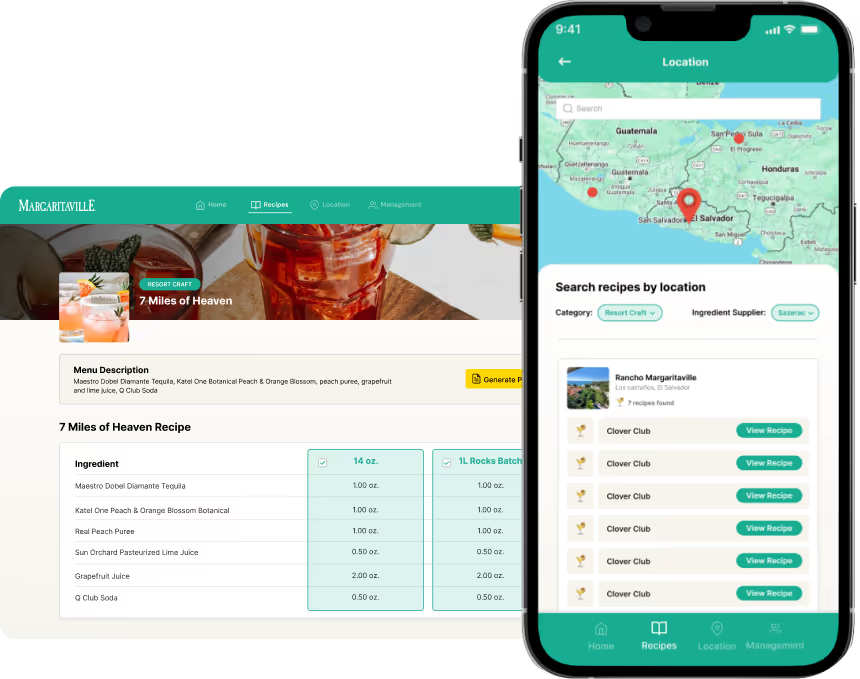

What Is Replit and What Is Glide?
Replit is a browser-based development environment for writing and deploying code. Glide is a no-code platform that converts spreadsheet data into polished mobile and web applications.
The Replit vs Glide comparison matters because both platforms create functional apps, but they serve different skill levels and project types. Replit targets developers who want code-level control. Glide targets business teams who want apps built from their existing data.
- Replit provides a full IDE in the browser with terminal access, package managers, and deployment tools for any language.
- Glide connects directly to Google Sheets and Airtable, using rows as records and columns as fields automatically.
- Replit applications have no platform constraints since code can implement any feature, API, or user experience.
- Glide apps use pre-built components like lists, forms, charts, and detail views that snap together visually.
- Replit supports real-time collaboration where multiple developers edit the same codebase simultaneously.
Understanding Replit vs Glide starts with recognizing they occupy different points on the complexity spectrum. Glide simplifies app building dramatically but limits what you can build. Replit enables anything but requires more effort.
When Should You Choose Replit Over Glide?
Choose Replit when your application needs custom business logic, complex data relationships, or functionality that no-code components cannot provide. Replit handles the projects Glide cannot.
The Replit vs Glide decision favors Replit when project requirements exceed what spreadsheet-backed components deliver. If you need real-time features, complex algorithms, or integrations with systems that lack Glide connectors, code is the only path forward.
- Custom algorithms and calculations that go beyond spreadsheet formulas need Replit's code execution environment.
- Multi-database architectures require Replit because Glide connects primarily to spreadsheets and Airtable tables.
- Real-time features like live chat or collaborative editing need WebSocket connections that Replit supports natively.
- Complex API integrations work better in Replit where you control request handling, error management, and data transformation.
- Replit supports mobile app development through frameworks like React Native or Flutter for cross-platform deployment.
Teams evaluating different use cases for Replit find the platform excels when project scope grows beyond what visual builders can handle. The investment in code pays off through unlimited extensibility.
When Should You Choose Glide Over Replit?
Choose Glide when your data lives in spreadsheets, your app follows standard patterns, and your team needs something live in hours rather than weeks. Glide turns existing data into apps instantly.
Glide wins the Replit vs Glide comparison for internal business tools, data collection apps, and simple customer-facing applications. When your spreadsheet already contains the data structure your app needs, Glide eliminates weeks of development work.
- Internal team tools launch same day because Glide converts existing spreadsheets into functional apps immediately.
- Inventory tracking apps work perfectly in Glide since product data in spreadsheets becomes searchable, filterable lists.
- Client portals built on Glide let customers access their data through polished interfaces connected to your backend sheets.
- Field data collection apps suit Glide because forms sync directly to spreadsheets where teams already analyze data.
- Event management apps fit Glide naturally with attendee lists, schedules, and check-in forms built from event spreadsheets.
- Non-technical teams manage Glide apps by updating the source spreadsheet without touching the application layer.
Glide eliminates the development bottleneck for straightforward data applications. When the platform fits, it delivers results that would take weeks to code in Replit.
How Does Pricing Compare for Replit vs Glide?
Replit offers a free tier with paid plans starting at $25 per month for enhanced development resources. Glide offers a free tier with paid plans starting at $25 per month for more apps and rows.
Replit vs Glide pricing scales differently because Replit charges for compute and deployment resources while Glide charges based on the number of apps, rows, and users. Both free tiers work for testing but impose limits that prevent production use.
- Replit free tier provides basic development with limited compute for building and testing applications.
- Glide free tier allows one app with limited rows and updates, suitable for personal use or prototyping.
- Replit paid plans unlock deployment along with increased compute, storage, and always-on application hosting.
- Glide Team plan at $60 monthly includes multiple apps, more rows, and team collaboration features.
- Replit total cost includes development time because coding applications requires significantly more hours than Glide.
The true cost of Replit vs Glide includes development time. A Glide app built in four hours costs far less than a Replit application that takes two weeks to code, even if the subscription prices look similar.
What Are the Data and Database Differences?
Replit supports any database including PostgreSQL, MongoDB, and Firebase. Glide uses Google Sheets, Excel, Airtable, and its own Glide Tables as data sources.
Data architecture is where Replit vs Glide differs most in capability. Replit gives you full database design freedom with SQL, NoSQL, and graph databases. Glide constrains you to tabular data sources but makes that data immediately usable.
- Replit connects to PostgreSQL, MySQL, and MongoDB giving developers full control over schema design and query optimization.
- Glide Tables provide a built-in database with better performance than Google Sheets for larger datasets.
- Replit handles complex data relationships through proper foreign keys, joins, and normalized database schemas.
- Glide relations connect sheets through lookup columns that work like simplified database relationships.
- Replit scales to millions of records with proper database indexing and query optimization techniques.
For apps that need advanced data operations, Replit vs Glide clearly favors Replit. For apps where a few thousand rows in a spreadsheet cover all data needs, Glide eliminates database complexity entirely.
How Do Both Platforms Handle Mobile Apps?
Glide creates native-feeling mobile apps by default with progressive web app technology. Replit can build mobile apps through frameworks but requires significantly more development effort.
Mobile app creation is where Glide shines brightest in the Replit vs Glide comparison. Glide apps look and feel like native mobile apps from day one. Replit mobile development means choosing a framework, writing code, and handling platform-specific requirements.
- Glide apps are mobile-first by design with responsive layouts that work beautifully on phones and tablets.
- Replit mobile apps use frameworks like React Native or Flutter that require learning platform-specific development patterns.
- Glide handles offline capability for certain features, letting users interact with apps without constant connectivity.
- Replit mobile deployments require app stores or progressive web app configuration depending on your framework choice.
- Glide mobile apps share instantly via link with no app store submission, review process, or installation required.
For simple mobile applications, exploring Replit alternatives like Glide often reveals faster paths to a working product. Glide delivers mobile apps in hours that would take weeks to code.
Can You Migrate Between Replit and Glide?
Migration between Replit and Glide is not straightforward because the platforms use fundamentally different architectures. Planning for growth matters before you start building.
Moving from Glide to Replit means rebuilding from scratch since no-code visual configurations do not translate to code. Moving from Replit to Glide means simplifying your application to fit within Glide's component and data model constraints.
- Glide to Replit migration requires rebuilding because visual app configurations have no code equivalent to export.
- Glide data exports easily since spreadsheet data can move to any database that Replit applications connect to.
- Replit to Glide works only if simplified because complex code logic cannot be replicated with no-code components.
- Starting with Glide for prototyping then rebuilding in Replit for production is a common and effective development strategy.
- Planning for scale from the start avoids costly migrations by choosing the right platform based on long-term needs.
The Replit vs Glide platform choice is difficult to reverse, making it important to evaluate long-term requirements before committing significant effort to either tool.
Which Platform Updates and Improves Faster?
Both Replit and Glide invest heavily in new features, AI capabilities, and platform improvements. Their development pace reflects the competitive pressure in their respective markets.
Replit vs Glide feature development targets different capabilities. Replit adds developer tools, AI coding assistance, and deployment improvements. Glide adds new components, data source integrations, and business-focused features.
- Replit Agent now builds full applications from natural language descriptions, dramatically lowering the coding barrier.
- Glide AI features auto-generate app layouts from data structures and business descriptions without manual design.
- Replit continuously expands language support and improves its AI assistant for faster development workflows.
- Glide regularly adds new components and integrations that expand what no-code apps can accomplish.
- Both platforms respond to user feedback with Replit focusing on developer experience and Glide on business user needs.
The pace of improvement in both platforms means the Replit vs Glide comparison evolves constantly. Features that required code last year might become available as Glide components this year.
Conclusion
Replit vs Glide is a choice between unlimited code flexibility and rapid no-code app deployment. Replit handles any project regardless of complexity. Glide turns spreadsheet data into polished apps at remarkable speed.
Choose Replit when your application needs custom logic, complex databases, or features beyond what pre-built components provide. Choose Glide when your data already lives in spreadsheets and your app follows standard patterns like lists, forms, and detail views. Many teams start with Glide for speed and move to code when complexity demands it.
The best platform is the one that matches your project requirements, not the one with the most features.
Need Help Building Your Application with the Right Platform?
Choosing between Replit vs Glide is just the beginning. LOW/CODE Agency has deep expertise with both code-based and no-code platforms, helping teams pick the right tool for each project.
- 350 plus projects delivered spanning internal tools, customer-facing apps, and enterprise platforms across every industry.
- Trusted by Medtronic, American Express, Coca-Cola, Zapier, and Sotheby's for strategic application development.
- Expertise across Glide, Bubble, FlutterFlow, and custom code ensuring the right platform for every use case.
- Platform-agnostic recommendations driven by your business requirements rather than any technology preference.
- Product strategy included with every engagement so your application investment translates to measurable business results.
Related Articles
- Replit vs Google Colab: Coding Environments
- Replit vs Google AI Studio: AI Dev Platforms
- Replit vs Glitch: Cloud Development Comparison
- Replit vs Gitpod: Cloud IDE Comparison
- Replit vs GitHub: Dev Platform Comparison
- Replit vs GitHub Copilot: AI Coding Tools
Want to learn more? Explore our services.
Last updated on
September 24, 2026
.

Jesus is a visionary entrepreneur and tech expert. After nearly a decade working in web development, he founded LOW/CODE Agency to help businesses optimize their operations through custom software solutions.


FAQs
What is Glide and how does it compare to Replit?
Which is better for non-developers: Glide or Replit?
What types of apps can Glide build that Replit cannot easily match?
Can apps built on Glide scale the same way as Replit apps?
Can you connect Glide and Replit together?
How does pricing compare between Glide and Replit?
Related Articles

Replit
Best Replit Alternatives for AI Coding in 2026
Looking for a Replit alternative in 2026? Compare the best AI coding platforms by features, pricing, and deployment to find the right fit for your project.
Replit
Replit vs WordPress: Coding vs CMS
Replit vs WordPress — when should you build with code versus use a CMS? Compare use cases, scalability, hosting costs, and the right tool for your goals.
Replit
Replit vs Glitch: Cloud Development Comparison
Replit vs Glitch — compare AI features, hosting reliability, language support, collaboration, and pricing to choose the better cloud coding platform.
Replit
Replit vs GitHub: Dev Platform Comparison
Replit vs GitHub — cloud IDE vs code hosting platform. Learn how they differ, how they work together, and which one your development workflow actually needs.

Why customers trust us for no-code development


