

Lovable MVP Service Benefits and FAQs
8 min
read
Discover key insights about Lovable MVP Service, its benefits, risks, and how it compares to traditional MVP approaches.


A lovable mvp service can deliver a working, production-ready application in weeks — not the six months and significant budget that traditional development agencies require. The question is what exactly that service involves.
This article gives you the complete picture: what the service includes, how the process works, what it costs, and what your options are after delivery.
Key Takeaways
- Working app delivered, not a prototype: The output is a real deployed application with real infrastructure, not a clickable mockup or a Lovable preview URL.
- Timelines are genuinely faster: A well-scoped Lovable MVP typically takes 2 to 6 weeks, compared to 3 to 6 months for equivalent traditional development.
- Scope clarity determines delivery success: The more precisely defined your feature set, the more predictable your cost and timeline will be.
- The process has distinct phases: Discovery, build, review, and deployment are separate phases with different inputs and outputs — understanding each prevents misaligned expectations.
- Post-delivery options are real choices: Continuing in Lovable, handing off to a developer, or maintaining the MVP as-is are all valid paths depending on what validation the MVP achieves.
- Complexity drives cost more than hours: Feature count, integration requirements, and production-readiness standards all affect total engagement cost more than time alone.
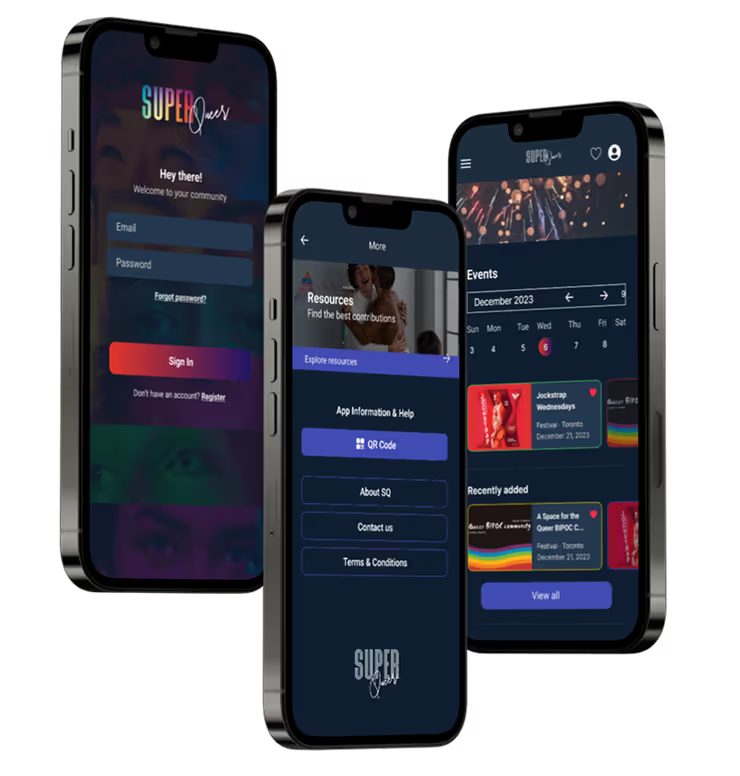

What Is Included in a Lovable MVP Service?
A Lovable MVP service delivers a working, deployed application accessible at a real URL, with all core MVP features functional and connected to real infrastructure.
The foundation of every engagement is the platform itself — understanding what Lovable builds and how it works clarifies what the service can and cannot deliver before you commit.
- Core deliverable: A live, deployed application with a real URL and functional core features, not a Lovable preview link.
- Typical inclusions: Product scoping, UI generation, feature build, Supabase database setup, authentication, and basic integrations like email and payments.
- Common exclusions: Advanced custom infrastructure, complex third-party integrations, post-launch support, and branding work unless separately scoped.
- Documentation handoff: Technical documentation quality varies by provider, so ask explicitly what the handoff package includes before signing.
- Production configuration: Custom domain setup, security review, and environment configuration distinguish a production-ready MVP from a preview build.
The difference between a preview-ready and a production-ready MVP comes down to configuration choices covered in the assessment of how production-ready a Lovable MVP can be. Ask your provider which standard they build to.
What Does the Process Look Like From Brief to Launch?
A Lovable MVP engagement runs through five distinct phases, from discovery to delivery, each with defined inputs, outputs, and timelines.
The process structure varies between providers — understanding how a Lovable agency structures its engagements helps you evaluate whether a specific provider fits your expectations.
- Phase 1, Discovery: 1 to 3 days to define the feature set, user flows, data model, and integration requirements in a written build brief.
- Phase 2, Build: 1 to 3 weeks of core feature construction in Lovable, with regular progress updates and defined client review points.
- Phase 3, Review: 3 to 5 days of structured user flow testing, bug fixing, performance baseline, and security checks.
- Phase 4, Launch Prep: 1 to 2 days for custom domain setup, environment variable configuration, and production database setup.
- Phase 5, Delivery: Handoff of the live application, access transfer, and documentation delivery to the client.
Daily async updates suit active builds; weekly check-ins work for lower-intensity phases. Agree on the communication rhythm before work begins.
What Should You Prepare Before Engaging a Lovable MVP Service?
Arriving with a clear brief saves days of discovery time and directly reduces your engagement cost. Preparation before the first call is one of the highest-return activities you can do.
A clear brief does double duty — it also serves as the evaluation document when finding the right Lovable developer to run the engagement.
- Product definition: Write clearly what your app does, who it is for, and what single core problem it solves — before any call.
- Feature priorities: Separate your feature list into core MVP, nice-to-have, and explicitly out-of-scope columns.
- User flow map: List the 3 to 5 core journeys a user will take through your app, as simple written descriptions not formal diagrams.
- Integration requirements: List every third-party service your app must connect to — payments, email, auth providers, specific APIs.
- Design preferences: Collect brand colours, reference apps you like, and any UI conventions the app must follow.
- Accounts ready: Set up your Lovable account, Supabase account, and domain registrar access in advance to avoid delays at delivery.
The cleaner your brief, the more accurate the cost estimate you receive will be. Vague briefs produce vague quotes.
What Does a Lovable MVP Service Cost?
A simple Lovable MVP with 3 to 5 core features, basic authentication, and a straightforward data model typically costs between £3,000 and £8,000 with an experienced team.
For a specific example of current market pricing, LOW/CODE Agency's Lovable MVP pricing and scope outlines what is included at different investment levels.
- Simple MVP range: £3,000 to £8,000 for 3 to 5 core features, basic auth, simple data model, and standard configuration.
- Complex MVP range: £8,000 to £20,000 or more when integrations, real-time features, multiple user roles, or custom design are required.
- Cost drivers up: Integration complexity, production-readiness requirements, number of user types, and custom design requirements.
- Cost drivers down: A clear well-scoped brief, a small prioritised feature set, and willingness to use Lovable's default design patterns.
- Fixed vs day rate: Fixed price requires airtight scope — day rate gives flexibility but needs active management from your side.
The most honest way to assess whether a Lovable MVP cost is justified is to see Lovable MVPs delivered by LOW/CODE Agency, where real products show real scope and outcomes.
What Happens After the MVP Is Delivered?
Delivery is not the end of the project. The MVP's purpose is to test assumptions with real users before you commit to the next build phase.
If the delivery does not include full production setup, you will need to manage deploying a Lovable app post-delivery — a process with specific steps worth understanding in advance.
- Validation phase: Use the live MVP to test your core assumptions with real users before spending on the next feature set.
- Continue in Lovable: You can take over Lovable-based iteration yourself after the agency completes the initial build.
- Developer handoff: If the MVP validates and the product needs to scale, a structured handoff to a developer or team is a defined process.
- Post-launch support: Bug fix retainers, iteration sprints, and ongoing agency engagement are options — ask about them before signing the initial contract.
- The pivot scenario: If the MVP reveals a significant product change is needed, Lovable builds are generally easier to restructure than traditional codebases.
Products that validate and need to scale have access to AI-assisted development for post-MVP growth — a structured approach that extends the MVP without starting from scratch.
Conclusion
A Lovable MVP service is one of the most cost-efficient ways to move from idea to a live, testable product. The builders who get the most from it arrive with a clear brief, realistic expectations, and a plan for what to do with the learning the MVP provides.
Write your feature list in two columns: core MVP and post-MVP. If the core MVP column has fewer than six items, you have a buildable scope. If it has more than ten, you have scoping work to do before any engagement begins.
Ready to Scope Your Lovable MVP With a Team That Has Done It 450+ Times?
You have an idea and a timeline. The next step is knowing exactly what your app requires, how long it will take, and what it will cost.
LOW/CODE Agency is an AI product development company for SMBs. We build web apps, mobile apps, RAG systems, chatbots, and AI agents — custom software engineered for businesses that are not enterprise but demand enterprise-grade AI. We scope, build, and ship Lovable MVPs to production — and the first conversation is a scoping call that gives you a real answer, not a range so wide it's useless.
- Scoping: We help you sharpen your feature list before a single line of code is written, saving time and budget from day one.
- Design: We produce a written build brief that defines features, user flows, data model, and integration requirements clearly.
- Build: We construct your core MVP in Lovable with daily progress updates and defined client review checkpoints throughout.
- Scalability: We structure your Lovable build so iteration after delivery is clean and not a tangled codebase to unpick.
- Delivery: We configure custom domains, environment variables, and production databases so your app is live-ready on handoff.
- Post-launch: We transfer full access, provide documentation, and leave you with an app you can operate independently.
- Full team: We offer retainer-based support for bug fixes, iteration sprints, and next-phase builds after your MVP validates.
We have built 450+ products for clients including Coca-Cola, American Express, and Medtronic.
Related Articles
Last updated on
September 28, 2026
.

Jesus is a visionary entrepreneur and tech expert. After nearly a decade working in web development, he founded LOW/CODE Agency to help businesses optimize their operations through custom software solutions.


FAQs
What is a Lovable MVP Service?
How does a Lovable MVP differ from a traditional MVP?
What are the risks of launching a Lovable MVP Service?
How can a Lovable MVP improve customer retention?
When should a startup choose a Lovable MVP approach?
Can a Lovable MVP Service save development costs?
Related Articles
Lovable
How to Build an AI App With Lovable - Step by Step Guide
Learn how to create an AI app using Lovable with easy steps, tips, and best practices for beginners and developers.
Lovable
How to Build a Booking App With Lovable Quickly
Learn step-by-step how to create a booking app using Lovable with ease. Discover tips, features, and common challenges.

Lovable
Lovable vs Zite: Which One Fits You Best?
Compare Lovable and Zite to find out which suits your needs better. Discover key differences, benefits, and user tips here.

Lovable
How to Build a SaaS App With Lovable - Step by Step Guide
Learn how to create a successful SaaS app using Lovable with practical steps, tips, and common challenges to avoid.


Why customers trust us for no-code development


