

How to Build an Alumni Network App with Bubble
13 min
read
Launch an alumni network app with Bubble without coding. Connect graduates, share opportunities & host events step-by-step using no-code tools.


Alumni networks need more than a mailing list. They need searchable directories, event management, mentorship matching, and donation processing. Generic platforms charge per member and lock your data behind proprietary exports.
Bubble lets you build a fully custom alumni platform with member profiles, career networking, and event tools in one system your institution owns entirely. A well-scoped build ships in six to nine weeks with an experienced team.
Key Takeaways
- Member profiles and graduation data are the foundation of every alumni feature: Directory search, mentorship matching, and event targeting all depend on clean profile data.
- Mentorship matching needs its own data type separate from the User record: A MentorshipMatch record tracks request status, matched pairs, and session history independently of profile data.
- Event registration and payment should be handled natively in Bubble with Stripe: No third-party ticketing platform means no per-ticket fees and no redirecting alumni off your platform.
- Job board and career networking are the highest-engagement features to build early: Alumni use career tools far more consistently than event pages or donation portals.
- Privacy rules must let alumni control their own profile visibility: Directory opt-in and field-level privacy controls increase member participation rates in any network.
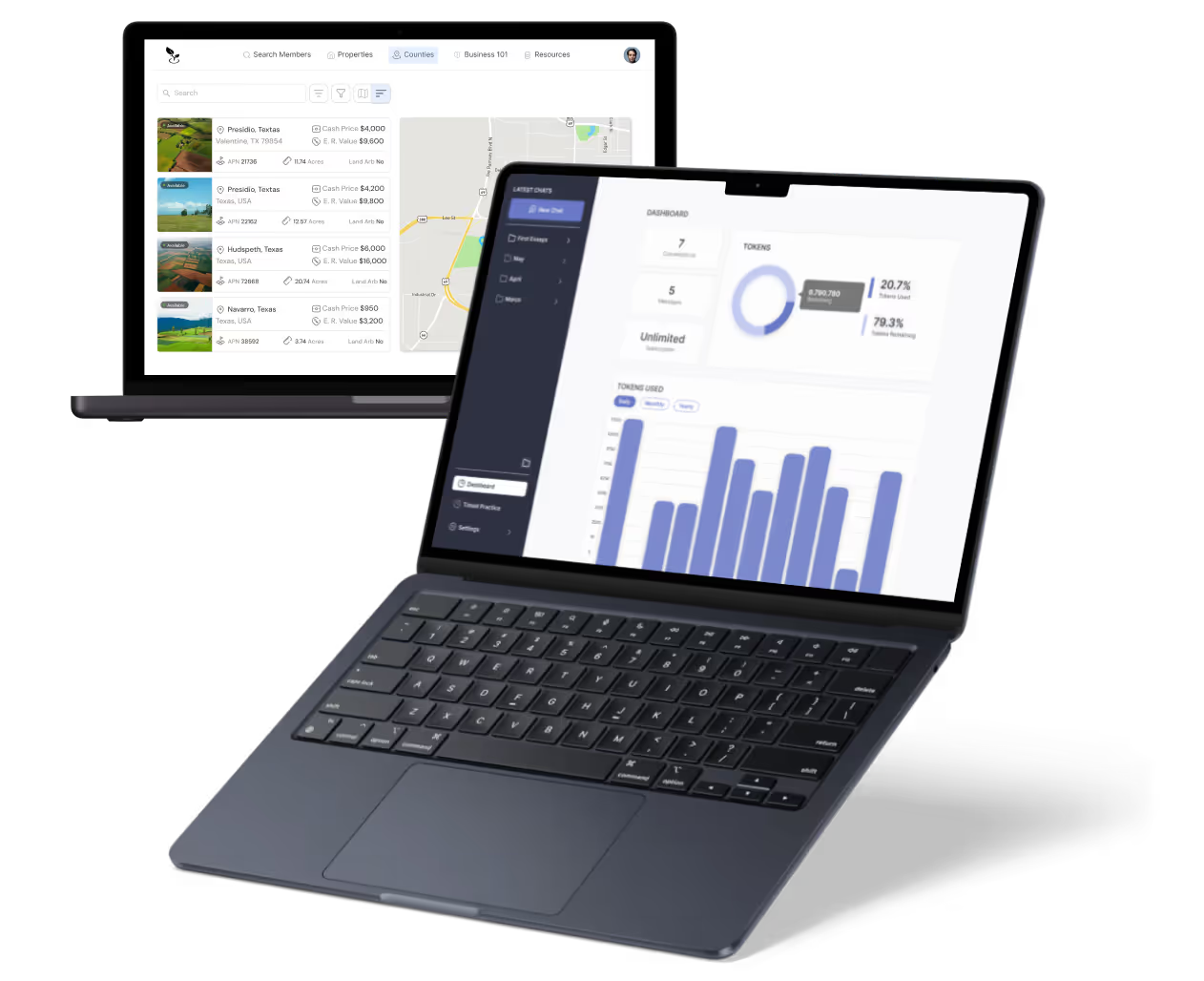

What Is an Alumni Network App — and Why Build It with Bubble?
An alumni network app is a member platform that connects graduates through a searchable directory, facilitates mentorship and career networking, manages events and giving campaigns, and keeps the institution's relationship with alumni active between major milestones.
Core user roles are the alumni member, mentor, mentee, alumni relations staff, and an institutional admin managing the platform. Each role needs a distinct feature scope and data access level.
- Custom matching algorithms: Off-the-shelf alumni platforms offer basic directory search; a Bubble build can implement industry, graduation year, geography, and skill-based mentorship matching using custom filtering logic.
- No per-member fees: Commercial platforms like Graduway or Alumni Spaces charge based on member count; a Bubble app carries a fixed monthly platform cost regardless of network size.
- Integrated giving portal: A Bubble alumni app can include a donation form with Stripe, campaign tracking, and donor recognition without a separate development fundraising platform.
- Data ownership: All member data, engagement history, and contact information stays in your Bubble database, not in a vendor's shared infrastructure.
- Branded experience: Custom UI means the network looks and feels like your institution's brand, not a white-labeled SaaS product.
Understanding Bubble's pros and cons before scoping helps you decide which features to build natively in Bubble and which to handle via API integrations with existing institutional systems.
What Features Should an Alumni Network App Include?
A complete alumni network feature set covers member management, engagement tools, career networking, and giving, built as a cohesive platform rather than isolated modules. Mapping all features before building prevents the common mistake of starting with events and discovering the member data model cannot support mentorship matching later.
Each feature maps to specific Bubble data types and workflows. None require custom backend code.
- Member directory with search and filters: Searchable alumni profiles filtered by graduation year, degree program, industry, location, and availability for mentorship, built with Bubble's native search or Algolia for larger networks.
- Event registration and ticketing: Event records with capacity tracking, registration forms, Stripe payment for paid events, confirmation emails, and attendance check-in built in Bubble's mobile interface.
- Mentorship matching: Alumni can opt in as mentors with skills and availability; mentees submit match requests filtered by industry or expertise; a staff admin confirms matches or an automated workflow scores compatibility.
- Job board: Alumni post openings, students and recent graduates apply directly through the platform, and hiring alumni receive applications in a dedicated inbox, all within the Bubble app.
- Donation and giving portal: Campaign records with goals, progress bars, individual donation forms with Stripe, donor recognition display, and automated tax receipt emails via SendGrid.
- Discussion groups or forums: Topic-based groups where alumni can post, comment, and connect, scoped to graduation cohorts, professional interests, or geographic chapters.
- Push and email notifications: Event reminders, mentorship match confirmations, job application alerts, and giving campaign milestones sent via SendGrid or OneSignal for push notifications.
Starting with directory and mentorship matching before events and donations is the right build sequence because every other feature depends on having clean, searchable member profiles.
How Do You Structure the Database for an Alumni Network App in Bubble?
An alumni network database must support member search, relational event and mentorship data, and transactional giving records. Getting the data model right before building any workflows is the single most important step in a network platform build.
Seven core data types support the full feature set: AlumniProfile, Event, EventRegistration, MentorshipMatch, JobPosting, Donation, and User.
- AlumniProfile fields: user link, graduation_year, degree_program, current_industry option set, current_title, employer, location_city, location_country, bio, linkedin_url, is_mentor yes/no, mentor_skills text list, is_directory_visible yes/no, and profile_photo image.
- Event fields: event_name, event_date, event_type option set (in-person, virtual, hybrid), location or virtual_link, capacity, is_paid yes/no, ticket_price, description, organiser user link, and registration_count calculated field.
- EventRegistration fields: event link, registrant user link, registration_date, payment_status option set (free, paid, refunded), stripe_payment_intent, and attended yes/no.
- MentorshipMatch fields: mentor user link, mentee user link, status option set (requested, active, completed, declined), request_date, match_date, meeting_count, and notes.
- JobPosting fields: posted_by user link, job_title, company_name, location, job_type option set (full-time, part-time, contract), description, application_url or application_email, posted_date, is_active yes/no, and application_count.
- Donation fields: donor user link, campaign_name, amount, donation_date, stripe_payment_intent, is_recurring yes/no, receipt_sent yes/no, and anonymous yes/no.
The AlumniProfile is a separate data type from User rather than embedded, because graduation data, mentorship availability, and directory visibility are alumni-specific fields that do not belong on the authentication record. For networks planning to scale beyond 10,000 members, reviewing best backends for Bubble helps you decide whether native Bubble database or an external backend better fits your data volume.
How Do You Build the Core Workflows for an Alumni Network App in Bubble?
Alumni network workflows fall into four categories: onboarding and profile management, engagement (events, mentorship, jobs), giving, and notifications. Build onboarding and profile workflows first. Every other workflow depends on a complete AlumniProfile existing.
Sequencing correctly prevents broken references and eliminates rebuilding workflows when a new data type is added mid-project.
- Profile creation workflow: New user registers; workflow creates a User record, then immediately creates a linked AlumniProfile with graduation_year and degree_program from the signup form; sets is_directory_visible to true by default with an opt-out toggle.
- Event registration and payment: Alumni clicks register on an event; if is_paid is true, workflow initiates a Stripe Checkout session; on payment confirmation webhook, workflow creates an EventRegistration record, increments registration_count, and sends a confirmation email via SendGrid.
- Mentorship request workflow: Mentee submits a match request selecting a mentor from the directory; workflow creates a MentorshipMatch record with status "requested" and sends a notification email to the mentor with accept and decline actions.
- Mentor acceptance workflow: Mentor clicks accept; workflow updates MentorshipMatch status to "active," notifies the mentee, and creates a calendar event via Google Calendar API with a suggested first meeting time.
- Job posting submission: Alumni submits a job form; workflow creates a JobPosting record with is_active = false and notifies a staff admin; admin reviews and sets is_active = true; posting then appears in the public job board repeating group.
- Donation processing: Donor submits giving form; workflow creates a Stripe PaymentIntent, processes charge, creates a Donation record on success, triggers a SendGrid receipt email, and updates the campaign's total_raised calculated field.
- Scheduled re-engagement workflow: A monthly backend workflow searches for AlumniProfile records where the user has had no EventRegistration, MentorshipMatch, or Donation in the past 90 days and sends a personalised re-engagement email with upcoming events and new job postings.
The scheduled re-engagement workflow is what separates an active alumni platform from a dormant directory. Build it early even if email lists are small at launch.
What Security and Data Requirements Apply to an Alumni Network App?
Alumni network apps handle personally identifiable information, payment data, employment history, and in some cases FERPA-regulated student records. Security decisions must be made at the data type level, not applied after the app is functional.
- Profile visibility privacy rules: Bubble Privacy Rules must enforce that AlumniProfile records are only searchable by authenticated users with is_directory_visible = true; guest visitors should never access the directory.
- FERPA considerations: If graduation year, degree program, or GPA data is imported from institutional records, that data carries FERPA obligations. Restrict access to staff admin roles and avoid displaying raw academic records in alumni-facing views.
- Payment data security: Stripe handles all card data. Never store raw card numbers in Bubble. Store only the stripe_payment_intent reference on Donation and EventRegistration records.
- Mentor-mentee data isolation: MentorshipMatch records should be visible only to the matched pair and staff admins, not to other alumni browsing the directory.
- Anonymous donation option: Donors who select anonymous = true on their Donation record should not appear on public donor recognition lists; enforce this with a Privacy Rule condition on the Donation data type.
- Staff admin access controls: Alumni relations staff need access to registration data and donation records but should not have access to private message content or mentorship session notes.
Properly securing data in Bubble for a member network requires privacy rules at the data type level, not just conditional visibility on UI elements. Direct database queries bypass interface-layer controls entirely.
What Plugins and Integrations Does an Alumni Network App Need?
An alumni network needs payment processing, email delivery, search, and optionally calendar and social integration. The plugin selection determines which features are buildable natively and which require API Connector calls.
Select integrations based on your anticipated member volume before building. Replacing a native Bubble search with Algolia after the app is live requires rebuilding all search-dependent workflows.
- Stripe plugin: Handles event ticket payments and donation processing; use Stripe Checkout for payments and Stripe Webhooks to confirm payment status and trigger Bubble workflows.
- SendGrid plugin: Delivers event confirmations, donation receipts, mentorship notifications, and scheduled re-engagement emails; use dynamic email templates so content is personalised per recipient.
- Algolia Search plugin: For networks over 5,000 members, Algolia replaces Bubble's native search for the alumni directory, providing instant, typo-tolerant filtering by industry, location, and graduation year.
- Google Calendar API via API Connector: Creates calendar events for in-person and virtual alumni events, and for confirmed mentorship meetings, syncing directly to each registrant's calendar.
- LinkedIn API via API Connector: Allows alumni to import their current title, employer, and industry from LinkedIn during onboarding, reducing friction in profile completion.
- OneSignal plugin: Delivers push notifications for mobile alumni who install a Bubble progressive web app, useful for event reminders and mentorship match alerts.
For institutions already running Salesforce Education Cloud or a custom CRM, an API Connector integration that syncs AlumniProfile records with the institutional database avoids duplicate record management across platforms.
How Long Does It Take and What Does It Cost to Build an Alumni Network App with Bubble?
Build timeline depends primarily on whether the app includes a giving portal, mentorship matching, and job board together, or a phased rollout of engagement features. Network platforms are mid-to-high complexity Bubble builds.
Understanding the cost breakdown helps institutions budget accurately for both the one-time build and the ongoing platform cost.
- Bubble plan: Growth plan is recommended for production alumni platforms, supporting higher workflow capacity, custom domains, and adequate database record limits for member growth.
- Algolia costs: Free up to 10,000 records; paid tiers start at $50/month for larger alumni bases.
- Stripe fees: 2.9% plus $0.30 per transaction for event ticketing and donations; no monthly fee for basic use.
- SendGrid costs: Free tier covers up to 100 emails/day; paid tiers from $20/month for higher notification volumes.
- Total monthly running cost: $80–$250/month depending on Bubble plan, member count, Algolia tier, and email volume.
- Build complexity drivers: Number of member profiles at launch, mentorship matching logic complexity, whether CRM integration is required, and giving campaign features are the four main variables.
A phased approach works well here. Launch with directory and events, validate engagement with the first cohort of members, then add mentorship matching and the job board in phase two.
Conclusion
A Bubble alumni network app replaces fragmented email lists and disconnected tools with a unified member platform built around a clean AlumniProfile data model.
Build profile creation and directory first, then layer in events, mentorship matching, and the job board. Each phase delivers immediate value while setting up the data structure for the next.
Ready to Build Your Alumni Network App with Bubble?
Alumni network builds fail when mentorship matching is added to a directory-only data model, and when giving portal logic is wired before Donation and Campaign types support recurring transactions.
Both problems require significant rework once alumni are actively using the platform.
At LOW/CODE Agency, we build AI-powered products for SMBs — custom web apps, mobile apps, chatbots, RAG systems, and AI agents, delivered with the depth and standards of a specialist software team. We scope the architecture, engineer the workflows, and stay involved through launch and beyond.
- Data architecture: We design your data types, option sets, and privacy rules before writing a single element on the canvas.
- Workflow engineering: We build backend workflows, scheduled jobs, and API integrations with proper logic and error handling.
- Plugin configuration: We select and configure the right Bubble plugins for your feature set without unnecessary bloat.
- Role-based access: We implement privacy rules at the database level, not just conditional UI visibility.
- Integration setup: We connect your Bubble app to Stripe, SendGrid, Twilio, and other services correctly from day one.
- Pre-launch testing: We test against real data before deployment so every workflow performs correctly under live conditions.
- Post-launch support: We stay involved after go-live to optimize as real usage data shapes the app.
We have built 350+ products for clients including Coca-Cola, American Express, Sotheby's, and Medtronic. We know exactly where Bubble builds fail and we address those problems before they surface.
Related Articles
- How to Build an Asset Tracking App with Bubble
- How to Build an Asset Inspection App with Bubble
- How to Build an Assessment Platform App with Bubble
- How to Build an Alumni Management App with Bubble
- How to Build an Allergen Management App with Bubble
- How to Build an Agent Management App with Bubble
Looking to go no-code? See how our no-code development services can accelerate your build.
Want to learn more? Explore our services.
Last updated on
September 24, 2026
.

Jesus is a visionary entrepreneur and tech expert. After nearly a decade working in web development, he founded LOW/CODE Agency to help businesses optimize their operations through custom software solutions.


FAQs
Can you build an alumni network app without coding using Bubble?
How do you build mentorship matching in a Bubble alumni network app?
How do you enable peer messaging in a Bubble alumni network app?
How do you create alumni interest groups in a Bubble network app?
How do you display alumni career milestones in a Bubble network app?
How do you build a job board in a Bubble alumni network app?
Related Articles
Bubble
How to Build a Tutoring Platform App with Bubble
Launch a tutoring platform with Bubble without coding. Match tutors with students, schedule sessions & accept payments. Build fast, no-code.
Bubble
How to Build an Event Budget Management App with Bubble
Control event budgets with Bubble. Build a no-code budget management app step-by-step track spend, forecast costs & avoid overruns without coding.

Bubble
How to Build a Project Management App with Bubble
Build a project management app with Bubble. Tasks, timelines, and team collaboration in one custom tool — no code, no per-seat software fees.

Bubble
How to Build a Customer Review Platform With Bubble
Build a customer review platform with Bubble. Collect, display, and manage reviews — a fully custom alternative to third-party review tools.
Why customers trust us for no-code development


