

Base44 vs Glide: Key Differences Explained
9 min
read
Compare Base44 and Glide to find out which platform suits your app development needs better. Learn features, pricing, and use cases.


Base44 vs Glide comes up when a team wants to build without code but cannot decide which tool actually fits the job. Both promise fast app creation, but they start from completely different places.
Glide builds mobile-friendly interfaces around data you already have in a spreadsheet. Base44 builds a custom web application from an idea alone. That difference in starting point changes almost every other decision.
Key Takeaways
- Starting point is the key differentiator: Glide starts from existing spreadsheet data; Base44 starts from a description of what you want to build.
- Glide excels at data-driven mobile tools: For displaying, filtering, and interacting with structured spreadsheet data on mobile, Glide reaches a polished result very fast.
- Base44 wins for custom web applications: Web apps needing custom logic, multiple user types, or dynamic workflows get significantly more capability from Base44.
- Glide is not an AI app builder: Glide uses templates and visual configuration, not conversational AI prompts, to construct apps.
- Pricing models reflect different use cases: Glide charges based on users and features; Base44 charges based on AI credit usage and subscription tier.
- Both have portability limitations: Neither platform gives full code ownership; Glide adds a second dependency on the connected spreadsheet.

What Is Glide and Who Is It For?
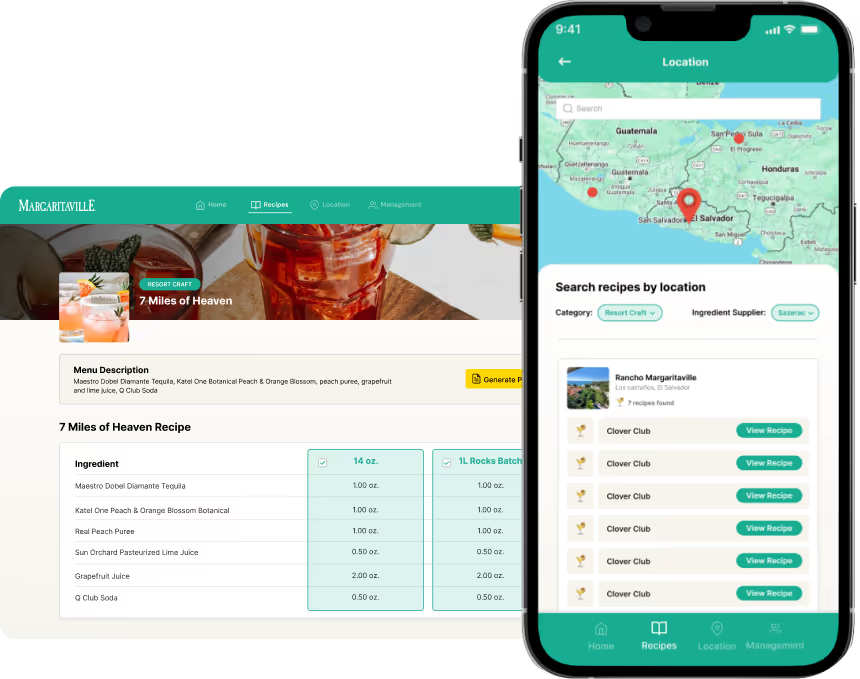
Glide is a no-code builder that wraps Google Sheets, Excel, or Airtable data in a mobile-optimised interface, designed for teams who already have structured data and want a usable app front end around it.
Glide was built for operations teams and non-technical managers who want to mobilise existing data.
- Data-first design: Glide requires a connected spreadsheet before you can build; the app is always an interface layer over that data source.
- Mobile-first output: Glide apps are progressive web apps (PWAs) optimised for mobile browsers, not native iOS or Android apps — no App Store listing is created.
- Visual configuration model: Users connect a data source, choose a template, configure the UI with a drag-and-drop editor, and publish — no prompts, no code.
- AI-powered columns: Glide has added AI features that can generate content or process data inside the spreadsheet layer, which is different from full-app AI generation.
- Bounded use cases: Glide is not designed for apps that start from scratch without data, nor for web-first experiences where data display is not the core function.
For context on the comparison, a full breakdown of what Base44 is covers the platform's approach and who it is designed for.
How Do Base44 and Glide Compare on Features?
Base44 uses AI to generate a full application, including UI, logic, and a built-in database, from a text prompt. Glide builds a configured interface over an external spreadsheet using templates and a visual editor.
The core difference is where data lives and how the app is constructed.
- Data model: Glide reads and writes to an external spreadsheet; Base44 manages data internally through its own built-in database, with no external source required.
- App generation approach: Base44 uses AI prompting to build the entire app structure and logic; Glide uses template selection and visual field mapping around a data source.
- UI customisation: Glide offers polished mobile-first templates with limited deep customisation; Base44 generates UI with more flexibility in layout and component arrangement.
- Logic and workflows: Base44 handles multi-step logic, conditional behaviour, and custom workflows through prompting; Glide handles computed columns and conditional visibility, with workarounds needed for anything more complex.
- Integration depth: Both platforms connect to external services, but Base44's integration range is broader for non-data-source connections; Glide's strength is in its native Google Sheets and Airtable sync.
A complete overview of the Base44 feature set is useful for understanding which capabilities the AI builder handles natively versus which require external tools.
Which Platform Is Faster to Build With?
Glide is faster when you already have clean spreadsheet data. Base44 is faster when you are starting from an idea with no data layer in place yet.
The speed question only makes sense once you know your starting point.
- Existing data advantage: Glide can go from connecting a Google Sheet to a published app in under an hour when the data is already well-structured and ready to use.
- Idea-first advantage: Base44 can generate a functional web app from a prompt in hours, with no data preparation, schema design, or template configuration required before starting.
- Iteration approach: Glide iteration happens in the visual editor, adjusting fields, templates, and layout; Base44 iteration happens through follow-up prompts, which is faster for logic changes.
- Data preparation overhead: Glide's speed depends entirely on the data being clean; a messy or poorly structured spreadsheet adds significant time before the app is usable.
- Publishing speed: Both platforms publish immediately, with shareable URLs requiring no deployment process or developer involvement on either side.
A balanced review of Base44 strengths and drawbacks provides useful framing for where the speed advantage holds and where it starts to break down.
How Do the Pricing Models Compare?
Glide charges based on features and user counts, with a free tier for simple projects and paid plans unlocking business features. Base44 uses subscription tiers with AI credit usage for app generation.
Both are accessible at low cost to start, but the ongoing cost structure differs significantly.
- Glide's tier structure: Free plans cover basic personal use; paid plans are required for private apps, custom domains, and business-grade features, with pricing tied to users and rows.
- Base44's subscription model: Users pay a subscription with AI credits applied to generation activity, with higher tiers covering more projects and heavier usage.
- What each subscription includes: Glide covers the builder and hosting for connected apps; Base44 covers the builder, hosting, database, and authentication, making Base44's all-in model broader in scope.
- Per-user cost difference: Glide can become expensive for apps with larger user bases because some plans charge based on user count; Base44 does not typically charge per end user.
- Hidden dependencies: Glide users may already pay for Google Workspace or Airtable as the data source; Base44 users should monitor credit consumption on complex or multi-project builds.
A full breakdown of Base44 pricing plans clarifies what each tier includes and where credit costs become a significant factor.
What Are the Real Limitations of Each Platform?
Glide's ceiling is the spreadsheet. Once an app grows beyond what a spreadsheet can represent cleanly, Glide becomes difficult to maintain. Base44's ceiling is complexity, mobile output, and code portability.
Knowing these limits before you build prevents painful rebuilds later.
- Glide's data ceiling: Complex relational data, multi-table logic, and non-spreadsheet structures are awkward or impossible; row and column limits become real constraints as apps grow.
- Glide's mobile context: Glide produces PWAs, not native apps, so features requiring native device access or App Store distribution are not available.
- Base44's mobile gap: Base44 does not produce native mobile apps; web apps are the primary output, which limits use cases where a true mobile app experience is required.
- Base44's portability gap: There is no code export from Base44; the app lives inside the platform, creating dependency on continued subscription and platform availability.
- Platform lock-in on both sides: Glide's dependency is doubled, relying on both Glide as a platform and Google Sheets or Excel as the data layer, compounding the migration risk.
Reviewing what Base44 can build provides important context for understanding where the platform's boundaries actually sit relative to Glide's.
Which Should You Choose for Your Project?
The clearest decision filter is whether you have existing structured data and whether the app primarily needs to run on mobile. Those two questions point directly to one platform or the other.
If you have structured spreadsheet data and need mobile access to it, start with Glide.
- Data already exists: If the core job is making a Google Sheet accessible and interactive on a phone, Glide is purpose-built for that and will reach a result faster.
- Building from scratch: If you are starting from an idea with no existing data layer, Base44 removes the data-prep requirement and builds the whole application from a prompt.
- Project type fit for Glide: Field team tools, inventory management from an existing Sheet, customer-facing data directories, and simple internal mobile dashboards are strong Glide use cases.
- Project type fit for Base44: Custom web SaaS apps, client portals, internal tools without an existing data layer, and multi-feature web applications belong in Base44.
- The scale question: Glide works best with a bounded, stable user base and defined data structure; Base44 handles more varied use cases but has its own scaling limits.
A clear view of where Base44 falls short is important context for anyone using this decision framework to evaluate their specific project.
Conclusion
Base44 and Glide serve genuinely different use cases, and the right choice is usually clearer than it first appears. If you have a spreadsheet full of data and need a mobile-friendly way to work with it, Glide is purpose-built for that. If you have an app idea and want a live web application built through AI prompting, Base44 is the right tool. Define two things before deciding: whether the app needs to start from existing data, and whether it needs to run on mobile or web. Those two answers will point to the right platform.
Not Sure Which Platform Fits Your Project? Let's Find Out.
Choosing between a data-driven mobile builder and an AI-powered web app platform is not always straightforward, especially when the project requirements are still being defined.
LOW/CODE Agency is the AI product development partner built for SMBs. We build and ship web apps, mobile apps, chatbots, RAG systems, and AI agents — end to end, without the enterprise overhead. We help teams assess whether a prompt-based AI builder, a data-driven mobile tool, or a custom development approach is the right foundation for their product, before time and budget are committed to the wrong path.
- Platform evaluation: We assess your project requirements against the real capabilities and limits of tools like Base44 and Glide.
- Build scoping: We map out what your product actually needs before recommending a tool or approach.
- AI app development: Our AI app development services cover projects from initial scoping through to a working, deployed product.
- AI-assisted development: For projects that need developer-grade output with AI speed, our AI-assisted development support bridges the gap between no-code and custom code.
- Tool-agnostic advice: We recommend the right tool for the job, not the tool we are most comfortable selling.
- Prototype to production: We help teams move from a Base44 prototype to a production-grade product when the time is right.
- Founder-focused process: We work with non-technical founders and product teams who need clarity on the build, not just a vendor to execute it.
We have built 450+ products for clients including Coca-Cola, American Express, Sotheby's, Medtronic, Zapier, and Dataiku.
Related Articles
Last updated on
September 3, 2026
.

Jesus is a visionary entrepreneur and tech expert. After nearly a decade working in web development, he founded LOW/CODE Agency to help businesses optimize their operations through custom software solutions.


FAQs
What are the main differences between Base44 and Glide?
Which platform is better for beginners, Base44 or Glide?
Can I integrate external databases with Base44 and Glide?
How do pricing models compare between Base44 and Glide?
Are apps built with Base44 or Glide suitable for large-scale projects?
What are the risks of choosing Glide over Base44 for app development?
Related Articles
Base44
Base44 vs Low-Code Development: Key Differences Explained
Discover the main differences between Base44 and low-code development platforms for faster app building and customization.

Base44
Base44 vs Softr: Key Differences Explained
Compare Base44 and Softr to find the best no-code platform for your project. Features, pricing, and ease of use explained.

Base44
Base44 vs Firebase: Key Differences Explained
Compare Base44 and Firebase to choose the best backend solution for your app development needs. Learn features, pricing, and use cases.

Base44
Base44 Tech Stack Overview | Key Technologies Used
Discover the main technologies powering Base44. Learn about their programming languages, frameworks, and tools in this detailed tech stack guide.


Why customers trust us for no-code development


