

Base44 vs Bubble: Key Differences Explained
10 min
read
Compare Base44 and Bubble platforms to find which suits your needs. Learn features, ease of use, pricing, and more.


Base44 vs Bubble is a comparison between two genuinely different approaches to building web applications. Base44 trades deep control for speed — you describe an app and AI builds it.
Bubble trades speed for depth — you configure every piece of logic, workflow, and data structure yourself. This article helps you decide which fits your project.
Key Takeaways
- AI-first vs mature no-code: Base44 generates apps from prompts; Bubble gives you a full visual programming environment with granular control over every element.
- Speed vs depth: Base44 gets you to a prototype in hours; Bubble takes longer to learn but supports significantly more complex applications at scale.
- Target user: Base44 suits solo founders and non-technical builders moving fast; Bubble suits builders willing to invest time for a more powerful result.
- Logic complexity: Bubble handles multi-step workflows, conditional logic, and complex data relationships natively; Base44's AI-managed logic hits limits faster on complex builds.
- Ecosystem maturity: Bubble has a large plugin marketplace, active community, and years of production use cases; Base44 is newer with a smaller ecosystem overall.

What Is Bubble and Who Is It For?
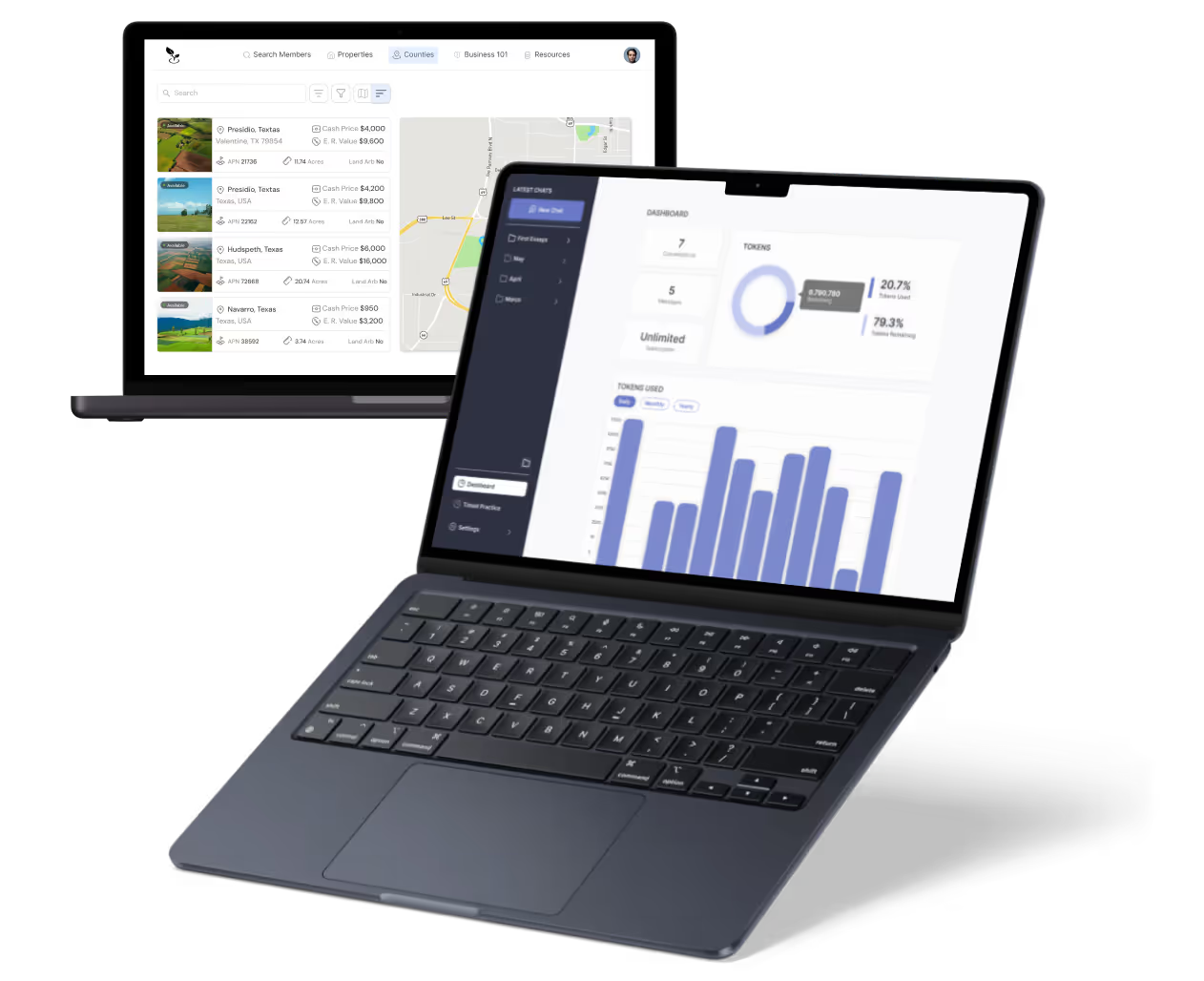
Bubble is a mature visual no-code platform for building full-stack web applications. It gives builders deep control over workflows, data structures, and UI without requiring code.
Bubble has been in production since 2012 and has a large, active user community. Its core strength is allowing non-technical founders to build complex applications — marketplaces, SaaS tools, multi-user platforms — with precise logic control.
- Primary use case: Web apps with complex workflows, multi-user systems, marketplaces, and business tools requiring precise logic configuration.
- Target user: Non-technical founders and product teams willing to invest in learning the platform for more powerful, scalable results.
- Core strengths: Deep workflow logic, a robust database with relational capabilities, a large plugin library, and a proven production track record.
- Learning investment: Bubble requires meaningful upfront learning — typically 20 to 40 hours before you build efficiently, sometimes more.
- UI builder: Bubble's visual canvas is powerful but can feel dated compared to modern design tools; responsive layout requires deliberate configuration.
To understand the contrast in approach, it helps to know how Base44 works as an AI-first builder before weighing it against Bubble's logic-first visual environment.
How Do Base44 and Bubble Compare on Features?
Both platforms build complete full-stack web applications. The difference is control depth. Bubble lets you configure every workflow step; Base44 lets AI handle that layer for you.
The Base44 feature set covers AI-generated UI, a managed database, authentication, and hosting — all included. Bubble requires you to assemble those pieces yourself, but gives you far more precision over each.
- App-building capability: Bubble allows precise control over data models, workflows, and UI; Base44 abstracts this through AI generation with less manual configuration.
- AI and automation: Base44 uses AI as the primary build mechanism; Bubble has added AI features but remains fundamentally a visual builder where AI is supplementary.
- Database and backend: Bubble's database supports complex relational structures, server-side actions, and custom API workflows; Base44's data layer is simpler and AI-managed.
- Deployment and hosting: Both host on their own infrastructure; Bubble offers more performance control and custom domain options on higher plans.
- Integrations and extensibility: Bubble's plugin ecosystem has hundreds of options; Base44 has fewer integrations, largely managed through AI connectors.
Both platforms are legitimate full-stack builders. The feature gap becomes most visible when logic complexity increases — Bubble scales with it; Base44 reaches its ceiling faster.
Which Platform Is Faster to Build With?
Base44 wins on initial speed. A functional prototype from a natural language prompt typically takes hours. Bubble requires learning before you build anything efficiently.
For a non-technical builder who has never used Bubble, expect 20 to 40 or more hours of learning before building productively. Understanding what Base44 can build helps calibrate whether that learning investment is worth making for your project scope.
- Prototype speed: Base44 delivers a working prototype in hours; Bubble for a new user typically takes days to weeks to reach the same output.
- Learning requirement: Base44 requires only natural language; Bubble requires learning its workflow editor, data types, and responsive engine before building efficiently.
- Template availability: Bubble has a larger template marketplace for starting points; Base44 generates from prompts rather than templates.
- Iteration after first build: Bubble's visual editor allows targeted, precise changes; Base44 re-generates through prompts, which can be less predictable for specific modifications.
- Where each slows down: Base44 slows when AI cannot accurately interpret complex requirements; Bubble slows at the start during learning, and again during complex UI layout work.
For rapid validation of a simple idea, Base44 is faster by a wide margin. For a builder already proficient in Bubble, that advantage shrinks considerably once you reach the build stage.
How Do the Pricing Models Compare?
Both platforms run subscription-based pricing with free or trial tiers. The costs are comparable at entry level but diverge as usage grows.
A clear breakdown of Base44 pricing plans shows subscription tiers with AI generation credits as the variable cost. Bubble uses a workload-unit model on higher plans, where server-side operations consume units.
- Base44 pricing: Subscription-based with AI credit usage; entry-level plans start around $49 per month with costs scaling as AI generation increases.
- Bubble pricing: A free tier is available for development and testing; production apps require a paid plan, typically starting around $29 per month.
- Prototyping cost: Bubble's free tier is genuinely useful for prototyping before paying; Base44's free or trial options are more limited for extended use.
- Scaling costs: Bubble costs scale with workload units on high-traffic apps; Base44 costs scale with AI generation usage during active building phases.
- Hidden variable costs: Base44 credit depletion during active building; Bubble workload overages on high-traffic apps and the cost of plugins that unlock key functionality.
At entry-level paid tiers, both platforms are in a similar range. At production scale with real traffic, Bubble's workload model and Base44's credit model both require attention to avoid surprise costs.
What Are the Real Limitations of Each Platform?
Both platforms have ceilings that vendors do not advertise clearly. Knowing these before you start saves time and budget.
Reviewing Base44 strengths and drawbacks alongside Bubble's known failure modes gives a realistic picture of where each platform breaks down under real project demands.
- Base44 ceiling: Complex multi-step workflows, fine-grained user permissions, large-scale data operations, and production apps requiring precise performance control all exceed Base44's comfort zone.
- Bubble ceiling: Performance under high load without careful optimisation, complex responsive design, and the time investment required before building productively are Bubble's recurring friction points.
- Poor use cases for Base44: Complex SaaS products requiring deep logic, regulated industries with compliance requirements, or enterprise rollouts with multiple internal stakeholders.
- Poor use cases for Bubble: Builders who need to move fast without a learning investment, or teams validating a concept with a short runway.
- Lock-in risk: Both platforms create significant lock-in; migrating a Bubble app is a full rebuild, and migrating a Base44 app is similarly difficult — neither exports cleanly to standard code.
The migration cost for both platforms is high. If platform independence matters to you, factor that into the decision before committing, not after you have spent months building.
Which Should You Choose for Your Project?
The decision depends almost entirely on the complexity of your business logic and how much time you are willing to invest before shipping.
Understanding where Base44 falls short and how it compares to Base44 versus traditional no-code development gives you the full picture before committing to either platform.
- Choose Base44 if: You need a working prototype in days, your app logic is relatively straightforward, and you are validating an idea before committing to a more complex build.
- Choose Bubble if: You are building a complex web app — marketplace, SaaS, multi-user platform — that requires deep workflow logic and relational data structures.
- Choose Bubble if you have time: You are prepared to invest 20 to 40 hours learning the platform and want more control over the final product with a larger plugin ecosystem.
- Consider both sequentially: Use Base44 to test the concept fast, then evaluate whether the logic complexity justifies rebuilding on Bubble after validation.
- The deciding factor: How complex is your business logic? Simple logic with fast deadlines points to Base44; complex conditional workflows and data relationships point to Bubble.
Neither platform is the right answer for every project. The most useful question is not which platform is better — it is which trade-off your project can tolerate more: speed with less control, or control with a slower start.
Conclusion
Base44 wins on speed for straightforward apps; Bubble wins on depth for complex products. Neither is the clear winner for every project.
The complexity of your business logic is the deciding factor. Simple workflows with fast deadlines point to Base44. Branching conditions and relational data point to Bubble.
Write down the three most complex workflows your app needs. If each can be described in one sentence, test Base44 first. If they require multiple conditions and data relationships, Bubble is the better long-term investment.
Not Sure Which Platform Fits Your Project? Let's Find Out.
Choosing between Base44 and Bubble is a platform decision that directly affects your build speed, cost, and long-term flexibility. Getting it wrong means rebuilding later.
SMBs do not need a no-code tool. They need an AI product team. At LOW/CODE Agency, we build custom web apps, mobile apps, chatbots, and AI agents — software that actually scales with your business. We help founders and product teams evaluate platforms, scope builds correctly, and ship products that hold up beyond the prototype stage. We work across custom AI app development and AI-assisted development for teams at every stage.
- Platform evaluation: We assess your project requirements and recommend the right tool before you commit time and budget to the wrong one.
- Scoping and architecture: We map your app's data model, logic flows, and integrations before a single screen is built, avoiding expensive rework.
- Prototype to production: We build working prototypes quickly and know when to upgrade the architecture as complexity grows.
- No-code and AI-first builds: We build on Base44, Bubble, and other platforms when they are the right fit, and in custom code when they are not.
- Team training and handoff: We train your team to own and operate the platform after launch, reducing dependency on outside support.
- Product strategy: We help you define what to build before deciding how, so the platform choice follows the product logic.
- Ongoing build support: We stay engaged after launch to iterate, optimise, and extend as your product evolves.
Related Articles
Last updated on
September 3, 2026
.

Jesus is a visionary entrepreneur and tech expert. After nearly a decade working in web development, he founded LOW/CODE Agency to help businesses optimize their operations through custom software solutions.


FAQs
What are the main differences between Base44 and Bubble?
Which platform is easier for beginners, Base44 or Bubble?
Can I build complex applications with Base44 compared to Bubble?
How do Base44 and Bubble differ in pricing models?
Is it possible to integrate third-party services with both Base44 and Bubble?
What are the risks of choosing Base44 over Bubble for app development?
Related Articles

Base44
Base44 vs Hostinger Horizons: Key Differences Explained
Compare Base44 and Hostinger Horizons hosting services to find which suits your website needs better. Features, pricing, and performance insights.

Base44
Base44 vs ChatGPT: Key Differences Explained
Compare Base44 and ChatGPT features, uses, and performance to choose the best AI tool for your needs.
Base44
How to Build a SaaS App Using Base44
Learn step-by-step how to create a SaaS app with Base44, including setup, features, and best practices for success.

Base44
Top Real Apps Built With Base44 Framework
Discover popular real apps developed using Base44. Learn about features, benefits, and why developers choose Base44 for app creation.


Why customers trust us for no-code development


